|
In 1974, ancient astronaut theorist Erich von Däniken sat down with the science writer Timothy Ferris for three days of interviews for Playboy magazine. This was one of the rare occasions when an ancient astronaut theorist submitted to questioning from a well-informed skeptic, something that almost never happens today. I am reviewing this extraordinary interview in segments. This is part five. I have to admit that the section of the interview following Erich von Däniken’s admission that he lies about his evidence is consequently anticlimactic. It is less fun to pick apart EVD’s evidence after he confessed that any given piece of it might well be the result of a “theatrical effect,” or, quite simply, a lie. So, I may pass over some of the material with less than detailed interest. After EVD admitted that he had lied about many of the details of the cave where the aliens stashed their archives, Ferris next challenged him about the Dropa stones, a series of large discs covered in hieroglyphs supposedly telling of the crash of a flying saucer and its occupants’ subsequent activities in China. Ferris notes that Chinese experts have no record of these stones’ existence, and the archaeologist and translator who worked on them also do not exist. Their very names appear to be a Western pastiche of Chinese. EVD admits that he included the material in his book without investigating it. His source was a “friend in Moscow.” But EVD deflects criticism by saying that journalist Peter Krassa found new evidence that the story is true. EVD neglected to mention that Krassa was a fellow ancient astronaut theorist. Later, Krassa would write EVD's biography (Disciple of the Gods, 1976) and still later would claim that the Vatican was hiding a time machine. Ferris agrees to reserve judgment on the Dropa stones pending Krassa’s evidence (which, of course, never materialized) and then asks EVD about claims that a cave painting in Uzbekistan depicts an astronaut in modern-day flight gear. This painting appears in the film version of Chariots of the Gods as absolutely genuine despite the fact that the Soviet scholar who first published the painting, Dr. Saizev, admitted it was a hoax. EVD asks why Ferris focuses on the few artifacts that were questionable and which EVD merely copied from others. He cites Krassa again because it was Krassa who elicited the confession of the painting’s modernity and then blames Saizev for changing his story after filming Chariots. 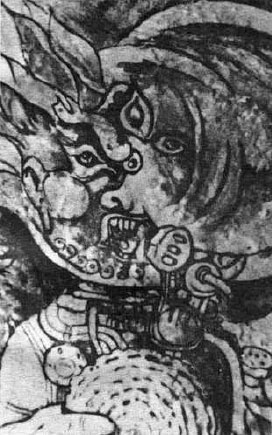 Fake rock painting as it appeared on page 82 of "The Gold of the Gods" as "an astronaut hold[ing] a disc." 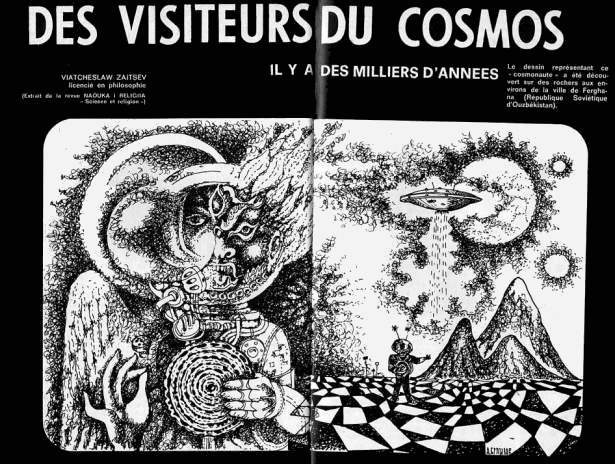 The actual source of the "painting": A modern illustration for a 1967 article in Sputnik magazine. It was entirely the artist's invention. Note: EVD has cropped and flipped the image to hide its origins. EVD, though, suggests that the painting may well be real and Saizev a liar. “You can never be sure when they [Russians and the Chinese] tell you something that they really mean it. They sometimes have reasons to say one thing in private and another in public” (p. 60). High quality evidence, indeed! And, also, a little racist.
Ferris asks EVD why the film version of Chariots makes no mention of the controversy over the painting, presenting it as real. EVD scores a point by noting, correctly, that he did not write the film and can’t be held responsible for its producers’ mistakes. His own, however... Despite receiving evidence that the picture was a hoax in 1974, EVD went on to include it as "proof" of alien visitation in his 1976 book In Search of Ancient Astronauts: My Pictorial Evidence for the Impossible, reproducing the entire image and still claiming it is a genuine prehistoric picture. (There is more about this piece of fake evidence in my article about the image here.) The two then discuss the Great Pyramid, with EVD reciting a litany of common pyramid fallacies about its supposedly miraculous construction, the weight of the blocks, and other boring things that had been bandied about since at least Greaves’ Pyramidographia (1646), but especially in the work of Piazzi Smyth, merely substituting aliens for Smyth’s idea that God encoded special knowledge into the pyramid. EVD claims Herodotus confirmed that gods from the sky came down and taught Egyptians how to build the pyramids, and Ferris notes this is not true. The relevant passage is Histories 2.124-134, and it clearly states that the pyramids were built by humans, by stacking stone atop one another, over many years. EVD began a trend exemplified by Giorgio Tsoukalos in which ancient astronaut theorists make false claims about ancient texts talking about aliens coming from the sky, shiny and glowing, and working miracles. In many instances, the theorist has interpolated much of the description into texts that say no such thing. Ferris next asks EVD what he means by this nonsense question in Chariots: “Is it a coincidence that a meridian running through the pyramids divides continents and oceans into two exactly equal halves?” EVD disclaims knowledge of the question, saying he merely is summarizing “many other writers.” But his explanation of his own ignorance is astounding: “As I understand them, if you took all the water away from the Earth and pushed the continents together—so, for example, South America fit up against Africa—then the pyramid would be right in the middle. That’s how it was explained to me. I’ve never tried it” (p. 60). EVD admits that he included material in his books that he had not confirmed, did not understand, and made no effort to understand. Astonishing. Next time: The Piri Reis map causes EVD trouble, and he admits that he never bothers to check whether the sources he copies from are telling the truth.
1 Comment
Don Hoe
4/20/2014 02:47:57 am
I have know for years that the man is a liar. When the book first came out, I was living near the University of Minnesota campus. Scathing reviews came out about the book. Researchers had discovered he had "paid" people to craft rock carvings showing ET and then burying the to be conveniently discovered later. The man is a fraud. He's been doing this stuff for so long he is beginning to b believe his own lies. Your comment will be posted after it is approved.
Leave a Reply. |


AuthorI am an author and researcher focusing on pop culture, science, and history. Bylines: New Republic, Esquire, Slate, etc. There's more about me in the About Jason tab. 
Newsletters
Enter your email below to subscribe to my newsletter for updates on my latest projects, blog posts, and activities, and subscribe to Culture & Curiosities, my Substack newsletter.
Categories
All
Terms & ConditionsPlease read all applicable terms and conditions before posting a comment on this blog. Posting a comment constitutes your agreement to abide by the terms and conditions linked herein.
Archives
April 2024
|

- Home
- Blog
- Books
-
Articles
-
Newsletter
>
- Television Reviews >
- Book Reviews
- Galleries >
- Videos
-
Collection: Ancient Alien Fraud
>
- Chariots of the Gods at 50
- Secret History of Ancient Astronauts
- Of Atlantis and Aliens
- Aliens and Ancient Texts
- Profiles in Ancient Astronautics >
- Blunders in the Sky
- The Case of the False Quotes
- Alternative Authors' Quote Fraud
- David Childress & the Aliens
- Faking Ancient Art in Uzbekistan
- Intimations of Persecution
- Zecharia Sitchin's World
- Jesus' Alien Ancestors?
- Extraterrestrial Evolution?
- Collection: Skeptic Magazine >
- Collection: Ancient History >
- Collection: The Lovecraft Legacy >
- Collection: UFOs >
- Scholomance: The Devil's School
- Prehistory of Chupacabra
- The Templars, the Holy Grail, & Henry Sinclair
- Magicians of the Gods Review
- The Curse of the Pharaohs
- The Antediluvian Pyramid Myth
- Whitewashing American Prehistory
- James Dean's Cursed Porsche
-
Newsletter
>
-
The Library
-
Ancient Mysteries
>
-
Ancient Texts
>
- Mesopotamian Texts >
-
Egyptian Texts
>
- The Shipwrecked Sailor
- Dream Stela of Thutmose IV
- The Papyrus of Ani
- Classical Accounts of the Pyramids
- Inventory Stela
- Manetho
- Eratosthenes' King List
- The Story of Setna
- Leon of Pella
- Diodorus on Egyptian History
- On Isis and Osiris
- Famine Stela
- Old Egyptian Chronicle
- The Book of Sothis
- Horapollo
- Al-Maqrizi's King List
- Teshub and the Dragon
- Hermetica >
- Hesiod's Theogony
- Periplus of Hanno
- Ctesias' Indica
- Sanchuniathon
- Sima Qian
- Syncellus's Enoch Fragments
- The Book of Enoch
- Slavonic Enoch
- Sepher Yetzirah
- Tacitus' Germania
- De Dea Syria
- Aelian's Various Histories
- Julius Africanus' Chronography
- Eusebius' Chronicle
- Chinese Accounts of Rome
- Ancient Chinese Automaton
- The Orphic Argonautica
- Fragments of Panodorus
- Annianus on the Watchers
- The Watchers and Antediluvian Wisdom
-
Medieval Texts
>
- Medieval Legends of Ancient Egypt >
- The Hunt for Noah's Ark
- Isidore of Seville
- Book of Liang: Fusang
- Agobard on Magonia
- Book of Thousands
- Voyage of Saint Brendan
- Power of Art and of Nature
- Travels of Sir John Mandeville
- Yazidi Revelation and Black Book
- Al-Biruni on the Great Flood
- Voyage of the Zeno Brothers
- The Kensington Runestone (Hoax)
- Islamic Discovery of America
- The Aztec Creation Myth
-
Lost Civilizations
>
-
Atlantis
>
- Plato's Atlantis Dialogues >
- Fragments on Atlantis
- Panchaea: The Other Atlantis
- Eumalos on Atlantis (Hoax)
- Gómara on Atlantis
- Sardinia and Atlantis
- Santorini and Atlantis
- The Mound Builders and Atlantis
- Donnelly's Atlantis
- Atlantis in Morocco
- Atlantis and the Sea Peoples
- W. Scott-Elliot >
- The Lost Atlantis
- Atlantis in Africa
- How I Found Atlantis (Hoax)
- Termier on Atlantis
- The Critias and Minoan Crete
- Rebuttal to Termier
- Further Responses to Termier
- Flinders Petrie on Atlantis
- Amazing New Light (Hoax)
- Lost Cities >
- OOPARTs
- Oronteus Finaeus Antarctica Map
- Caucasians in Panama
- Jefferson's Excavation
- Fictitious Discoveries in America
- Against Diffusionism
- Tunnels Under Peru
- The Parahyba Inscription (Hoax)
- Mound Builders
- Gunung Padang
- Tales of Enchanted Islands
- The 1907 Ancient World Map Hoax
- The 1909 Grand Canyon Hoax
- The Interglacial Period
- Solving Oak Island
-
Atlantis
>
- Religious Conspiracies >
-
Giants in the Earth
>
-
Fossil Origins of Myths
>
- Fossil Teeth and Bones of Elephants
- Fossil Elephants
- Fossil Bones of Teutobochus
- Fossil Mammoths and Giants
- Giants' Bones Dug Out of the Earth
- Fossils and the Supernatural
- Fossils, Myth, and Pseudo-History
- Man During the Stone Age
- Fossil Bones and Giants
- Mastodon, Mammoth, and Man
- American Elephant Myths
- The Mammoth and the Flood
- Fossils and Myth
- Fossil Origin of the Cyclops
- History of Paleontology
- Fragments on Giants
- Manichaean Book of Giants
- Geoffrey on British Giants
- Alfonso X's Hermetic History of Giants
- Boccaccio and the Fossil 'Giant'
- Book of Howth
- Purchas His Pilgrimage
- Edmond Temple's 1827 Giant Investigation
- The Giants of Sardinia
- Giants and the Sons of God
- The Magnetism of Evil
- Tertiary Giants
- Smithsonian Giant Reports
- Early American Giants
- The Giant of Coahuila
- Jewish Encyclopedia on Giants
- Index of Giants
- Newspaper Accounts of Giants
- Lanier's A Book of Giants
-
Fossil Origins of Myths
>
-
Science and History
>
- Halley on Noah's Comet
- The Newport Tower
- Iron: The Stone from Heaven
- Ararat and the Ark
- Pyramid Facts and Fancies
- Argonauts before Homer
- The Deluge
- Crown Prince Rudolf on the Pyramids
- Old Mythology in New Apparel
- Blavatsky on Dinosaurs
- Teddy Roosevelt on Bigfoot
- Devil Worship in France
- Maspero's Review of Akhbar al-zaman
- The Holy Grail as Lucifer's Crown Jewel
- The Mutinous Sea
- The Rock Wall of Rockwall
- Fabulous Zoology
- The Origins of Talos
- Mexican Mythology
- Chinese Pyramids
- Maqrizi's Names of the Pharaohs
-
Extreme History
>
- Roman Empire Hoax
- American Antiquities
- American Cataclysms
- England, the Remnant of Judah
- Historical Chronology of the Mexicans
- Maspero on the Predynastic Sphinx
- Vestiges of the Mayas
- Ragnarok: The Age of Fire and Gravel
- Origins of the Egyptian People
- The Secret Doctrine >
- Phoenicians in America
- The Electric Ark
- Traces of European Influence
- Prince Henry Sinclair
- Pyramid Prophecies
- Templars of Ancient Mexico
- Chronology and the "Riddle of the Sphinx"
- The Faith of Ancient Egypt
- Remarkable Discoveries Within the Sphinx (Hoax)
- Spirit of the Hour in Archaeology
- Book of the Damned
- Great Pyramid As Noah's Ark
- Richard Shaver's Proofs
-
Ancient Texts
>
-
Alien Encounters
>
-
US Government Ancient Astronaut Files
>
- Fortean Society and Columbus
- Inquiry into Shaver and Palmer
- The Skyfort Document
- Whirling Wheels
- Denver Ancient Astronaut Lecture
- Soviet Search for Lemuria
- Visitors from Outer Space
- Unidentified Flying Objects (Abstract)
- "Flying Saucers"? They're a Myth
- UFO Hypothesis Survival Questions
- Air Force Academy UFO Textbook
- The Condon Report on Ancient Astronauts
- Atlantis Discovery Telegrams
- Ancient Astronaut Society Telegram
- Noah's Ark Cables
- The Von Daniken Letter
- CIA Psychic Probe of Ancient Mars
- Scott Wolter Lawsuit
- UFOs in Ancient China
- CIA Report on Noah's Ark
- CIA Noah's Ark Memos
- Congressional Ancient Aliens Testimony
- Ancient Astronaut and Nibiru Email
- Congressional Ancient Mars Hearing
- House UFO Hearing
- Ancient Extraterrestrials >
- A Message from Mars
- Saucer Mystery Solved?
- Orville Wright on UFOs
- Interdimensional Flying Saucers
- Flying Saucers Are Real
- Report on UFOs
-
US Government Ancient Astronaut Files
>
-
The Supernatural
>
- The Devils of Loudun
- Sublime and Beautiful
- Voltaire on Vampires
- Demonology and Witchcraft
- Thaumaturgia
- Bulgarian Vampires
- Religion and Evolution
- Transylvanian Superstitions
- Defining a Zombie
- Dread of the Supernatural
- Vampires
- Werewolves and Vampires and Ghouls
- Science and Fairy Stories
- The Cursed Car
-
Classic Fiction
>
- Lucian's True History
- Some Words with a Mummy
- The Coming Race
- King Solomon's Mines
- An Inhabitant of Carcosa
- The Xipéhuz
- Lot No. 249
- The Novel of the Black Seal
- The Island of Doctor Moreau
- Pharaoh's Curse
- Edison's Conquest of Mars
- The Lost Continent
- Count Magnus
- The Mysterious Stranger
- The Wendigo
- Sredni Vashtar
- The Lost World
- The Red One
- H. P. Lovecraft >
- The Skeptical Poltergeist
- The Corpse on the Grating
- The Second Satellite
- Queen of the Black Coast
- A Martian Odyssey
- Classic Genre Movies
-
Miscellaneous Documents
>
- The Balloon-Hoax
- A Problem in Greek Ethics
- The Migration of Symbols
- The Gospel of Intensity
- De Profundis
- The Life and Death of Crown Prince Rudolf
- The Bathtub Hoax
- Crown Prince Rudolf's Letters
- Position of Viking Women
- Employment of Homosexuals
- James Dean's Scrapbook
- James Dean's Love Letters
- The Amazing James Dean Hoax!
- James Dean, The Human Ashtray
- Free Classic Pseudohistory eBooks
-
Ancient Mysteries
>
- About Jason
- Search
 RSS Feed

© 2010-2024 Jason Colavito. All rights reserved.