|
Yesterday I mentioned the claim that H. P. Lovecraft modeled the ancient ruins in The Dunwich Horror on the alleged prehistoric stone ruins of America’s Stonehenge (formerly Mystery Hill) in New Hampshire. This reminded me of another instance where Lovecraft is tied to one of America Unearthed star Scott Wolter’s pseudo-investigations. Archaeologist Marc A. Beherec argued in Lovecraft Annual no. 2 (2004) that in “The Mound,” one of Lovecraft’s tales ghostwritten for Zealia Bishop, Lovecraft alluded to the 1924 discovery of alleged artifacts in Arizona proving the existence of a lost medieval Jewish-Roman colony in Arizona called Calalus. I do not have that Lovecraft Annual, so I’m not sure about the exact arguments Beherec offered; I don’t recall anything about “Roman” Arizona in “The Mound.” The only reference to Arizona I recall from “The Mound” was an un-sourced quotation from H. R. Wakefield’s “He Cometh and He Passeth By” (1928). I suppose one could read the whole story as a reference to a “lost” civilization in the West, but there were plenty of claimants to that title. (Update: I later learned that the lines were from chapter VII of “The Mound,” where Lovecraft mistakenly places them in New Mexico: “Surely this was the clever forgery of some learned cynic—something like the leaden crosses in New Mexico, which a jester once planted and pretended to discover as a relique of some forgotten Dark Age colony from Europe.”) Anyway, the Lovecraft claims come into play because last year Scott Wolter traveled to Arizona to complete “microscopic” analysis of some of the lead artifacts dug up in 1924 and now known as the Tucson Artifacts. Wolter claimed that under the microscope he found mineral deposits consistent with deposition in the desert sands for a thousand years or so. Of course, Wolter’s microscopic analysis of the Kensington Runestone proved disastrously flawed, so I have no reason to trust his superficial analysis of the Tucson artifacts either. Mainstream scholars who have examined the finds have unanimously declared them fake on historical, archaeological, and linguistic grounds. The cache of 31 lead artifacts, primarily swords, crosses, and spears, supposedly chronicles the history of a colony called Calalus, founded around 775 CE and, when Jews and Romans somehow landed in the Americas. The cache contains dates down to around 1000 CE and conveniently supports Mormon claims about Jewish migrations to medieval America. Here’s a picture of one of the pieces Wolter tested, via the Westford Knights. 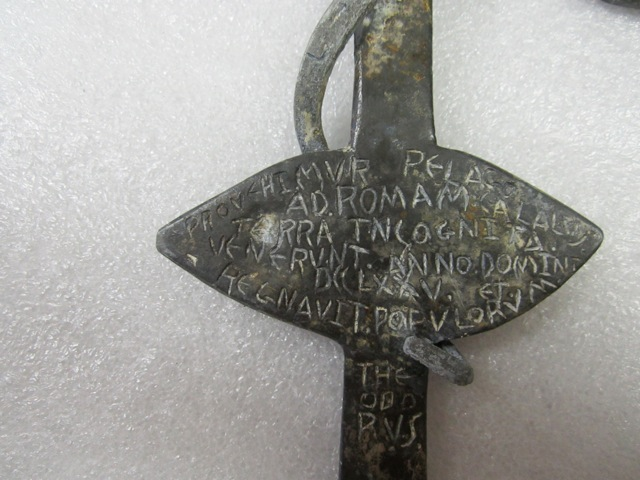 The Latin, very poor, reads, in translation: “We were carried (or sailed) by sea to [error for “from”] Rome Calalus [“to Calalus” probably intended, but the case is wrong], an unknown land. They came in the Year of Our Lord 775, and Theodorus ruled of [error for “over”] the people.” The Anno Domini dating system was not widely used before 800, and not well attested outside the Carolingian heartland until around 1000. Most medieval inscriptions also tended to abbreviate rather than write out the Latin. Worse, the specific phrases used to construct the bad Latin have been traced to standard Classical Latin texts available at the Tucson Public Library when the artifacts were found. Supporters of the artifacts’ authenticity, such as Cyclone Covey, a former Wake Forest history professor with a longstanding interest in diffusionism, claim that the bad Latin is actually a sign that the artifacts are genuine rather than a hoax since a modern copyist wouldn’t make so many errors. Covey, for example, argued in 2004 that the errors indicated a Latin novice: Confusing ad and ex by a novice in Latin compares with present-day speakers in English who reverse ante and post, terminus ad quem and terminus a pro, induction and deduction. We have all heard such solecisms. No, it’s really not. It’s like confusing “to” and “from.” In 775, the supposed immigrants from Rome would have by definition needed to be fluent in sermo vulgaris or rustica lingua romantica, Vulgar Latin, the common tongue from which the Romance languages developed. No matter where in Covey’s proposed mix of Romans, Britons, and Gauls the immigrants came, they would have needed a basic understanding of prepositions to communicate. Romans obviously spoke Latin. The Britons, I can only imagine, had to communicate somehow with the Romans and Gauls, and I doubt the Romans spoke Old English. Since Old French did not develop until around 800, Vulgar Latin would have been the preferred language for the former residents of Gaul. Now you might argue they spoke Gaulish, but that language went extinct under the Empire, and Old Low Frankish, a Germanic tongue, was associated with Franks (Germans), not Gauls.
That said, we know that in 772 CE Boniface complained that he could not understand the pope’s Latin, and in 813 CE the Council of Tours ordered priests to preach in vernacular because common people could not understand Latin. This did not extend to basic prepositions, however, which were remained part of Vulgar Latin, Old French, and modern French. Oh, and more importantly: There is not a single archaeological trace of a colony of Europeans anywhere in Arizona. No trash middens with European artifacts, no foundations of European-style structures, no graves with European artifacts. Nothing. Perhaps most humorously, the artifacts tell a remarkably complete story that specifies that the Jewish-Roman people who came to Arizona recognized the Natives ruling all Mexico and the southwest as Toltezus, i.e. “the Toltec.” That’s cute and all, obviously derived from the Nahuatl word Toltecatl, which gives us the modern name for the Toltec people. The word derives from the Aztec (Nahuatl) formation of the words meaning “inhabitant” (catl) of Tollan, the Toltec capital. While “Toltec” is what the Aztec called the people of Tollan, we do not know what the Toltec called themselves, though they were Nahuatl speakers. The Toltec flourished from 800 to 1000 CE, but perhaps tellingly the "Toltez" term is attested as a modern (mis)spelling of Toltec, though I can only trace it back to 1931. (At any rate, the "z" is very rare for Latin; it was used only for transliterated Greek words. My guess is that the forger could have misread an italicized "c" in Toltec, such as appears in William Prescott's Mexico [1900] or in Latinized scientific uses of "toltecus" as species descriptors, in which in an italic serif typeface can look like a "z.") So how do we get the Toltec to Arizona? The answer, for Cyclone Covey and other supporters, lies at sites like Wupatki, one of the ancestral Pueblo (Anasazi) ruins we encountered last week on Ancient Aliens as part of a fictitious architectural depiction of the constellation Orion, as well as the Hohokam site of Snaketown. Both of these sites feature evidence that Mexican peoples either influenced, traded with, or immigrated to this area of Arizona. The Hohokam territory extended deep into northern Mexico. Nevertheless, while Mexican features appear at Snaketown (including luxury trade goods and platform mounds after 800 CE), it does not amount to what Covey describes as “Toltec domination of Snaketown” in the eighth century. The Hohokam could be Mexican all on their own, and they were incorporating and localizing broader Mexican cultural traits. Wupatki’s “Toltec” connection derives primarily from the fact that it has the northernmost example of Mesoamerican ball courts (also found among the Maya and most Mexican peoples), a feature Wupatki shares with (and probably borrowed from) the Hohokam. Now, to tie this all together with a bow: The Hopi, Zuni, and Navajo legends about the ruins of Wupatki. The Hopi believe that the people who lived and died in the ruins continue to haunt the site as spiritual guardians. This story of the spirit guardians perfectly parallels H. P. Lovecraft’s "The Mound," in which the ghostly forms of long-dead residents of a lost civilization patrol the titular edifice. This would have been a great way to tie together all these threads, except that Zealia Bishop actually suggested that much of the plot from a romantic imagination and a love of conventional ghost stories, and the titular mound itself was based on real mounds (and a natural hill) that actually exist in and around Binger, Oklahoma and had nothing to do with the Toltec.
67 Comments
1/16/2013 10:39:23 am
The Tucson swords are pure gold example of fake "medieval" artifacts.
Dr. D
8/8/2017 04:37:34 pm
Ignorance and the religion of continental isolationism abounds in so-called academic circles. The artifacts were carried standards not literal swords. The dig was done according to the protocols and standards of archeology of the day. The layer of earth/ rock above the artifacts was not a disturbed layer. Calalus existed. Because you have not found cities with European dumps only means you have been looking in the wrong places. I would suggest you are looking too far West to find anything. Up the Rio Grand up to Los Lunes (Decalogue) and then west into the Gila river basin is more probable. 1/27/2013 11:44:04 am
Jason, 1/27/2013 12:42:54 pm
Scott, thank you for assuming I have "followers"! It's great to know that my little blog, with a budget of $0 and nearly no promotion, has such an impact that you feel the need to respond personally. Because this comment is long, I will respond in two parts. 1/27/2013 12:54:05 pm
I can’t imagine what “fear” you think is motivating me. Why would I fear the discovery of trans-oceanic contact? In 2007, scientists found evidence of trans-Pacific contact between Polynesia and the Americas. This was fascinating! It caused me no fear. Similarly, the discovery of the Norse colony at L’anse aux Meadows was exciting, not fear-inducing. How would any further, secure discoveries of Europeans in early America terrify me? The question is not “is this possible”; the question is: Did you prove it? As I said, I find your evidence wanting, and I resent honest disagreement over the quality of your evidence being taken as a fearful, blinkered rejection of even the possibility of contact. The problem is that I think your evidence is terrible and the reasoning you present illogical. This is a disagreement over evidence and argumentation, not abject terror that you’ve stumbled on some hidden secret. 1/27/2013 01:20:09 pm
Your points are well taken and I respect your opinion. I still find your criticism a little extreme given the context of our show. It is not intended to the final word (well, maybe in a couple cases), it is intended to incite reasoned debate and follow-up. As I stated before, we simply cannot go into the level of detail these matters require. However, the opinions I express are based on the facts I have in front of me and if you listen carefully, I try to make it clear when I am speculating and what I consider to be fact. I'm sure we miss the mark sometimes, but I try to be careful. 1/28/2013 12:14:02 am
I appreciate your comments, Scott, and I trust you can accept that my blog posts are the "debate and follow-up" you hoped to incite. I doubt, though, that my blog posts can be considered any more extreme that your claim at the beginning of every episode that history is a lie and that historians and archaeologists are purposely lying to the public to cover up a hidden history, a claim that is breathtaking in its audacity.
terry the censor
2/4/2013 06:20:00 pm
Come on, Mr Wolter, be honest. Jason makes substantial and specific criticisms but in your first comment you address NONE of them. Your response is entirely ad hominem, followed up later by plenty of self-pity. Jason is unfailing polite but you see yourself as a victim of irrational hatred.
tru leigh
2/26/2013 11:05:45 am
Thumbs up!
G. R. Bullaro
3/5/2013 11:19:17 am
Dear Mr. Wolter, having recently been foolish enough to watch the Tucson artifact episode of your America Unearthed series, I have absolutely no qualms in concluding that you have no knowledge whatsoever of the scientific method and how to conduct an investigation. The way that you make fantastic leaps of logic (or I should say illogic) is shameless. The false syllogisms are even worse. And last but not least, as evidenced not only from the television program but from the above letter that you have written, your lack of command of English grammar is frightening. A forensic geologist may not be an English scholar, but for god's sake you should know the basics of grammar and spelling. I refuse to believe that you have any academic degrees. You are a complete charlatan masquerading as an intellectual liberal. Please leave the scientific investigations to people who are trained to know how to do them.
José Antonio Hernández
7/9/2013 07:10:33 pm
Mr. Wolter, I was watching your show with real interest here in Mexico, which, by the way, it's called "Misterios Revelados". But as soon as you mentioned that something (I don't remember what) would lead you to the Holy Grail, that very minute I realized that most of your investigations were similar to the ones made by the "Alien Chasers", you and they always leave me with the feeling that something is missing, a lack of real proof. I can see when someone tells you that something is not genuine, you cannot hide your anger. 1/27/2013 12:55:29 pm
Jason, 1/27/2013 01:09:23 pm
Scott,
Rev. Americanegro
9/4/2016 05:27:57 pm
"Jason, 1/27/2013 02:54:04 pm
OK, let me ask you this. I claim that a medieval party, almost certainly led by the ideological descendants of the post put-down Templar Knights (likely the eight Goths) and traveling with Native Americans carved and buried the KRS as a land claim. Before you scoff, have you compared the four Mide' win rituals with the Masonic Knights Templar degrees the earliest missionaries and fur traders said the Natives were practicing when they got here? They are identical and I will be publishing this research in my forthcoming book. 1/28/2013 12:40:54 am
I'm happy to tell you, Scott, that I don't know about the holes. But I also know that because I don't know something, it doesn't mean that Vikings or Knights Templar did it, any more than aliens. There are many things I don't know, and that's part of the excitement of archaeology: learning new things.
Jake
2/22/2013 04:36:20 pm
Who says the Romans who came to Arizona occupied the territory or setup permanent structures? You're speculating about what happened. Perhaps the reason no ruins were found is because no structures were built. This doesn't mean they weren't there as part of a long term expedition.
Rev. Americanegro
9/4/2016 05:30:52 pm
"My question to you given this scenario is, what would you expect these people to leave as trash that would finger them as European? Wouldn't they kill and eat animals the same way as their Native brothers? I've participated in archaeological digs in Minnesota and asked the attending archaeologists the same question and they were stumped. I suppose they could leave behind a knife, chainmail, or sword, but I highly doubt it. I'm at a loss as to what you would find in that archaeological context."
Clint Knapp
1/27/2013 07:12:43 pm
While I certainly can't speak directly to the geological or archaeological claims made in this most interesting discussion- as I am neither and expert nor a television personality with a show to defend- there is just one point I want to make.
Christopher Randolph
1/29/2013 03:32:10 am
Jason, you're being WAY too polite to this lying idiot.
Lynn Brant
2/3/2013 01:34:30 am
Jason, You might ask Scott who wrote the "Taking a Stand" essay he refers to. (I did) By the way, I have a short story on the KRS ready for publication soon that might be very illuminating. (hint: it's a hoax).
Jake
2/22/2013 03:36:21 pm
I would very much like to know how exactly you have determined the KRS is a fake? I'm no expert, my field is psychology and counter terrorism, nonetheless I take an interest in these things. What evidence have you found that proves it's fake? The Larson Papers seem to prove the validity of the runes and the report attached to this story that is meant to damn Mr. Wolter seems to support the claim that the stone is far older than mid 1800's. In fact that report doesn't seem too damning to Wolter as it only says he underestimated the age of the stone but everyone seems to agree that it is at least 200 years old. I am extremely interested to know what you have found that concludes this to be a hoax. Do you have a picture of Olaf burying the stone? So far the evidence seems to conclude that the stone is genuine.
Loren St. Vincent
2/5/2013 06:16:23 am
Pardon my involuntary laughter at this whole dialogue.
Lynn Brant
2/5/2013 06:34:35 am
That certainly holds true for the geological conclusions. But it seems to me there is much else where there is simply not enough evidence to prove one thing or another. Take for example the runes themselves, and when the were in use and when they became known in modernity. That's not subject to a scientific study.
Janiece Stamper
2/8/2013 05:09:16 pm
Lynn Brant
2/8/2013 11:23:13 pm
"Mr. Wolter is out there."
terry the censor
2/9/2013 04:18:55 am
> Some 'scientific' work of the 1800's is by people with no more education than the credentials they created
Janiece
2/18/2013 07:06:42 am
LOL, my ponder considered a tirade? tehe!
Janiece Stamper
2/18/2013 07:07:29 am
LOL, my ponder considered a tirade? tehe!
Janiece Stamper
2/9/2013 04:08:46 am
Sorry clicked wrong button, didn't mean to unsub, please reinstate.
Janiece Stamper
2/9/2013 05:36:41 am
How is Scott Wolter, 'wayyy out there?'
Lynn Brant
2/9/2013 09:24:37 am
Before we know it, he will be taking us to the "Mystery House" where it leans and the ball rolls uphill. lol
Dolores
3/31/2015 12:27:06 am
"Before we know it, he will be taking us to the "Mystery House" where it leans and the ball rolls uphill. lol
Janiece Stamper
2/18/2013 07:17:33 am
First it wouldn't let me publish then it does it twice... sorry.
Rev. Americanegro
9/4/2016 05:40:48 pm
One thing I've noticed here is that it's usually Wolter's defenders who do the multiple posting. My colleague Rev. Phil Gotsch is the worst offender. He's offended so much one could almost say he's a registered offender.
Jake
2/22/2013 04:04:16 pm
A lot of what you're basing your argument on can be easily countered. First, the report you attached that is meant to show Mr. Wolter as incompetent doesn't really do the trick. The report indicates his method was flawed only partially. It is still agreed that the KRS is at least 200 years old and is likely far older. The only real fault found with Wolter's conclusion seems to be that he underestimated the age of the stone. 2/22/2013 10:29:25 pm
Did you listen to yourself? "Absence of proof is not proof." And yet you want me to believe that it is my burden to "prove" Romans were "not" in Arizona?
Jake
2/23/2013 04:31:31 am
The proof that they were there is the artifacts that were found. It is on you to prove they are fake, which you have not done. You're attempting to discredit these artifacts as fake by pointing to a lack of other evidence to support their authenticity. That argument does not work. The absence of evidence is not proof of theory. Furthermore, the artifacts do not indicate they lived in Arizona for several years. They merely indicate that the expedition lasted several years. They could have spent several years living in Mexico before traveling north into Arizona where they met their end. You simply do not know. 2/23/2013 04:36:22 am
I'm not an expert, but I know how to call them up or email to ask. You're undrestanding of the AD dating system is very simplistic. It was invented in the 500s but not adopted until Charlemagne, and then only in Germany, and not until much later elsewhere.
Jake
2/23/2013 04:46:27 am
I also notice that you did not provide counters to any of my other points which would seem to validate my claim that your argument is based largely on speculation and assumptions which you cannot support. 2/23/2013 04:49:50 am
Your entire position is "assume they are genuine until proved fake," but the real world works on the opposite principle: the person making the claim to change the status quo has the burden of proving his case. Otherwise, you'd be subject to the predations of every hoaxer and scam artist in the world.
Jake
2/22/2013 04:04:25 pm
A lot of what you're basing your argument on can be easily countered. First, the report you attached that is meant to show Mr. Wolter as incompetent doesn't really do the trick. The report indicates his method was flawed only partially. It is still agreed that the KRS is at least 200 years old and is likely far older. The only real fault found with Wolter's conclusion seems to be that he underestimated the age of the stone.
terry the censor
2/23/2013 03:55:34 am
> The absence of proof is not proof.
Jake
2/23/2013 04:38:03 am
The proof that they came to America is the artifacts. It's you who has not provided any proof that they did not come to America. It is you who has not proved these artifacts are fake. As I said, it is entirely possible these are fakes but until you or someone else has proven it definitively you must accept it is possible they are genuine. You're the one making claims without proof.
Dolores
3/31/2015 12:44:26 am
"In truth, the absence of evidence after a thorough investigation is a strong clue that what was not found does not exist or did not happen, and common sense says go with that until contrary clues show up." (Shockingly Close to the Truth, p 313)" via Terry the censor
Jake
2/22/2013 04:04:36 pm
A lot of what you're basing your argument on can be easily countered. First, the report you attached that is meant to show Mr. Wolter as incompetent doesn't really do the trick. The report indicates his method was flawed only partially. It is still agreed that the KRS is at least 200 years old and is likely far older. The only real fault found with Wolter's conclusion seems to be that he underestimated the age of the stone.
Jake
2/22/2013 04:07:16 pm
Sorry about the multiple posts, the page glitched on me.
Lynn Brant
2/23/2013 12:00:21 am
Let's stipulate, for the moment, that Scott really did discover a new technology for dating carvings in stone. This was over a decade ago now. Wouldn't you think we would have seen university geology departments all over the world jumping to replicate the work, expand it, make it part of their curriculum? I mean, there aren't that many breakthroughs in the field of rocks, are there? Why haven't we seen dozens of doctoral dissertations on the subject? Are geology professors not expected to "publish or perish" like the rest of the academics? But yet, no journal articles.
Jake
2/23/2013 04:43:30 am
Jason - "As I explained in my piece, the people specifically claimed to have made the artifacts spoke Vulgar Latin (on its way to becoming Italian, French, etc.) and would be expected to know how to use their own pronouns." 2/23/2013 04:46:01 am
So they are fluent enough to quote Cicero, but ignorant enough to not understand it?
Jake
2/23/2013 04:50:44 am
As I already said, the West Roman Empire fell in 476. Rome was occupied by several barbarian tribes between 476 and 800 to include Germanic peoples. Being from Rome doesn't mean that person was of Roman decent. It simply indicates they left from Rome. Why don't you understand this? Just because a person is from America doesn't mean they speak perfect English, they could be Asian American, Latin American, Russian American etc... 2/23/2013 05:00:58 am
The Roman Empire didn't cease to exist in 476. That's when the last Western emperor was deposed. Under Roman legal theory, the empire was then wholly controlled by the emperor in Constantinople, whom Odoacer and Theodoric both acknowledged as sovereign. The transition from Rome to the Middle Ages was subtle, gradual, and not equal in every location.
Jake
2/23/2013 04:54:50 am
Jason - "Your entire position is "assume they are genuine until proved fake," but the real world works on the opposite principle: the person making the claim to change the status quo has the burden of proving his case. Otherwise, you'd be subject to the predations of every hoaxer and scam artist in the world." 2/23/2013 04:59:24 am
You do realize this was written before the episode aired? My current thoughts on his science are provided in my review, posted today. That said, these kinds of claims don't have two equal sides. It's up to the person asking for a change in the status quo to provide enough evidence to support the change. Wolter hasn't done that. His "examination," for example, failed to account for rainfall, capillary action, and the water table, all factors that affect the formation of caliche.
Lynn Brant
2/23/2013 05:57:28 am
I have to disagree that it is a matter of "status quo," since the status quo might have been arrived at with very flawed logic, or by default. For example, the status quo opinion is that the Newport Tower is a colonial windmill, even though the evidence for that is very weak, and far from conclusive. That flawed status quo came about because "other" theories of the tower's origin couldn't "prove" they were correct. Ergo, if it isn't Templar, or Norse, or Portuguese or Chinese, then it MUST be a colonial windmill. I don't know what its origins are, but I know colonial windmill is not a parsimonious or even plausible explanation, even though it is the staus quo.
Rich
2/23/2013 05:58:24 am
Jason, I enjoy this blog and discussion.
wallyworldet
2/23/2013 06:01:57 am
I'm just a dumb uneducated viewer of Scott's program but I was hoping to see a complete translation of the artifacts. ???????????? 2/23/2013 06:09:55 am
You can read my views about how Wolter manipulated the evidence in this case in my review of the episode, posted on my blog today, 2/23/13.
Mark Potter
2/28/2013 10:54:55 am
Look guys, the bottom line is this, none of you REALLY know exactly what you're talking about. Being "educated" simply means you can quote somebody's work and perhaps add your own opinions. The books the educated can quote are usually quoted as gospel without the presence of mind that they could flawed themselves. I'm not trying to detract from the brilliance of those who have come before us, but let's face it, 99% of archaeology and most of the sciences is speculation. Yes, educated speculation and more often than not supported speculation, but speculation nonetheless. I listen to academics because of their education and experience, and lets face it they're probably smarter than I am. But let us not loose sight of the fact that almost none of them know exactly what they're talking about - they couldn't possibly. When we're talking about history, it's a guessing game. You look at the evidence and make assumptions based on other evidence and experience. But that fact is this, history and it's telling is more fodder for the imagination than it is absolute fact. A good healthy debate is great, but the demeaning of a person's opinion, or stating that if a person didn't get a worthy education (in your opinion) is foolish and looks more like an example of attempts to shut down an argument that you find uncomfortable. Are the artifacts real? Who knows, the fact is, whatever people think, it's based on opinion because (and too few people are able to admit it) nobody REALLY knows for sure. I find it enjoyable to sit and think about the possibilities and wonder at it all. That is what the TV show does for me. 2/28/2013 11:05:54 am
What you've described is post-modernism, a theory that discounts the possibility of objective knowledge and sees all knowledge as the product of cultural biases and forces. The trouble with post-modernism is that it eliminates any way of evaluating truth claims, making the generation of new knowledge impossible and also making it impossible to discriminate between competing ideas to decide which is true. But the past really did happen, and there is evidence of what occurred.
Christopher Randolph
2/28/2013 12:05:58 pm
"99% of archaeology and most of the sciences is speculation" 2/28/2013 12:34:12 pm
I agree that most people don't have a theoretical framework in mind, though I think that the ideas of postmodernism have filtered down to the extent that the simplified version ("truth is relative," "history is an opinion") has become popularized.
terry the censor
2/28/2013 04:10:51 pm
@Mark
John
5/18/2013 08:16:12 am
Lets assume that all of Mr. Wolter's evidence is strong. The evidence still does not justify the conclusion that early medieval Europeans were in the Americas. It only suggests that early-medieval artifacts were in the Americas sometimes before the 1920's. Mr. Wolter, is it not possible that those artifacts were brough to the Americas sometimes between the Viking arrivals and when they were found in the 20th century?
Corinne Zellner
8/3/2013 03:00:49 am
While I find the leaps of conclusions from theory to "proof" problematic in Mr. Wolter's show, the ad hominem attacks that many on this blog resort to are even more troubling. Mr. Wolter professes to wish to get viewers to discuss alternative views on history and it is obvious that his approach, while admittedly flawed in terms of scientific research, is working. I think everyone can agree that getting the general public interested in history, archaeology and related subjects is laudable, even if the methods resorted to by popular media are overly dramatized. I certainly would not consider myself an expert in the field, though I am currently working on a cultural anthro doctorate (with anthro BA and MA) with an emphasis on historic archaeology in the American Southeast, because every day, new discoveries are being made that can either build on or completely alter long-held theories that were previously held to be valid. We can embrace our own ideas while still keeping an open mind, I hope, without slipping back into postmodernism! I will say, in Mr. Wolter's defense, that via his program I have been exposed to some artifacts--whether real or manufactured--I had not been aware of which led me to this site in search of more information. Another, if anyone is interested on the Tucson artifacts, is a book entitled "Byron Cummings: Dean of Southwest Archeology" which has more detailed history on the subject. Also, while isolated settlements or expeditions from cultures outside North America might well have existed, in terms of the dramatic and lasting impact on local societies, few could deny the historic importance of the Columbian Exchange. Well,as the discussion goes, are they artifacts - yes. Are they genuine - yes (in that they are artifacts). But there is no provenance, context or consequential evidence for proof. Therefore, it could mean only one thing, Meddling Teenage Time Travelers from the future. Take that Bainbridge Scholars!
Don Hendrix
3/19/2014 12:54:05 pm
There is considerable evidence, for those who wish to seek it, that the Tucson "artifacts" are modern fakes. There is very little evidence that supports their authenticity. The "artifacts" are currently on display at the Arizona Historical Society, and the museum appears to be attempting to cash in on the History Channel association by placing labels on the exhibit, which read, "Fact or Fiction?" Having first read about them in a book while I was in high school in the 60's, I had been hoping to examine them ever since, and, last Monday, I was able to do that. By far the most complete account of the history of the "artifacts" occupies the complete Spring 2009 issue of Journal of the Southwest. I recently purchased what was thought to be the last remaining back issue of the publication, but was told, upon arriving to pick it up, that another box of the issue had been found. It may be obtained from the publishers at the University of Arizona for $15. A Google search of Journal of the Southwest will provide the necessary contact information. You will not find a more complete history of the "artifacts" or more photographs than in this publication. The author is Don Burgess, and he appears to have done a very thorough job of research. I don't believe that anyone who reads it can possibly maintain the position that the "artifacts" are genuine. Your comment will be posted after it is approved.
Leave a Reply. |


AuthorI am an author and researcher focusing on pop culture, science, and history. Bylines: New Republic, Esquire, Slate, etc. There's more about me in the About Jason tab. 
Newsletters
Enter your email below to subscribe to my newsletter for updates on my latest projects, blog posts, and activities, and subscribe to Culture & Curiosities, my Substack newsletter.
Categories
All
Terms & ConditionsPlease read all applicable terms and conditions before posting a comment on this blog. Posting a comment constitutes your agreement to abide by the terms and conditions linked herein.
Archives
April 2024
|

- Home
- Blog
- Books
-
Articles
-
Newsletter
>
- Television Reviews >
- Book Reviews
- Galleries >
- Videos
-
Collection: Ancient Alien Fraud
>
- Chariots of the Gods at 50
- Secret History of Ancient Astronauts
- Of Atlantis and Aliens
- Aliens and Ancient Texts
- Profiles in Ancient Astronautics >
- Blunders in the Sky
- The Case of the False Quotes
- Alternative Authors' Quote Fraud
- David Childress & the Aliens
- Faking Ancient Art in Uzbekistan
- Intimations of Persecution
- Zecharia Sitchin's World
- Jesus' Alien Ancestors?
- Extraterrestrial Evolution?
- Collection: Skeptic Magazine >
- Collection: Ancient History >
- Collection: The Lovecraft Legacy >
- Collection: UFOs >
- Scholomance: The Devil's School
- Prehistory of Chupacabra
- The Templars, the Holy Grail, & Henry Sinclair
- Magicians of the Gods Review
- The Curse of the Pharaohs
- The Antediluvian Pyramid Myth
- Whitewashing American Prehistory
- James Dean's Cursed Porsche
-
Newsletter
>
-
The Library
-
Ancient Mysteries
>
-
Ancient Texts
>
- Mesopotamian Texts >
-
Egyptian Texts
>
- The Shipwrecked Sailor
- Dream Stela of Thutmose IV
- The Papyrus of Ani
- Classical Accounts of the Pyramids
- Inventory Stela
- Manetho
- Eratosthenes' King List
- The Story of Setna
- Leon of Pella
- Diodorus on Egyptian History
- On Isis and Osiris
- Famine Stela
- Old Egyptian Chronicle
- The Book of Sothis
- Horapollo
- Al-Maqrizi's King List
- Teshub and the Dragon
- Hermetica >
- Hesiod's Theogony
- Periplus of Hanno
- Ctesias' Indica
- Sanchuniathon
- Sima Qian
- Syncellus's Enoch Fragments
- The Book of Enoch
- Slavonic Enoch
- Sepher Yetzirah
- Tacitus' Germania
- De Dea Syria
- Aelian's Various Histories
- Julius Africanus' Chronography
- Eusebius' Chronicle
- Chinese Accounts of Rome
- Ancient Chinese Automaton
- The Orphic Argonautica
- Fragments of Panodorus
- Annianus on the Watchers
- The Watchers and Antediluvian Wisdom
-
Medieval Texts
>
- Medieval Legends of Ancient Egypt >
- The Hunt for Noah's Ark
- Isidore of Seville
- Book of Liang: Fusang
- Agobard on Magonia
- Book of Thousands
- Voyage of Saint Brendan
- Power of Art and of Nature
- Travels of Sir John Mandeville
- Yazidi Revelation and Black Book
- Al-Biruni on the Great Flood
- Voyage of the Zeno Brothers
- The Kensington Runestone (Hoax)
- Islamic Discovery of America
- The Aztec Creation Myth
-
Lost Civilizations
>
-
Atlantis
>
- Plato's Atlantis Dialogues >
- Fragments on Atlantis
- Panchaea: The Other Atlantis
- Eumalos on Atlantis (Hoax)
- Gómara on Atlantis
- Sardinia and Atlantis
- Santorini and Atlantis
- The Mound Builders and Atlantis
- Donnelly's Atlantis
- Atlantis in Morocco
- Atlantis and the Sea Peoples
- W. Scott-Elliot >
- The Lost Atlantis
- Atlantis in Africa
- How I Found Atlantis (Hoax)
- Termier on Atlantis
- The Critias and Minoan Crete
- Rebuttal to Termier
- Further Responses to Termier
- Flinders Petrie on Atlantis
- Amazing New Light (Hoax)
- Lost Cities >
- OOPARTs
- Oronteus Finaeus Antarctica Map
- Caucasians in Panama
- Jefferson's Excavation
- Fictitious Discoveries in America
- Against Diffusionism
- Tunnels Under Peru
- The Parahyba Inscription (Hoax)
- Mound Builders
- Gunung Padang
- Tales of Enchanted Islands
- The 1907 Ancient World Map Hoax
- The 1909 Grand Canyon Hoax
- The Interglacial Period
- Solving Oak Island
-
Atlantis
>
- Religious Conspiracies >
-
Giants in the Earth
>
-
Fossil Origins of Myths
>
- Fossil Teeth and Bones of Elephants
- Fossil Elephants
- Fossil Bones of Teutobochus
- Fossil Mammoths and Giants
- Giants' Bones Dug Out of the Earth
- Fossils and the Supernatural
- Fossils, Myth, and Pseudo-History
- Man During the Stone Age
- Fossil Bones and Giants
- Mastodon, Mammoth, and Man
- American Elephant Myths
- The Mammoth and the Flood
- Fossils and Myth
- Fossil Origin of the Cyclops
- History of Paleontology
- Fragments on Giants
- Manichaean Book of Giants
- Geoffrey on British Giants
- Alfonso X's Hermetic History of Giants
- Boccaccio and the Fossil 'Giant'
- Book of Howth
- Purchas His Pilgrimage
- Edmond Temple's 1827 Giant Investigation
- The Giants of Sardinia
- Giants and the Sons of God
- The Magnetism of Evil
- Tertiary Giants
- Smithsonian Giant Reports
- Early American Giants
- The Giant of Coahuila
- Jewish Encyclopedia on Giants
- Index of Giants
- Newspaper Accounts of Giants
- Lanier's A Book of Giants
-
Fossil Origins of Myths
>
-
Science and History
>
- Halley on Noah's Comet
- The Newport Tower
- Iron: The Stone from Heaven
- Ararat and the Ark
- Pyramid Facts and Fancies
- Argonauts before Homer
- The Deluge
- Crown Prince Rudolf on the Pyramids
- Old Mythology in New Apparel
- Blavatsky on Dinosaurs
- Teddy Roosevelt on Bigfoot
- Devil Worship in France
- Maspero's Review of Akhbar al-zaman
- The Holy Grail as Lucifer's Crown Jewel
- The Mutinous Sea
- The Rock Wall of Rockwall
- Fabulous Zoology
- The Origins of Talos
- Mexican Mythology
- Chinese Pyramids
- Maqrizi's Names of the Pharaohs
-
Extreme History
>
- Roman Empire Hoax
- American Antiquities
- American Cataclysms
- England, the Remnant of Judah
- Historical Chronology of the Mexicans
- Maspero on the Predynastic Sphinx
- Vestiges of the Mayas
- Ragnarok: The Age of Fire and Gravel
- Origins of the Egyptian People
- The Secret Doctrine >
- Phoenicians in America
- The Electric Ark
- Traces of European Influence
- Prince Henry Sinclair
- Pyramid Prophecies
- Templars of Ancient Mexico
- Chronology and the "Riddle of the Sphinx"
- The Faith of Ancient Egypt
- Remarkable Discoveries Within the Sphinx (Hoax)
- Spirit of the Hour in Archaeology
- Book of the Damned
- Great Pyramid As Noah's Ark
- Richard Shaver's Proofs
-
Ancient Texts
>
-
Alien Encounters
>
-
US Government Ancient Astronaut Files
>
- Fortean Society and Columbus
- Inquiry into Shaver and Palmer
- The Skyfort Document
- Whirling Wheels
- Denver Ancient Astronaut Lecture
- Soviet Search for Lemuria
- Visitors from Outer Space
- Unidentified Flying Objects (Abstract)
- "Flying Saucers"? They're a Myth
- UFO Hypothesis Survival Questions
- Air Force Academy UFO Textbook
- The Condon Report on Ancient Astronauts
- Atlantis Discovery Telegrams
- Ancient Astronaut Society Telegram
- Noah's Ark Cables
- The Von Daniken Letter
- CIA Psychic Probe of Ancient Mars
- Scott Wolter Lawsuit
- UFOs in Ancient China
- CIA Report on Noah's Ark
- CIA Noah's Ark Memos
- Congressional Ancient Aliens Testimony
- Ancient Astronaut and Nibiru Email
- Congressional Ancient Mars Hearing
- House UFO Hearing
- Ancient Extraterrestrials >
- A Message from Mars
- Saucer Mystery Solved?
- Orville Wright on UFOs
- Interdimensional Flying Saucers
- Flying Saucers Are Real
- Report on UFOs
-
US Government Ancient Astronaut Files
>
-
The Supernatural
>
- The Devils of Loudun
- Sublime and Beautiful
- Voltaire on Vampires
- Demonology and Witchcraft
- Thaumaturgia
- Bulgarian Vampires
- Religion and Evolution
- Transylvanian Superstitions
- Defining a Zombie
- Dread of the Supernatural
- Vampires
- Werewolves and Vampires and Ghouls
- Science and Fairy Stories
- The Cursed Car
-
Classic Fiction
>
- Lucian's True History
- Some Words with a Mummy
- The Coming Race
- King Solomon's Mines
- An Inhabitant of Carcosa
- The Xipéhuz
- Lot No. 249
- The Novel of the Black Seal
- The Island of Doctor Moreau
- Pharaoh's Curse
- Edison's Conquest of Mars
- The Lost Continent
- Count Magnus
- The Mysterious Stranger
- The Wendigo
- Sredni Vashtar
- The Lost World
- The Red One
- H. P. Lovecraft >
- The Skeptical Poltergeist
- The Corpse on the Grating
- The Second Satellite
- Queen of the Black Coast
- A Martian Odyssey
- Classic Genre Movies
-
Miscellaneous Documents
>
- The Balloon-Hoax
- A Problem in Greek Ethics
- The Migration of Symbols
- The Gospel of Intensity
- De Profundis
- The Life and Death of Crown Prince Rudolf
- The Bathtub Hoax
- Crown Prince Rudolf's Letters
- Position of Viking Women
- Employment of Homosexuals
- James Dean's Scrapbook
- James Dean's Love Letters
- The Amazing James Dean Hoax!
- James Dean, The Human Ashtray
- Free Classic Pseudohistory eBooks
-
Ancient Mysteries
>
- About Jason
- Search
 RSS Feed

© 2010-2024 Jason Colavito. All rights reserved.