|
In an article published Sunday on New Dawn magazine’s website, former Neo-Nazi and convicted sexual molester Frank Joseph reported on a megalithic site I’ve never heard of, Mount Padang on the Indonesian island of Java. According to Joseph, this elaborate ruin composed of large stones carried to the site from an unknown source, is more than 6,500 years old, with an earlier occupation of perhaps 16,000 years ago. Mount Padang, also called Gunung Padang, is a volcanic cone that had been reshaped with terraces in the early centuries CE. These dates, in turn, suggest to Joseph that the site is related to the lost continent of Mu (which he does not name but deceptively hides under the false claim of “original Hindu monastery source materials,” i.e. Churchward’s non-existent Naacal tablets). It also suggests the existence of Lemuria, as well as any other advanced lost civilization, which in other works Joseph has identified as a forgotten race of white supermen who bequeathed civilization to the benighted dark-skinned peoples of the world. 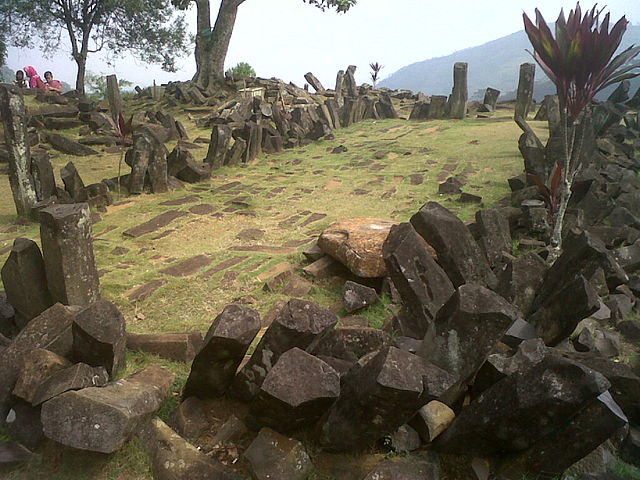 Gunung Padang. Note humans in background for scale. It's not that big. © 2011 Mohammad Fadli via Wikimedia Commons I haven’t been able to find much information about the Mount Padang site, and archaeological reports on it are scarce. Joseph relies on recent news accounts published in Indonesia, particularly this one from the Jakarta Post, which in turn are merely repeating information provided by Andi Arief, an advisor to Indonesia’s president and a firm believer in the existence of a lost Ice Age civilization. Just as advocates in the country of Georgia proclaim that country to be the source of Greek civilization and U.S. government officials once proclaimed America’s Native American ruins the work of a lost white race, relying on Indonesian politicians for accurate assessments of that country’s ancient history is something less than scientific.
Last November, if I understand the news accounts correctly, geologists radiocarbon dated material taken from within the mountain to 14,000 BCE. This is relevant because they believe (but, so far as I can tell, have not proved) that there is a manmade structure within the mountain, which therefore would be that old. The existence of the structure is dependent entirely on anomalous geoelectric and georadar results, which suggest—but again do not prove—the existence of a stony mass within the mountain. The geologists were not carbon dating human-made organic artifacts, only samples of soil from below ground level. Because this soil is not associated with organic human-made artifacts (such as hearths, wood, trash middens, etc.), it can only suggest the earliest possible date that the rocks were set atop the dirt, not the latest. (For example, if soil layers were removed by digging a hole to set the rocks into, the dirt beneath would appear “older” than the construction date.) Worse, government geologist Budianto Ontowirjo claimed that the radiocarbon dates, taken from three feet below the surface, should have given a date of “millions of years” in age had the soil been naturally deposited rather than the result of Ice Age human construction. Radiocarbon cannot date back farther than about 50,000 years, not millions, and since the mountain is a volcano that has been repeatedly reshaped, including by frequent recent human activity over the past 2,000 years, Budianto should be well aware that the upper layers of the soil would be rather recent geologically speaking. This implies that something is amiss with the story. Frank Joseph does not report what the Jakarta Post was honest enough to include: “Meanwhile, archeologist Ali Akbar of the University of Indonesia said that it was premature to conclude that the [underground] Mount Padang structure was man-made. Ali said that before drawing such conclusion, the team would need to start a massive excavation project to unearth the whole structure beneath the mountain.” Ali suggested that the ruins atop the mountain were manmade. (Western archaeologists agree they are manmade.) According to an article by Sukawati Susetyo in a 2006 book on Indonesian archaeology that I was able to find, the Mount Padang site is one of dozens of similar “megalithic” sites in the region, and in the 400 years that the sites have been known and investigated (including several investigations in the 1980s), no one had found dates similar to those of the current geological team. Research on the Javanese and related Sumatran sites (the two islands are neighbors) indicated that the cultures associated with the use of these sites dated from the late first and early second millenniums CE, according to peer-reviewed academic articles. According to Peter Bellwood’s Prehistory of the Indo-Malaysian Archipelago (2007 edition), the megalithic slab graves and stone paved terraces at Gunung Padang are the most impressive of their kind, but are similar to open-air temples found elsewhere on the island as well as in Polynesia. While Bellwood says that the stone sites cannot themselves be directly dated (because no organic human-made artifacts have been found at the sites for radiocarbon dating), the site featured crude statues, one of which was found nearby and carries the inscribed date of 1341 CE, though there is the possibility the date was a later addition. It is possible, though not certain, that these temples have a relationship to similar Polynesian structures constructed between 500 and 1500 CE, perhaps sharing a common ancestor. The area around Gunung Padang is well-known for its Chinese and Buddhist ruins, dated to the sixth century CE, and even today it is the site of an ancient ethnic Chinese graveyard. The documented Chinese presence at the site has been a sore spot for local ethnic relations, and successive Indonesian administrations have sought archaeological, ethnological, and other justifications for discounting the Chinese presence, according to the 1993 edition of Urban Symbolism. The promotion of a pre-Chinese super-civilization would play into this ongoing pattern, as well as bolster Indonesia’s self-image vis-à-vis the antiquity of Chinese civilization. China is one of Indonesia's main regional economic rivals, and competing claims to preeminence in antiquity go back to the rivalry between advocates of "Java Man" and "Peking Man" as the oldest human ancestor in the early twentieth century. So, while there is too little information about the ruins to conclude absolutely that they were not built 14,000 years ago, it seems challenging to throw out 400 years of established Javanese archaeology on the basis of the radiocarbon dating of a single sample (though in two labs), from dirt not associated with artifacts, obtained by geologists rather than archaeologists, working for a high government official with special interest in proving a lost civilization really existed, in a country trying to outcompete China.
4 Comments
Christopher Randolph
2/5/2013 03:54:51 pm
A convicted molester familiar with SE Asia? Wouldn't be the first...
siswa
4/5/2013 01:23:17 pm
you have missed about ancient cement and metal slag from metal purification (metalurgy engineering) found on the site.
Wawa Herawaty
4/8/2017 02:02:04 am
Your writing shows that you've never visited MOUNTAIN PADANG and did not know the local culture. We Sunda archipelago with the teachings Sunda Wiwitan. Myths and legends we talk a lot about our origin from Parahyangan. Your comment will be posted after it is approved.
Leave a Reply. |


AuthorI am an author and researcher focusing on pop culture, science, and history. Bylines: New Republic, Esquire, Slate, etc. There's more about me in the About Jason tab. 
Newsletters
Enter your email below to subscribe to my newsletter for updates on my latest projects, blog posts, and activities, and subscribe to Culture & Curiosities, my Substack newsletter.
Categories
All
Terms & ConditionsPlease read all applicable terms and conditions before posting a comment on this blog. Posting a comment constitutes your agreement to abide by the terms and conditions linked herein.
Archives
April 2024
|

- Home
- Blog
- Books
-
Articles
-
Newsletter
>
- Television Reviews >
- Book Reviews
- Galleries >
- Videos
-
Collection: Ancient Alien Fraud
>
- Chariots of the Gods at 50
- Secret History of Ancient Astronauts
- Of Atlantis and Aliens
- Aliens and Ancient Texts
- Profiles in Ancient Astronautics >
- Blunders in the Sky
- The Case of the False Quotes
- Alternative Authors' Quote Fraud
- David Childress & the Aliens
- Faking Ancient Art in Uzbekistan
- Intimations of Persecution
- Zecharia Sitchin's World
- Jesus' Alien Ancestors?
- Extraterrestrial Evolution?
- Collection: Skeptic Magazine >
- Collection: Ancient History >
- Collection: The Lovecraft Legacy >
- Collection: UFOs >
- Scholomance: The Devil's School
- Prehistory of Chupacabra
- The Templars, the Holy Grail, & Henry Sinclair
- Magicians of the Gods Review
- The Curse of the Pharaohs
- The Antediluvian Pyramid Myth
- Whitewashing American Prehistory
- James Dean's Cursed Porsche
-
Newsletter
>
-
The Library
-
Ancient Mysteries
>
-
Ancient Texts
>
- Mesopotamian Texts >
-
Egyptian Texts
>
- The Shipwrecked Sailor
- Dream Stela of Thutmose IV
- The Papyrus of Ani
- Classical Accounts of the Pyramids
- Inventory Stela
- Manetho
- Eratosthenes' King List
- The Story of Setna
- Leon of Pella
- Diodorus on Egyptian History
- On Isis and Osiris
- Famine Stela
- Old Egyptian Chronicle
- The Book of Sothis
- Horapollo
- Al-Maqrizi's King List
- Teshub and the Dragon
- Hermetica >
- Hesiod's Theogony
- Periplus of Hanno
- Ctesias' Indica
- Sanchuniathon
- Sima Qian
- Syncellus's Enoch Fragments
- The Book of Enoch
- Slavonic Enoch
- Sepher Yetzirah
- Tacitus' Germania
- De Dea Syria
- Aelian's Various Histories
- Julius Africanus' Chronography
- Eusebius' Chronicle
- Chinese Accounts of Rome
- Ancient Chinese Automaton
- The Orphic Argonautica
- Fragments of Panodorus
- Annianus on the Watchers
- The Watchers and Antediluvian Wisdom
-
Medieval Texts
>
- Medieval Legends of Ancient Egypt >
- The Hunt for Noah's Ark
- Isidore of Seville
- Book of Liang: Fusang
- Agobard on Magonia
- Book of Thousands
- Voyage of Saint Brendan
- Power of Art and of Nature
- Travels of Sir John Mandeville
- Yazidi Revelation and Black Book
- Al-Biruni on the Great Flood
- Voyage of the Zeno Brothers
- The Kensington Runestone (Hoax)
- Islamic Discovery of America
- The Aztec Creation Myth
-
Lost Civilizations
>
-
Atlantis
>
- Plato's Atlantis Dialogues >
- Fragments on Atlantis
- Panchaea: The Other Atlantis
- Eumalos on Atlantis (Hoax)
- Gómara on Atlantis
- Sardinia and Atlantis
- Santorini and Atlantis
- The Mound Builders and Atlantis
- Donnelly's Atlantis
- Atlantis in Morocco
- Atlantis and the Sea Peoples
- W. Scott-Elliot >
- The Lost Atlantis
- Atlantis in Africa
- How I Found Atlantis (Hoax)
- Termier on Atlantis
- The Critias and Minoan Crete
- Rebuttal to Termier
- Further Responses to Termier
- Flinders Petrie on Atlantis
- Amazing New Light (Hoax)
- Lost Cities >
- OOPARTs
- Oronteus Finaeus Antarctica Map
- Caucasians in Panama
- Jefferson's Excavation
- Fictitious Discoveries in America
- Against Diffusionism
- Tunnels Under Peru
- The Parahyba Inscription (Hoax)
- Mound Builders
- Gunung Padang
- Tales of Enchanted Islands
- The 1907 Ancient World Map Hoax
- The 1909 Grand Canyon Hoax
- The Interglacial Period
- Solving Oak Island
-
Atlantis
>
- Religious Conspiracies >
-
Giants in the Earth
>
-
Fossil Origins of Myths
>
- Fossil Teeth and Bones of Elephants
- Fossil Elephants
- Fossil Bones of Teutobochus
- Fossil Mammoths and Giants
- Giants' Bones Dug Out of the Earth
- Fossils and the Supernatural
- Fossils, Myth, and Pseudo-History
- Man During the Stone Age
- Fossil Bones and Giants
- Mastodon, Mammoth, and Man
- American Elephant Myths
- The Mammoth and the Flood
- Fossils and Myth
- Fossil Origin of the Cyclops
- History of Paleontology
- Fragments on Giants
- Manichaean Book of Giants
- Geoffrey on British Giants
- Alfonso X's Hermetic History of Giants
- Boccaccio and the Fossil 'Giant'
- Book of Howth
- Purchas His Pilgrimage
- Edmond Temple's 1827 Giant Investigation
- The Giants of Sardinia
- Giants and the Sons of God
- The Magnetism of Evil
- Tertiary Giants
- Smithsonian Giant Reports
- Early American Giants
- The Giant of Coahuila
- Jewish Encyclopedia on Giants
- Index of Giants
- Newspaper Accounts of Giants
- Lanier's A Book of Giants
-
Fossil Origins of Myths
>
-
Science and History
>
- Halley on Noah's Comet
- The Newport Tower
- Iron: The Stone from Heaven
- Ararat and the Ark
- Pyramid Facts and Fancies
- Argonauts before Homer
- The Deluge
- Crown Prince Rudolf on the Pyramids
- Old Mythology in New Apparel
- Blavatsky on Dinosaurs
- Teddy Roosevelt on Bigfoot
- Devil Worship in France
- Maspero's Review of Akhbar al-zaman
- The Holy Grail as Lucifer's Crown Jewel
- The Mutinous Sea
- The Rock Wall of Rockwall
- Fabulous Zoology
- The Origins of Talos
- Mexican Mythology
- Chinese Pyramids
- Maqrizi's Names of the Pharaohs
-
Extreme History
>
- Roman Empire Hoax
- American Antiquities
- American Cataclysms
- England, the Remnant of Judah
- Historical Chronology of the Mexicans
- Maspero on the Predynastic Sphinx
- Vestiges of the Mayas
- Ragnarok: The Age of Fire and Gravel
- Origins of the Egyptian People
- The Secret Doctrine >
- Phoenicians in America
- The Electric Ark
- Traces of European Influence
- Prince Henry Sinclair
- Pyramid Prophecies
- Templars of Ancient Mexico
- Chronology and the "Riddle of the Sphinx"
- The Faith of Ancient Egypt
- Remarkable Discoveries Within the Sphinx (Hoax)
- Spirit of the Hour in Archaeology
- Book of the Damned
- Great Pyramid As Noah's Ark
- Richard Shaver's Proofs
-
Ancient Texts
>
-
Alien Encounters
>
-
US Government Ancient Astronaut Files
>
- Fortean Society and Columbus
- Inquiry into Shaver and Palmer
- The Skyfort Document
- Whirling Wheels
- Denver Ancient Astronaut Lecture
- Soviet Search for Lemuria
- Visitors from Outer Space
- Unidentified Flying Objects (Abstract)
- "Flying Saucers"? They're a Myth
- UFO Hypothesis Survival Questions
- Air Force Academy UFO Textbook
- The Condon Report on Ancient Astronauts
- Atlantis Discovery Telegrams
- Ancient Astronaut Society Telegram
- Noah's Ark Cables
- The Von Daniken Letter
- CIA Psychic Probe of Ancient Mars
- Scott Wolter Lawsuit
- UFOs in Ancient China
- CIA Report on Noah's Ark
- CIA Noah's Ark Memos
- Congressional Ancient Aliens Testimony
- Ancient Astronaut and Nibiru Email
- Congressional Ancient Mars Hearing
- House UFO Hearing
- Ancient Extraterrestrials >
- A Message from Mars
- Saucer Mystery Solved?
- Orville Wright on UFOs
- Interdimensional Flying Saucers
- Flying Saucers Are Real
- Report on UFOs
-
US Government Ancient Astronaut Files
>
-
The Supernatural
>
- The Devils of Loudun
- Sublime and Beautiful
- Voltaire on Vampires
- Demonology and Witchcraft
- Thaumaturgia
- Bulgarian Vampires
- Religion and Evolution
- Transylvanian Superstitions
- Defining a Zombie
- Dread of the Supernatural
- Vampires
- Werewolves and Vampires and Ghouls
- Science and Fairy Stories
- The Cursed Car
-
Classic Fiction
>
- Lucian's True History
- Some Words with a Mummy
- The Coming Race
- King Solomon's Mines
- An Inhabitant of Carcosa
- The Xipéhuz
- Lot No. 249
- The Novel of the Black Seal
- The Island of Doctor Moreau
- Pharaoh's Curse
- Edison's Conquest of Mars
- The Lost Continent
- Count Magnus
- The Mysterious Stranger
- The Wendigo
- Sredni Vashtar
- The Lost World
- The Red One
- H. P. Lovecraft >
- The Skeptical Poltergeist
- The Corpse on the Grating
- The Second Satellite
- Queen of the Black Coast
- A Martian Odyssey
- Classic Genre Movies
-
Miscellaneous Documents
>
- The Balloon-Hoax
- A Problem in Greek Ethics
- The Migration of Symbols
- The Gospel of Intensity
- De Profundis
- The Life and Death of Crown Prince Rudolf
- The Bathtub Hoax
- Crown Prince Rudolf's Letters
- Position of Viking Women
- Employment of Homosexuals
- James Dean's Scrapbook
- James Dean's Love Letters
- The Amazing James Dean Hoax!
- James Dean, The Human Ashtray
- Free Classic Pseudohistory eBooks
-
Ancient Mysteries
>
- About Jason
- Search
 RSS Feed

© 2010-2024 Jason Colavito. All rights reserved.