|
One of the problems I’ve often encountered in discussing speculative claims is that many readers aren’t familiar with the concept of the burden of proof and therefore feel that the skeptic has an equal obligation to disprove a claim that the advocate has in proving it. But “prove me wrong” just doesn’t work as science or history; otherwise, we’d spend all our days trying to disprove the existence of every wild claim ever made and have to provisionally accept anything anyone ever said as true until proved otherwise to the satisfaction of the most diehard believer. And as we’ve seen, no evidence will ever convince the most zealous advocates that they are wrong. That’s why science deals in probabilities, not absolutes, and makes provisional claims based on evidence, not absolute truth claims from dogma. In the comments thread to one of my earlier blog posts about America Unearthed, one reader took exception to my suggestion that the evidence Scott Wolter used to spin his stories was no better than the stories of unicorns. Why should Wolter have all the fun? I thought it might be entertaining to use the America Unearthed system of speculation to see if we can “prove” that unicorns exist. So, here is my outline for how to develop a new episode of America Unearthed entirely from hot air. Read and enjoy, but note that nothing here is as it seems…. AMERICA UNHINGED: Unicorns in America?The show should start with a sepia-toned recreation of an old-timey person walking through some woods. His jaw will drop as he sees… a CGI unicorn! We’ll need some splashy graphics, like these:  And a good intro: HISTORY AS WE KNOW IT IS WRONG! Academic elites are keeping the truth from you! Facts can lie, but TV never does. Then we’ll start the show proper. To begin, we’ll need some wild stories that someone, somewhere once encountered a unicorn. This should preferably have occurred in the backwoods of rural America and have taken place sometime between 1500 and 1925 to ensure no living person survives to confirm the story. Can we do this? Yes, we can. In exploring the land of Spanish Florida in his second voyage of 1565, Sir John Hawkins recorded in his journal that he encountered evidence of unicorns: The Floridians have pieces of unicorns’ horns, which they wear about their necks, whereof the Frenchmen obtained many pieces. Of those unicorns they have many; for that they do affirm it to be a beast with one horn, which, coming to the river to drink, putteth the same into the water before he drinketh. Of this unicorn’s horn there are of our company that, having gotten the same of the Frenchmen, brought home thereof to show. John Davis, the arctic explorer fooled by the Zeno Map, reported that he found unicorn horns as far up as 67 degrees north latitude in 1588, in the hands of an Inuit: Of them I had a darte with a bone in it, or a piece of Unicornes horne, as I did judge. This dart he made store of, but when he saw a knife, he let it go, being more desirous of the knife than of his dart. Further, Dr. Olfert Dapper in Die Unbekannte Nue Welt (1673) writes that there were unicorns in Maine. In Odell Shepard’s translation: On the Canadian border there are sometimes seen animals resembling horses, but with cloven roofs, rough manes, a long straight horn upon the forehead, a curled tail like that of the wild boar, black eyes, and a neck like that of the stag. They live in the loneliest wildernesses and are so shy that the males do not even pasture with the females except in the season of rut, when they are not so wild. As soon as this season is past, however, they fight not only with other beasts but even with those of their own kind. So, now we have historic sightings up and down America’s east coast—the very coast where the European voyagers must have landed after leaving Europe. According to Hawkins, we also have “horns” as artifacts, which means that we can then do some fake geological tests to “prove” that these horns are in fact more than 500 years old and therefore genuine. Fossilized bone can’t easily be tested for DNA, so as long as its fossilized no one can prove it’s not a unicorn horn. How did unicorns get here, and what don’t academics want you to know? We should also see if a famous historical figure, preferably a major European with occult connections, had anything to say about unicorns. Oh, here we go. Leonardo da Vinci talked about unicorns in his notebooks: “The unicorn, through its intemperance and not knowing how to control itself, for the love it bears to fair maidens forgets its ferocity and wildness; and laying aside all fear it will go up to a seated damsel and go to sleep in her lap, and thus the hunters take it.” The traveler Marco Polo also claimed to have seen one: “They have a single large black horn in the middle of the forehead.” Obviously, there is a deep conspiracy connection that the academic elite are covering up? What could it be, and what is the connection to America? We should fly to Britain to find out because that’s what our travel budget already expensed for other episodes. Experts in medieval lore will explain that the unicorn’s association with virginity and purity meant that it was a symbol of Christ. We will also be amazed to discover that the unicorn is prominently featured on the arms of the United Kingdom. Could this be a coincidence? Of course not. The unicorn, we will learn, was added as a supporter to the heraldic arms of England in 1603, when England, symbolized by a lion, joined with… wait for it… Scotland, in personal union under King James. The unicorn was meant to symbolize Scotland because the unicorn was associated with purity and freedom, but those of us in the know understand that Scotland has an occult connection to the Knights Templar, who fled to Scotland after the suppression of their order, hid the Holy Grail in Rosslyn Chapel, and became the Scottish Rite Freemasons.  Arms of the United Kingdom We’re getting in deep now. At Rosslyn Chapel, we learn that the Holy Grail (San greal) was in fact a symbol of the womb of Mary Magdalene, who is believed by occult speculators to have been the wife of Jesus and the mother of his child. Spirited away to France, the bloodline (sang real) spawned by this union gave rise to Merovingian kings on the Continent. Kicked out of power by the Carolingians, they lay hidden, protected by various orders including the Knights Templar until the Catholic Church disbanded the Templars, who moved to Scotland and became Freemasons. There the Christ bloodline eventually became, according to ancient astronaut theorist Laurence Gardner, the Stuarts in Scotland, whose most famous scion was James I of England (James VI of Scotland)! But what did King James know about unicorns? To find out, we turn to the King James Bible, commissioned by that monarch, where shockingly we find the mysterious unicorn mentioned throughout, in Job 39:9–12; Psalms 22:21, 29:6; Numbers 23:22, 24:8; and Deuteronomy 33:17. In fact, the King James Bible seems to encode in its unicorn references a clear description of Templar-Freemason-Holy Grail activities. Psalm 22:21 appears to tell us that the Templars saved the Scottish bloodline of Christ from English corruption: “Save me from the lion’s mouth: for thou hast heard me from the horns of the unicorns.” This secretly-encoded message in the King James Bible seems to be a clear instruction to seek out the true divine bloodline in Scotland, not England. But there’s more: Psalm 29:6 says that God “maketh them also to skip like a calf; Lebanon and Sirion like a young unicorn.” But Sirion is an historical name for Mount Hermon, where the Book of Enoch states that the Fallen Angels descended to mate with human women. Is this a reference to the fact that the unicorn represents the bloodline of divine Christ and mortal Mary Magdalene? Numbers 23:22 tells us what happened next: “God brought them out of Egypt; he hath as it were the strength of an unicorn.” Clearly, the King James Bible is telling us that the bloodline escaped the Old World (the evil, corrupt “Egypt”) for the New! But the Knights Templar connection doesn’t end there. The unicorn was also said to be the special possession of Prester John, a shadowy medieval figure who ruled in either Ethiopia, where the Templars are said to have spirited the Ark of the Covenant and introduced Christianity, or in India, where the Greek writer Ctesias recorded the presence of the unicorn in his History of India 2,500 years ago (Photius, Biblioteca, codicil 72). (Ethiopia is also the only land where the Book of Enoch was preserved… coincidence?) This same unicorn appears in the art of the Indus Valley civilization thousands of years earlier still. 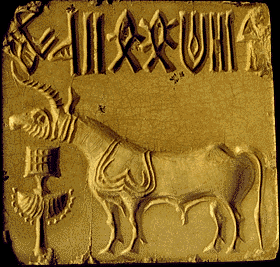 Indus Valley unicorn seal. The Indus Valley civilization, one of the oldest on earth, lost its place to the Aryan invasion, according to nineteenth century scholars, who of course must be correct because they are old and therefore smarter than twenty-first century scholars. These Aryans spread from India to England, and they must have adopted the unicorn as their symbol when they became civilized after conquering India. As a result, the warrior caste of these Aryans (confirmed to exist by scholars of Indo-European society) must have been the precursors to the Knights Templar. Consider: Both groups rode horses, used weapons and armor, recited epic poetry, and took orders from a high-ranking spiritual elite. Clearly they are the same people.
Now, America Unearthed already established that medieval and ancient peoples did not make up fanciful depictions of, say, dinosaurs, and rock drawings of boats are accurate enough to identify the specific type of ship, so any depiction must be a real creature. Given the wide range of unicorns depicted in art from the Indus Valley to the Middle Ages, we must conclude that there is good evidence for unicorns, especially since medieval apothecaries stocked “unicorn horn” among their medical offerings and we all know that if there is an artifact attached, it must be a real animal. In 1663, an entire unicorn skeleton was uncovered in Germany, buried in limestone—like the famous Tucson caliche—and was reconstructed by Gottfried Wilhelm von Leibnitz, becoming the toast of Europe. Its horn still exists today and can be geologically tested to “prove” it is ancient… no, wait, let’s “prove” it’s medieval instead. Caliche only takes a few hundred years to form, right? So what does this tell us? America Unearthed established that the Knights Templar came to America and explored the East Coast (where they built the Newport Tower). Certainly a branch of them came prior to Columbus, but why? Could they have been looking for their predecessors, the “precursors” who buried the Tucson Artifacts in the 800s CE? And would they have used unicorns to find them? Clearly, when the precursors left Europe for Arizona because “some Muslim group,” as Scott Wolter has established, had forced them from Europe, they took with them their most precious cargo: A member of the bloodline of Christ and his guardian unicorns. Every divine figure had his or her guardian animals. Just as Zeus had his bulls and Marduk his dragon, so too did Christ have his unicorn. His descendant would, of course, have needed an escort of unicorns to serve at his court. We also know that when the conquistador Hernando de Soto arrived in the New World to explore the southern United States, he brought pigs with him. Some of these pigs escaped and went feral, becoming the razorbacks of the South. Some of the unicorn herd the Templar precursors brought with them must have escaped as they made their way down the east coast, producing the herds of wild unicorns found in Maine and in Florida. From the distribution of unicorns, we know that the Templars precursors must have sailed the northerly route, from Scotland to Iceland to Greenland to Canada and then down the east coast. Or perhaps the more recent Templars of the 1300s brought their unicorns with them when they built the Newport Tower. We know from John of Hesse that unicorns roamed the Holy Land in 1389, when he saw one, so obviously the Templars had access to unicorns during the two centuries when they were headquartered atop Jerusalem’s Temple Mount. Unicorns were still active in the Sinai region in 1483 when Felix Fabri saw one, but by then they were by then on the brink of extinction. The last unicorn supposedly died at Mecca around 1600. Did the Templars bring these unicorns to America to save them from Muslim and Catholic hostility and extinction? We’ll never know until we perform some spurious geological testing on the unicorn horns in the possession of Native American groups to see if any date back before 1300 CE. This will let us establish which Templar or pre-Templar group brought unicorns and a descendant of Christ to America. But what happened to the Christ kid? Tune in next week to find out which digital-tier cable host is the lineal descendant of Jesus and a candidate to be the Last World Emperor! The above speculation is based on actual facts, though the interpretations given above are of course complete lies. The actual truth is this:
145 Comments
Kean Scott Monahan
2/26/2013 04:46:48 am
This from the same critic who, a mere 23 days ago, was in full blown denial in his blog, "Am I Obsessed with America Unearthed? No. 2/26/2013 04:58:07 am
Lighten up, Kean. It sounds like somebody's not having much fun.
Kean Monahan
2/26/2013 05:13:50 am
OK, Jason,
Kean Monahan
2/26/2013 05:39:13 am
A couple of corrections to my last post:
T.
2/26/2013 02:29:38 pm
"I type faster than I think sometimes." 2/26/2013 03:19:48 pm
Kean,
Christopher Randolph
2/26/2013 04:37:34 pm
"I'm not here to defend America Unearthed or Scott Wolter."
terry the censor
2/26/2013 06:00:50 pm
@kean
Kean Monahan
2/27/2013 12:31:38 am
JJ McKay & Terry,
Kean Monahan
2/27/2013 12:46:39 am
For your consideration, Michael D. Lemonick and Andrea Dorfman's March 13, 2006 TIME cover story included this gem:
Kean Monahan
2/27/2013 12:49:58 am
correction: examples where the dogma has NOT persisted.
T.
2/27/2013 02:24:13 am
I love how diffusionist proponents perpetually whine about how Archaeology doesn't just believe any crack-pot theory thrown in front of them regarding pre-columbian contact then site and exclude the actual example of it (L'Anse aux Meadows). You claim the proof that you're right is that no one wants to take your word for it. Look up "evidence". Fascinating stuff and I think it will connect the gap in your thought process. Or if you're content as you are may I suggest you start watching Ancient Aliens instead. Their ideas are even less likely to ever be taken seriously, they also have no proof of anything, present their ideas as fact, and believe in widespread conspiracy. You'll fit right in.
Kean Monahan
2/27/2013 07:42:03 am
T.,
Christopher Randolph
2/27/2013 08:23:47 am
"no one here has an issue with 18-22 thousand years of a North American continent isolated from contact with the outside world!" 2/27/2013 09:21:35 am
Mr. Randolph,
Christopher Randolph
2/27/2013 10:13:34 am
I'm not the lightweight intellect here.
Christopher Randolph
2/27/2013 10:16:24 am
"to advance the idea that you're pro-white"
Kean Monahan
2/27/2013 10:56:20 am
Mr. Randolph, intellectually challenged as you may be,
T.
2/27/2013 01:36:42 pm
You don't get it, do you? You have no place in this discussion. You have a belief system that you want to be taken as historical evidence. 2/27/2013 05:27:00 pm
T.,
Christopher Randolph
2/27/2013 05:35:59 pm
As best as I can determine the entire claim that Arabs of any sort reached the Americas before Columbus would be a couple of whisper-down-the-lane claims in 12th and 13th century Chinese documents that Arab sailors went somewhere called "Mulan Pi." 2/28/2013 12:40:45 am
Mr. Randolph:
Christopher Randolph
2/28/2013 02:05:15 am
OK, now I see what this is all about.
Kean Monahan
2/28/2013 02:55:21 am
Mr. Randolph,
Christopher Randolph
2/28/2013 04:35:44 am
"Mormons are de facto corrupt."
Kean Monahan
2/28/2013 05:31:58 am
I'm going to acknowledge there's psychological inertia (call it bias if you wish) on both your side and my side. We are polarized. However, if you try to lump me along side racism, you are dead wrong. I'm advocating for the Muslim who came to America and was invited by Phil Leonard to inspect suspiciously Arabic characters that proliferate with heavy weathered patina on the faces of Block Rock and Bear Rock, including the engraved depiction of an ancient seafaring vessel.
Christopher Randolph
2/28/2013 06:45:49 am
No, it's not "psychological bias." You have a faith-based claim and I don't. That's not equal. I have a "bias" toward wanting evidence and not speculation, and I have a "bias" toward humans doing things that make sense, not things that make no sense.
Kean Monahan
2/28/2013 07:05:40 am
Chris,
Christopher Randolph
2/28/2013 07:56:22 am
"now assuming I'm a stooge for the Book of Mormon" 2/28/2013 08:30:36 am
For someone who so vigorously wants to condemn anyone who fabricates evidence, you seem very blind to doing you yourself, and in abundance. Kindly read your own posts and my point blank denials, how prone you seem to be to predict, divine, and propagate the mythical motives you keep assigning to me. Are you disturbed?
Will Ritson
5/4/2013 06:04:34 pm
If this was fun for you.... I'd suggest venturing outside every now and then.
Tara Jordan
2/27/2013 04:50:53 am
Homoeroticism Unearthed Lost Episode : The Semantics of the Popular Short Pants Fetish, A study in Psychological anthropology, with special guest Kean Scott Monahan
T.
2/28/2013 06:12:25 am
So the bottom line is that you will never accept real evidence as proof of anything, you will never accept that history is always being rewritten with every new discovery, you will never accept that there's no reason for anyone to hide evidence because it's in the best interest of their careers to find and present new evidence. Is that about right? If these insane ideas aren't accepted without proof than it's clearly a conspiracy? Yeah, that must be it. Again, you have no place in this discussion. You're a fairy tale pusher. If you actually do know anything about anything and you're ignoring it to make these ridiculous arguments then shame on you. Apparently the previous schooling didn’t entirely sink in. Stop citing disgraced researchers, conspiracy theories, and personal prejudice against educated professionals as evidence for ancient transatlantic voyages. Deflect all you want but it will never make these ideas credible. Whatever personal reasons you have for wanting these things to be true are totally and completely irrelevant. These ideas that you’re so fond of are all sleight of hand and you’ve fallen for it. It’s that simple.
Kean Scott Monahan
2/28/2013 06:46:33 am
T.,
T.
2/28/2013 02:45:17 pm
In response to #1- You don't belong in this discussion because you lack anything informed or constructive to contribute. As for your First Amendment rights I think that our new Secretary of State John Kerry had a point in saying that as an American you have the right to be stupid but I'm going to exercise my right to free speech and call you on it.
Christopher Randolph
2/28/2013 05:11:40 pm
"There's a revolt by Americans, both journalists and otherwise, to just rollover and trust absolutely American archaeologists to impartially examine the evidence."
Kean Monahan
3/1/2013 03:16:43 am
T.,
Christopher Randolph
3/1/2013 04:07:53 am
Kean -
Christopher Randolph
3/1/2013 04:33:23 am
Continuing, the stupidity of the American public for me isn't that they don't know things. A lot of people never had great educational opportunities for a variety of reasons and I don't beat people up about that. There for the grace of a functioning public school system and scholarship $ go I. I certainly believe that most people have a capacity to learn. Anyone who has an informed opinion on NFL secondary coverages for example - I just described tens of millions of working class Americans - certainly has the intellectual raw material to follow any number of academic discussions, at least after learning some facts and having a concept of a difference between fact and opinion.
Christopher Randolph
3/1/2013 05:04:36 am
The stupidity of Barry Fell - see, PhDs can be stupid too - is in assuming that although he needed to rise through the zoology ranks through years of careful tutored study and peer review, this simply didn't apply to himself and/or archeology.
Kean Monahan
3/1/2013 05:43:10 am
Chris,
T.
3/1/2013 07:39:22 am
I'm enjoying how you've desperately stooped to attacking me by recycling the things I've used to describe you and then follow it up by proving everything I've stated is correct ( i.e that you’re uninformed and paranoid ). Thanks for that. Diffusionism is a cult. It hasn't passed peer review because it can't. No matter what you say or how you try to distract from this fact by accusing others of all manner of nonsense your position is no more valid now than it was ten posts ago. Feel free to keep attempting to rope others into treating you like an equal on this subject. We know better, don't we?
Kean Monahan
3/1/2013 07:53:12 am
T.,
Christopher Randolph
3/1/2013 07:58:43 am
"He was a scholar whose interests in diffusionism and epigraphy naturally arose from world travels." 3/1/2013 08:37:07 am
If you don't like the answers, don't ask your silly leading questions. As if I can divine details of the back story, where these guys stopped along the way, what their motives were (maybe the WERE lost tribal members blown off course by hurricane, but horror of horror, that might validate Joseph Smith), and whether they pissed in the Atlantic or Pacific on their way over.
Christopher Randolph
3/1/2013 08:49:37 am
"may have incidentally spoken at BYU" 3/1/2013 09:08:06 am
OK, I get it that you're a highly skeptical guy wound up in a conspiracy theory of your own device. You earlier accused me of racism for advocating ancient Irish in Colorado and Oklahoma. Then you equivocally diminished a Muslim researcher whom I advocated. Are you against dark-skinned people. Are they all stooges for BYU? Give me a break. Were the Irish here for Joseph Smith, too. How about the Utes of Arapahoe whose archaeoastronomy I am the only TV reporter to have documented along the Purgatoire River at the Pathfinder summit? I'm advocating for the higher intellectual interests of Native American's as well, while drawing a distinction in the Apishapa pecked petroglyph style from the presumed Celtic/Persian Ogham captioned archaeoastronomy nearby using variegated grooves. I'm presenting evidence that ought to stimulate the interest of truly curious archaeologists ready to compare, contrast, but importantly JUST EXAMINE this stuff. And all you can do is your rapid-fire, machine gun obliteration, using different caliber bullets and different assigned motives for my tendency to want to communicate that which archaeology prefer to subvert and hide from the public with a veil of official ignorance. How scientific is that? Check the link and fire away.
Christopher Randolph
3/1/2013 09:08:16 am
""Absence of evidence is not evidence of absence," may offend you"
Kean Monahan
3/1/2013 10:33:37 am
Mr. Randolph confesses, "My educational and formal professional background is actually in political science..."
T.
3/1/2013 11:08:45 am
Keane,
Kean Monahan
3/1/2013 11:48:48 am
T. asserts, "Everyone who has responded to you has answered your ridiculous questions over and over."
Brian
12/3/2014 04:05:00 pm
Scott Wolter is a silly fraud. He should get a security guard card so he can stay up all night listening to coast to coast.
tubby
2/26/2013 05:34:45 am
Wait, doesn't drinking unicorn blood make you immortal? This could be the grain of truth behind the fountain of youth in Florida! The Native Americans were drinking unicorn blood!
T.
2/26/2013 02:30:56 pm
Worked for Voldemort.
Tome
2/26/2013 06:02:16 am
Unicorn blood? Isn't that used to drive ancient alien spaceships?
Mila
2/26/2013 09:13:37 am
I went a little bit further to find about unicorns as I have found paintings of unicorns on Alchemy website.
CFC
2/26/2013 12:32:22 pm
Jason, 2/26/2013 12:34:10 pm
I'm glad you enjoyed the piece, but I do have to report that the razorback connection is a real theory put forward by actual scholars. If you click the link in the sentence, you'll see. The best hoaxes are those built on a foundation of truth!
CFC
2/26/2013 12:40:06 pm
Thanks for the clarification. What an entertaining story. I've passed it around to others. 2/26/2013 12:44:40 pm
And now you can tell anyone who tries to claim that the Templars were in America that they rode unicorns, too!
Mary Andersen
2/26/2013 12:42:28 pm
Jason: You need to get a job and a life. 2/26/2013 04:26:18 pm
Mary,
L Bean
2/27/2013 04:55:52 am
Oh Mary, Mary, Mary. Free lessons in keyboard warriorism are available in the gift shop.
Mila
2/27/2013 07:08:06 am
Jason did a good job. He saved me lots of my time because I didn’t know many writers with abundance of fantasy and distortions. I think that his website is good for a person who starts his own research and moves on. I have done that when I noticed that there are subjects that he avoids. Not good for a journalist who should exercise objectivity. Well, as Benjamin Franklin said, “half a truth is often a great lie” or Truman, “If you can’t convince them, confuse them" LOL!
BillUSA
11/30/2013 03:19:57 am
So, like a diffusionist, you suggest that Jason delve into subjects that he may not be qualified to examine?
Will Ritson
5/4/2013 06:06:17 pm
I was just thinking that as well. Far too much time on his hands.... but then again, if this is how he wants to spend hours and hours of his time.... better him than me. 2/26/2013 03:42:04 pm
Several points:
Christopher Randolph
2/26/2013 05:10:45 pm
"I think AMERICA UNHINGED should be a recurring topic."
L Bean
2/27/2013 04:53:31 am
Fantastic! So glad to see Shirazi's article spread around. Talk about rewriting history and the power of suggestion....Argo was by far the slicker of the two "CIA movies" up for an Oscar, miles more insidious than that made-for-TV Bin Laden flick.
terry the censor
2/26/2013 06:06:24 pm
In 2010, this fake video was put out by the Ontario Science Centre to draw attention to an exhibition on mythical creatures. They soon admitted it was a hoax, but as you can see by the comments, the video got worldwide coverage.
Matt
2/27/2013 12:36:12 am
There is a good reason why America Unearthed has contributed to your readership so much lately. When we have gone on Google to read more about Scott Wolter or the show in general, they do not have a real web presence. Your site has a very high listing for the search term "America Unearthed", and is really the only spot on the web that is discussing the show.
Lynn Brant
2/27/2013 01:30:12 am
You say, you're a scientist. I wonder, have you seen any reality TV shows that mocked your field with such blatant distortions? It's easier to say "what if" and engage in suspension of disbelief for entertainment, when the subject and science under attack isn't your own.
Rocky R Rockbourne
3/1/2013 04:03:39 am
Archaeology isn't even my field, and this show offends me because it makes a mockery of so many things. There's the covert racism behind many of its claims, the delusions of persecution of its host, and the pseudoscientific approach it generally takes. While certainly I could pretend that it's just entertainment, I don't think that would change the fact that it is pretending to be something more than that. Hitler might have just been comic relief, for example, if nobody had believed him; however, we can see what happens when people believe stupid things, and that's why people should be offended, I think, by this kind of stupidity. Not that I think Scott Wolter will cause a holocaust, but he certainly enables stupidity, and stupidity is capable of great evil.
L Bean
2/27/2013 04:46:48 am
People are Googling to 'read more about Scott Wolter', that much is true, but for the most part it's in a spirit of bewildered indignation and disgust.
JO
3/14/2013 01:42:15 pm
Case in point. I was blissfully ignorant until I happened to watch last episode and am still trying to recover from the experience. Had to make sure I wasn't watching some sinister version of Comedy Central. Google search sent me to this most informative, entertaining and objective site. I found Colavito via Woller,which works just fine for me. Now if I could only get me a hooked x unicorn!
CFC
2/27/2013 01:12:11 am
Matt
CFC
2/27/2013 01:12:55 am
Matt - I meant AU - America Unearthed.
Thorne
2/27/2013 02:54:03 am
I can just see it! Right now the producers over at AU are launching a massive witch hunt to find the person who leaked the script for their blockbuster, cliffhanger season finale.
L Bean
2/27/2013 04:28:42 am
ROTFLMAO! It's a masterpiece, Mr. Colavito!
Cathleen Anderson
2/27/2013 04:42:23 am
I enjoyed reading this.
Matt
2/27/2013 03:17:22 pm
I'm just saying that these shows aren't produced to be science, and their saying "this is the hidden truth" is very tongue-in-cheek. I don't know anyone who watches it for anything other than entertainment. I am sure there are some who do, but who in the world could take the guy on AA with the crazy black hair that looks like he stuck his finger in a light socket seriously?
Rocky R Rockbourne
3/1/2013 03:55:12 am
Matt, some people take America Unearthed seriously. People I know, in fact. I doubt they take Ancient Aliens seriously, but that's because it doesn't conform to their preferred brand of alternative history (i.e. divine intervention rather than extraterrestrial).
BillUSA
11/30/2013 03:27:07 am
Matt, you're almost there...
Jake
2/28/2013 04:52:38 pm
A pretty inventive Dan Brown mess of quasi-historical nonsense, that's good stuff. Although I didn't see anything in there about aliens (unless I missed that part). 2/28/2013 09:28:55 pm
Yes, the entire burden falls on the one making the claim. That's how the burden of proof works in every field of science.
Jake
3/1/2013 05:01:02 am
You're still thinking in such small terms. Science does not work in probabilities alone, it also works in possibilities. If science did not work in possibilities no new discoveries would ever be made. Before Copernicus postulated that Earth revolved around the Sun what was the probability this was true? Before the Wright brothers flew at Kitty Hawk what was the probability man would ever fly? Before Armstrong stepped foot on the moon what was the probability we would ever be able to do that? You have such narrow vision. If scientists don't except anything and everything as possible then why would they ever conduct research into anything? If science doesn't think it's possible we'll contact alien life then why do so many devote their lives to SETI and the like? What is the probability that science will find a cure for cancer or discover the secret to longer life; I can tell you those odds are not good yet science is working on both of those. You have such limited vision man. You think that because something is improbable it is impossible, I think improbable still means possible and I hate to tell you this but history and science are on my side on this one. 3/1/2013 05:27:50 am
You are confusing a hypothesis to be tested (a possibility) with the results of the testing (probability).
J.
2/28/2013 08:14:00 pm
Should end this with an Edward J. Olmos voice-over saying "It's too bad she don't last, eh? But who does?" and a shot of an origami unicorn sitting on a dusty desk.
Jake
3/1/2013 05:52:11 am
Jason - "You are confusing a hypothesis to be tested (a possibility) with the results of the testing (probability)." 3/1/2013 06:14:38 am
So, for you the jury is still out on gravity? Or evolution?
J.
3/1/2013 08:10:59 am
"True science does not dismiss the improbable simply because it is improbable. True science accepts that anything is possible, even if it is improbable, until proven otherwise."
Jake
3/1/2013 06:45:46 am
As someone with an IQ over 165 and who has turned MENSA down several times now I would think you would know that gravity in fact has not been proven definitively because we still don't know what causes it. Evolution has also not been proven definitively because where we used to think we were descendants of Neanderthal recent findings have shown that to be incorrect; and now we're finding there may have been several humanoid species we are possibly descended from. So no, neither of those has been proven definitively which is why they are still called THEORIES. I figured someone of your vast intellect would know the definition of a theory. I accept all things as possible, even if improbable. The probability of such theories as the devil fossil theory causes me to have my own opinions on those theories but I cannot rule them out entirely without proof. I make no declarations of anything being impossible without proof that indicates such. That is the difference between you and me, you declare things to be impossible based solely on your own determination of their probability; I accept all things to be possible even if highly improbable, until they are proven otherwise. That is how logic works. Logic accounts for both probability and possibility, not one or the other. Science works that way as well. Many scientists conduct experiments not just to prove theories but also to disprove them because they understand that until a theory is disproven it is still possible. 3/1/2013 06:51:53 am
So my Socratic method worked. I have gotten you to say what you really think, which is that no probability is sufficient to warrant your acceptance. Given that there is nothing that anyone can say or do to provide sufficient proof for you, there is really nothing left to talk about. In your view, there can be no facts because all can be doubted and wherever there is doubt, one cannot judge.
Jake
3/1/2013 06:59:26 am
You didn't comprehend a single word I said. I said until proof (facts) are presented that disproves a theory, that theory must be accepted as possible, even if highly improbable. Improbability is not proof. Any mathematician will tell you that .00000001 is not zero. Just admit that what you're arguing is that it's ok to dismiss a theory as bogus without any proof whatsoever based what you believe to be the probability of that theory being correct. What's really happening here is that I've poked a hole in your flawed logic and you can't stand the notion of having to admit it may be possible that aliens visited Earth during the Stone Age or that Romans may have come to America or that the Kensington Rune Stone may be real. You've spent so much time arguing that all these are impossible because they are improbable and now I've turned that notion on its head and you can't stand that. 3/1/2013 07:05:10 am
You can't prove a negative, Jake. All an experiment can prove is that the effect wasn't observed THAT TIME. Repeated tests can show that the effect isn't observed multiple times, and eventually the probability of the effect becomes low. But it will NEVER reach zero because you can never prove something will NEVER happen. There might be a 0.0000000000000001% chance that all the experiments are wrong, but there will always be a chance. Here I must say that it is you, not I, who are exhibiting ignorance of how science and statistics work.
Kean Monahan
3/1/2013 06:52:07 am
Jake,
Michigan Relic
8/18/2020 12:59:22 pm
"...it may be possible that aliens visited Earth during the Stone Age or that Romans may have come to America..." 3/1/2013 06:58:19 am
Jake,
Jake
3/1/2013 07:05:50 am
You're exactly right, we don't know what we don't know and to make declarations about what we don't know based solely on probability is inaccurate.
Mila
3/2/2013 05:57:43 am
Rocky R Rockbourne
3/1/2013 04:40:12 pm
I didn't realize that not knowing the exact nature of our relationship to other hominid species with absolute certainty--the obscene statistical significance (p>>99%) for the phylogenetic trees predicted by the theory where we have more complete data sets is for chumps (or is it chimps?)--meant that evolution as a general explanation for the diversification of life is on shaky ground. You should publish this astounding finding for the sake of scientific progress.
Jake
3/1/2013 07:09:14 am
Jason - "You can't prove a negative, Jake. All an experiment can prove is that the effect wasn't observed THAT TIME. Repeated tests can show that the effect isn't observed multiple times, and eventually the probability of the effect becomes low. But it will NEVER reach zero because you can never prove something will NEVER happen. There might be a 0.0000000000000001% chance that all the experiments are wrong, but there will always be a chance. Here I must say that it is you, not I, who are exhibiting ignorance of how science and statistics work." 3/1/2013 07:16:02 am
But you cannot prove a negative. You won't know that aliens DIDN'T visit until you completely destroy the entire earth and run every piece of dirt through an analyzer looking for traces of alien spaceships. You won't know Romans didn't come until you tear down every building and uproot every tree looking for coins.
Jake
3/1/2013 07:11:12 am
Jason - "Name a single fact you accept as proven true (or false) beyond all doubt." 3/1/2013 07:20:25 am
Is it really? Can you prove that nowhere in the universe, or in any other hypothetical dimension, a substance with all the properties of water could not be made with a different composition? Surely there is a chance, no matter how small.
Jake
3/1/2013 10:35:07 am
Yes it really is. Water, H2O, is an element. If a similar substance were made with different components it would not be water, it would be something else. Dude, c'mon. You're grasping at straws here man and it's very unbecoming. Heavy water has a different chemical make up than regular water, therefore it is different. The chemical makeup of heavy water is 2H2O. C'mon man, you're struggling to keep arguing with me when this is an issue you've clearly lost. Just concede that you're method is flawed because you disregard theories as false based on their probability of likelihood rather than on evidence. 3/1/2013 10:48:12 am
I'm not grasping at straws, Jake; I'm making a serious point. You accept the existence of water as a specific chemical formula, but doing so requires you to accept chemistry as a science, and atoms as real things. But atoms are a theory, one that is probably correct, but could be explained in other ways. (They might, for example, be a virtual reality delusion created by a conspiracy of aliens who have modified strings at the subatomic level to look like atoms. Don't laugh; some people actually believe this, and you are required by your own claims to accept this might be true because you haven't disproved it, even though doing so calls into question whether water--or matter at all--exist as reality in the first place.)
Jake
3/1/2013 10:45:11 am
Jason - "Name an idea about the past you can prove beyond doubt is false." 3/1/2013 10:51:27 am
Nope. Try again. The Flat Earth Society believes the earth is flat and has many arguments for why this is so, mostly involving a conspiracy. Since there are arguments for a flat earth, inclduding reasons why the evidence science accepts is fake, there must therefore be doubt about its roundness.
Jake
3/1/2013 11:05:34 am
The flat Earth society chooses to ignore the evidence that the Earth is not flat. You can point to them as your example if you want but I'm gonna laugh at you. The has been definitively proven to be not flat. So try again.
Sticker
7/22/2016 08:55:38 am
"Water is an element"?
Jake
3/1/2013 10:48:54 am
Jason - "Name an idea about the past you can prove beyond doubt is false." 3/1/2013 10:53:59 am
Nope. Try again. You'd have to survey ever inch to make sure not a single bacterium--or something we don't even understand--lives there. Otherwise, that's just a theory based on extrapolation from observations.
Jake
3/1/2013 11:03:50 am
No I'm saying they found life at the bottom of Challenger Deep, we know it's there. You said name a past notion about the world that was proven false, the notion was that life could not live down there. Today we know life does live down there. 3/1/2013 11:10:56 am
Sorry, I've been up since 5 AM and am getting tired. You were referring to a negative assumption, which isn't a "fact" but a hypothesis.
Jake
3/1/2013 11:02:14 am
"Many people believe this, so you must accept that dinosaurs don't "exist" because the devil theory hasn't been "disproved" to your satisfaction." 3/1/2013 11:13:23 am
I don't think you've ever read anything I've written beyond a couple of blog posts. If you read my book, The Cult of Alien Gods, you'll see that I carefully explain that the ancient astronaut hypothesis is possible (indeed, Carl Sagan thought it so), but that I do not believe any of the specific claims made for rise to the level of proof.
Jake
3/1/2013 11:22:32 am
Actually I haven't read anything besides the blogs. I came across your page a week ago or so and it's pretty good. Honestly you do fairly good job debunking things when you stick to what is proveable and not proveable. The only thing I have beef with is when you and other debunkers label things as "debunked" based only the notion that they are improbable events. That sort of debunking is nothing more than speculation which is exactly what guys like Wolter are doing on TV. The problem I have with the skeptic society is that they deal too much in absolutes and not enough in possibilities.
Jake
3/1/2013 11:38:25 am
I'm not sure anything offered by AA theorist is proof, it is circumstantial evidence that does raise the possibility that AA theory is true.
Tom
3/1/2013 11:59:07 am
So basically - entertain whatever idea or theory you want. Accept everything as possible as it cannot be disproved as impossible. Hypotheses with flimsy evidence should be treated with the same respect as hypotheses with firmer evidence.
Jake
3/1/2013 11:18:34 am
"Sorry, I've been up since 5 AM and am getting tired. You were referring to a negative assumption, which isn't a "fact" but a hypothesis."
Rocky R Rockbourne
3/1/2013 04:49:23 pm
Jake, given your allegiance to hyperagnosticism, how are you so sure the Earth is not flat? What if it's a hologram projected to have the illusion of three-dimensionality with cleverly placed wormholes giving it the illusion of roundness? And how do we know it wasn't the extraplanar reptilian nephilim Nibirutian Knights Templar Elders of Zion Freemason Illuminati Bilderberger Skull & Bones secret society that is behind it all? Or maybe there is no Earth ... whoa.
terry the censor
3/4/2013 09:15:57 pm
@kean
Nancy Sinclair
4/18/2013 02:07:05 pm
Hey Chris Randolph: Where were the news reporters of war stories when the so called Mormon slaughter at Mt. Meadows took place? Answer is there were none. Therefore, any hate filled idiot such as you or your brother can make up gossip stories about that happening. Your facts are made up falsehoods about all the negatives you are putting on The Church of Jesus Christ of Latter-day Saints and it's members. There is a "Visitors Welcome" sign on all the LDS churches. Try attending these Sunday meetings with an open mind.
Christopher Randolph
4/18/2013 06:06:34 pm
You know you have problems when you intend a question to be rhetorical and the person you aim it at has real answers.
Texas Willow
7/22/2013 07:42:00 am
Thanks for the blog. My sons and I do watch AU regularly - not because we believe everything that is presented in the show and not as entertainment but as a springboard for discussions. It is teaching the kids not to believe everything presented on TV (no matter what the channel) as fact but to look into things for deeper education. We do enjoy that we do learn about some things that do honestly exist in America that we have never heard about (for example, I had never heard of the "American Stonehenge" site) but it doesn't mean we buy into all of the theories.
Steven
9/4/2013 06:05:06 pm
I can't believe that all of you missed the following:
" ... And would they have used unicorns to find them?"
JJLouis
11/28/2013 02:07:53 pm
If this ever gets turned into an actual film (which it should), I want to play the crazy-haired guy who jumps to outrageous conclusions and states as matters of fact things like, "Well, it's obviously because Big Foot is not from this planet, but is in actuality an ancient alien ninja."
Steven
11/30/2013 05:43:01 am
So you want to play Giorgio Tsoukalos?
Steven
11/30/2013 05:43:16 am
So you want to play Giorgio Tsoukalos?
Steven
11/30/2013 05:43:36 am
So you want to play Giorgio Tsoukalos?
JJLouis
11/30/2013 10:44:50 am
Yes! I couldn't remember his name. That hair is definitely not from this planet.
Jason D.
11/30/2013 11:48:04 am
Can't wait to see tonight's premiere. Here's my take at an unaired (unairable) episode of AU.
BillUSA
12/1/2013 05:25:36 am
I realize that I'm a bit late to this blog party but I have a simple, straight-forward question for people like Kent.
BillUSA
12/1/2013 05:25:56 am
I realize that I'm a bit late to this blog party but I have a simple, straight-forward question for people like Kent.
Steven
12/5/2013 06:18:53 am
When I read that someone read something in a book that spouts these bizarre theories I'm reminded of a Benny Hill song|:
Andy
12/5/2013 01:35:02 am
I'm late to this party also. I just stumbled onto this blog the other day and have skimmed my way through a couple of Jason's reviews and some of the comments that follow. Why not throw my two cents in?
Andy
12/5/2013 01:38:00 am
The beginning of the fourth paragraph should have been "I'm not sure where in this process . . . "
Bob
2/13/2014 03:05:49 pm
The problem with your factual progression is that Scott Wolter has since conclusively proved that the Ark of the Covenant is not in Ethiopia, but rather was brought by the Lost Tribes of Israel through Ohio (where they built mounds in the shape of a Hanukah menorah) to the Grand Canyon. It is now in a nearly (but not entirely)inaccessible cave in the canyon wall, but the National Park Service will not let Scott or anyone else near it, which is further proof that it is in fact there! So it could well be that the Jews brought unicorns to America to protect the Ark, and the last unicorns are now residing in the cave, at least that is what many forensic geologists and dissenting historians believe.
Steven
2/14/2014 01:34:25 am
Ahhh! That explains the "Great Inverted Dreidel of Cleveland" which the Illuminati converted to the Rock and Roll Hall of Fame to hide it's true purpose!
Just a quick note on the means to defeat skepticism.
Bmiller
3/31/2015 04:34:52 am
What? This isn't a real episode? Once we got to the Templar/Indo-European Warrior Elite connection (identity?), I was certain that we were on the right track. We just need some hard evidence...
Sarah Kate
8/9/2015 03:33:22 pm
This is my favourite post yet! Except I think you've explained how you reached your conclusions a little too well... delete a few paragraphs so you have more extraordinary (and inexplicable) leaps of logic, and you'll have nailed it!
CaptainMommy
10/17/2015 11:22:05 am
You have missed the Unicorn herd that runs rampant through New Braunfels, Texas. We have even claimed them as our high school mascot (our football team hasn't been very good this year; is it because of a Masonic curse?) Your comment will be posted after it is approved.
Leave a Reply. |


AuthorI am an author and researcher focusing on pop culture, science, and history. Bylines: New Republic, Esquire, Slate, etc. There's more about me in the About Jason tab. 
Newsletters
Enter your email below to subscribe to my newsletter for updates on my latest projects, blog posts, and activities, and subscribe to Culture & Curiosities, my Substack newsletter.
Categories
All
Terms & ConditionsPlease read all applicable terms and conditions before posting a comment on this blog. Posting a comment constitutes your agreement to abide by the terms and conditions linked herein.
Archives
April 2024
|

- Home
- Blog
- Books
-
Articles
-
Newsletter
>
- Television Reviews >
- Book Reviews
- Galleries >
- Videos
-
Collection: Ancient Alien Fraud
>
- Chariots of the Gods at 50
- Secret History of Ancient Astronauts
- Of Atlantis and Aliens
- Aliens and Ancient Texts
- Profiles in Ancient Astronautics >
- Blunders in the Sky
- The Case of the False Quotes
- Alternative Authors' Quote Fraud
- David Childress & the Aliens
- Faking Ancient Art in Uzbekistan
- Intimations of Persecution
- Zecharia Sitchin's World
- Jesus' Alien Ancestors?
- Extraterrestrial Evolution?
- Collection: Skeptic Magazine >
- Collection: Ancient History >
- Collection: The Lovecraft Legacy >
- Collection: UFOs >
- Scholomance: The Devil's School
- Prehistory of Chupacabra
- The Templars, the Holy Grail, & Henry Sinclair
- Magicians of the Gods Review
- The Curse of the Pharaohs
- The Antediluvian Pyramid Myth
- Whitewashing American Prehistory
- James Dean's Cursed Porsche
-
Newsletter
>
-
The Library
-
Ancient Mysteries
>
-
Ancient Texts
>
- Mesopotamian Texts >
-
Egyptian Texts
>
- The Shipwrecked Sailor
- Dream Stela of Thutmose IV
- The Papyrus of Ani
- Classical Accounts of the Pyramids
- Inventory Stela
- Manetho
- Eratosthenes' King List
- The Story of Setna
- Leon of Pella
- Diodorus on Egyptian History
- On Isis and Osiris
- Famine Stela
- Old Egyptian Chronicle
- The Book of Sothis
- Horapollo
- Al-Maqrizi's King List
- Teshub and the Dragon
- Hermetica >
- Hesiod's Theogony
- Periplus of Hanno
- Ctesias' Indica
- Sanchuniathon
- Sima Qian
- Syncellus's Enoch Fragments
- The Book of Enoch
- Slavonic Enoch
- Sepher Yetzirah
- Tacitus' Germania
- De Dea Syria
- Aelian's Various Histories
- Julius Africanus' Chronography
- Eusebius' Chronicle
- Chinese Accounts of Rome
- Ancient Chinese Automaton
- The Orphic Argonautica
- Fragments of Panodorus
- Annianus on the Watchers
- The Watchers and Antediluvian Wisdom
-
Medieval Texts
>
- Medieval Legends of Ancient Egypt >
- The Hunt for Noah's Ark
- Isidore of Seville
- Book of Liang: Fusang
- Agobard on Magonia
- Book of Thousands
- Voyage of Saint Brendan
- Power of Art and of Nature
- Travels of Sir John Mandeville
- Yazidi Revelation and Black Book
- Al-Biruni on the Great Flood
- Voyage of the Zeno Brothers
- The Kensington Runestone (Hoax)
- Islamic Discovery of America
- The Aztec Creation Myth
-
Lost Civilizations
>
-
Atlantis
>
- Plato's Atlantis Dialogues >
- Fragments on Atlantis
- Panchaea: The Other Atlantis
- Eumalos on Atlantis (Hoax)
- Gómara on Atlantis
- Sardinia and Atlantis
- Santorini and Atlantis
- The Mound Builders and Atlantis
- Donnelly's Atlantis
- Atlantis in Morocco
- Atlantis and the Sea Peoples
- W. Scott-Elliot >
- The Lost Atlantis
- Atlantis in Africa
- How I Found Atlantis (Hoax)
- Termier on Atlantis
- The Critias and Minoan Crete
- Rebuttal to Termier
- Further Responses to Termier
- Flinders Petrie on Atlantis
- Amazing New Light (Hoax)
- Lost Cities >
- OOPARTs
- Oronteus Finaeus Antarctica Map
- Caucasians in Panama
- Jefferson's Excavation
- Fictitious Discoveries in America
- Against Diffusionism
- Tunnels Under Peru
- The Parahyba Inscription (Hoax)
- Mound Builders
- Gunung Padang
- Tales of Enchanted Islands
- The 1907 Ancient World Map Hoax
- The 1909 Grand Canyon Hoax
- The Interglacial Period
- Solving Oak Island
-
Atlantis
>
- Religious Conspiracies >
-
Giants in the Earth
>
-
Fossil Origins of Myths
>
- Fossil Teeth and Bones of Elephants
- Fossil Elephants
- Fossil Bones of Teutobochus
- Fossil Mammoths and Giants
- Giants' Bones Dug Out of the Earth
- Fossils and the Supernatural
- Fossils, Myth, and Pseudo-History
- Man During the Stone Age
- Fossil Bones and Giants
- Mastodon, Mammoth, and Man
- American Elephant Myths
- The Mammoth and the Flood
- Fossils and Myth
- Fossil Origin of the Cyclops
- History of Paleontology
- Fragments on Giants
- Manichaean Book of Giants
- Geoffrey on British Giants
- Alfonso X's Hermetic History of Giants
- Boccaccio and the Fossil 'Giant'
- Book of Howth
- Purchas His Pilgrimage
- Edmond Temple's 1827 Giant Investigation
- The Giants of Sardinia
- Giants and the Sons of God
- The Magnetism of Evil
- Tertiary Giants
- Smithsonian Giant Reports
- Early American Giants
- The Giant of Coahuila
- Jewish Encyclopedia on Giants
- Index of Giants
- Newspaper Accounts of Giants
- Lanier's A Book of Giants
-
Fossil Origins of Myths
>
-
Science and History
>
- Halley on Noah's Comet
- The Newport Tower
- Iron: The Stone from Heaven
- Ararat and the Ark
- Pyramid Facts and Fancies
- Argonauts before Homer
- The Deluge
- Crown Prince Rudolf on the Pyramids
- Old Mythology in New Apparel
- Blavatsky on Dinosaurs
- Teddy Roosevelt on Bigfoot
- Devil Worship in France
- Maspero's Review of Akhbar al-zaman
- The Holy Grail as Lucifer's Crown Jewel
- The Mutinous Sea
- The Rock Wall of Rockwall
- Fabulous Zoology
- The Origins of Talos
- Mexican Mythology
- Chinese Pyramids
- Maqrizi's Names of the Pharaohs
-
Extreme History
>
- Roman Empire Hoax
- American Antiquities
- American Cataclysms
- England, the Remnant of Judah
- Historical Chronology of the Mexicans
- Maspero on the Predynastic Sphinx
- Vestiges of the Mayas
- Ragnarok: The Age of Fire and Gravel
- Origins of the Egyptian People
- The Secret Doctrine >
- Phoenicians in America
- The Electric Ark
- Traces of European Influence
- Prince Henry Sinclair
- Pyramid Prophecies
- Templars of Ancient Mexico
- Chronology and the "Riddle of the Sphinx"
- The Faith of Ancient Egypt
- Remarkable Discoveries Within the Sphinx (Hoax)
- Spirit of the Hour in Archaeology
- Book of the Damned
- Great Pyramid As Noah's Ark
- Richard Shaver's Proofs
-
Ancient Texts
>
-
Alien Encounters
>
-
US Government Ancient Astronaut Files
>
- Fortean Society and Columbus
- Inquiry into Shaver and Palmer
- The Skyfort Document
- Whirling Wheels
- Denver Ancient Astronaut Lecture
- Soviet Search for Lemuria
- Visitors from Outer Space
- Unidentified Flying Objects (Abstract)
- "Flying Saucers"? They're a Myth
- UFO Hypothesis Survival Questions
- Air Force Academy UFO Textbook
- The Condon Report on Ancient Astronauts
- Atlantis Discovery Telegrams
- Ancient Astronaut Society Telegram
- Noah's Ark Cables
- The Von Daniken Letter
- CIA Psychic Probe of Ancient Mars
- Scott Wolter Lawsuit
- UFOs in Ancient China
- CIA Report on Noah's Ark
- CIA Noah's Ark Memos
- Congressional Ancient Aliens Testimony
- Ancient Astronaut and Nibiru Email
- Congressional Ancient Mars Hearing
- House UFO Hearing
- Ancient Extraterrestrials >
- A Message from Mars
- Saucer Mystery Solved?
- Orville Wright on UFOs
- Interdimensional Flying Saucers
- Flying Saucers Are Real
- Report on UFOs
-
US Government Ancient Astronaut Files
>
-
The Supernatural
>
- The Devils of Loudun
- Sublime and Beautiful
- Voltaire on Vampires
- Demonology and Witchcraft
- Thaumaturgia
- Bulgarian Vampires
- Religion and Evolution
- Transylvanian Superstitions
- Defining a Zombie
- Dread of the Supernatural
- Vampires
- Werewolves and Vampires and Ghouls
- Science and Fairy Stories
- The Cursed Car
-
Classic Fiction
>
- Lucian's True History
- Some Words with a Mummy
- The Coming Race
- King Solomon's Mines
- An Inhabitant of Carcosa
- The Xipéhuz
- Lot No. 249
- The Novel of the Black Seal
- The Island of Doctor Moreau
- Pharaoh's Curse
- Edison's Conquest of Mars
- The Lost Continent
- Count Magnus
- The Mysterious Stranger
- The Wendigo
- Sredni Vashtar
- The Lost World
- The Red One
- H. P. Lovecraft >
- The Skeptical Poltergeist
- The Corpse on the Grating
- The Second Satellite
- Queen of the Black Coast
- A Martian Odyssey
- Classic Genre Movies
-
Miscellaneous Documents
>
- The Balloon-Hoax
- A Problem in Greek Ethics
- The Migration of Symbols
- The Gospel of Intensity
- De Profundis
- The Life and Death of Crown Prince Rudolf
- The Bathtub Hoax
- Crown Prince Rudolf's Letters
- Position of Viking Women
- Employment of Homosexuals
- James Dean's Scrapbook
- James Dean's Love Letters
- The Amazing James Dean Hoax!
- James Dean, The Human Ashtray
- Free Classic Pseudohistory eBooks
-
Ancient Mysteries
>
- About Jason
- Search
 RSS Feed

© 2010-2024 Jason Colavito. All rights reserved.