|
In 1838, at Grave Creek mound on the Ohio-West Virginia border, a strange little stone came to light, written in weird characters and apparently of ancient manufacture. Controversy swirled around the stone. Could it be proof that Europeans had colonized early America? The stone certainly jived with the tales of European builders of America’s ancient mounds spun by Caleb Atwater and other proponents of non-Native builders of these earthen monuments, a theory given great weight when adopted by President Andrew Jackson as a justification for the removal of Native Americans from east of the Mississippi River. For, if the mounds were built by white men, Native Americans were not the first owners of the land and could therefore be dispossessed legally as squatters on historically “white” territory. It also played well with the story being spun by the most buzzed about religion of 1830s America, Mormonism. Just a few years earlier, Joseph Smith had reported finding wonderful tablets inside a mound in New York (actually a natural hill carved by glaciers, but which he thought was a burial mound) and had translated them with the help of magic glasses to reveal that the mounds were the work of Hebrew immigrants to the United States. God, the tablets said, had cursed most of them for their descent into polytheism and sin by turning their skin red and making them bloodthirsty Native Americans. The last pure white stock buried the tablets, the tale of their history, as a record of their whiteness…er, purity, in defending monotheism against the sinning Red Men. The whole tale was given in the Book of Mormon. (Modern Mormonism plays down the racial implications of this story.) Back at Grave Creek, Dr. James W. Clemens concocted a scheme to get rich from the treasures he believed (on evidence of the lost-race theorists, of which he was one) lay buried within the Grave Creek mound. He was part of a scheme to sell shares in the excavation, payable with the proceeds from the artifacts excavated within. This scheme fell apart when all that the excavators found were two human skeletons, some copper bracelets, and beads. After the excavation went bust, Clemens returned to the mound and made a completely unexpected discovery: a two-inch oval disc inscribed with “Old World” characters. 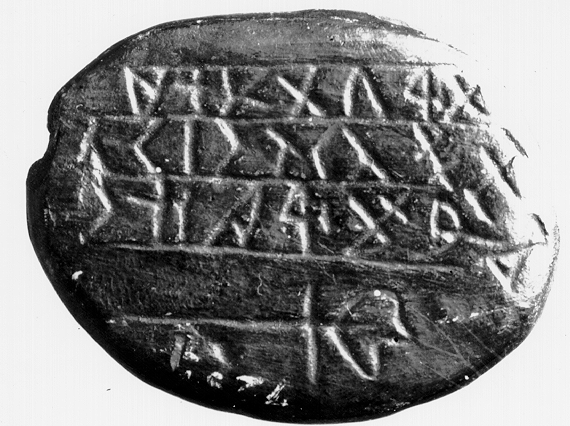
Cast of the Grave Creek Stone in the collection of the Smithsonian.
The Grave Creek Stone was submitted to a number of linguistic experts, many of whom believed it to be authentic ancient writing. The Bureau of American Ethnology reported the results in 1893, and these results were hilarious. These supposed characters had an astonishing array of explanations! One scholar finds among them four characters which he claims are ancient Greek; another claims that four are Etruscan; five have been said to be Runic; six, ancient Gaelic; seven, old Erse; ten, Phenician; fourteen, old British; and sixteen, Celtiberic. M. Levy Bing reported at the Congress of Americanists at Nancy, in 1875, that he found in the inscription twenty-three Canaanite letters, and translated it: “What thou sayest, thou dost impose it, thou shinest in thy impetuous clan and rapid chamois.” (!) M. Maurice Schwab in 1857 rendered it: “The Chief of Emigration who reached these places (or this island) has fixed these statutes forever.” M. Oppert, however, gave additional variety by the translation, so that all tastes can be suited: “The grave of one who was assassinated here. May God to avenge him strike his murderer, cutting off the hand of his existence.” The Bureau concluded that the stone was most likely a hoax, one of literally hundreds of hoax stones manufactured in Ohio in those years (many of the hoaxers confessed), and the Bureau believed the letters represented nothing more than a hoaxer copying random alphabetic symbols from reference books, with “no intelligent meaning to convey by them.” That’s where the story ended until 1930, when Andrew Price reported to Science News Letter that he had made a discovery. By viewing the stone at an angle, the obscure characters and weird lines that had stumped the experts came together to reveal a secret message: B I L-S T-U M P S S T O N E O C T-1 4-1 8 3 8 Not only did this date agree with the discovery date of the stone, it also had another connection. The year before, Charles Dickens had published the wildly popular Pickwick Papers in which Pickwick discovers a stone with a suspiciously similar inscription: X B I L S T U M P S H I S. M. A R K (X Bil Stumps His Mark.) Interest in the stone was revived in the 1970s, when Barry Fell declared the writing Punic in America B.C. This, in turn, led to revived discussion of Price’s explanation.
However, it seems that Price was hoaxing a hoax, and while the story of the “Bill Stumps Stone,” as it is sometimes called, continues to be repeated in books and online down to the present day, there is a better explanation. Anthropologist David Oestreicher discovered that all of the symbols on the stone can be found in the 1752 book Ensayo sobre los alphabetos de las letras desconocidas (“An Essay on the Alphabets and Unknown Letters”) by Luis José Velázquez de Velasco, marqués de Valdeflores. Several of the symbols, according to Oestreicher, were reproduced in the same sequence as they appear in the book, and the symbols on the stone copied errors that Velázquez made in drawing his letters. He presented his findings at the 2008 meeting of the West Virginia Archaeological Society. Unfortunately, I haven’t been able to find anything from Oestreicher on specifically which pages in Velázquez’s book the copied characters can be found. The book is more than 150 pages long with several pages of tables, and I did not immediately see identical sequences of characters in it, though I could easily identify several of the Grave Creek characters as matching symbols from the Etruscan, Phoenician, and other alphabets as drawn in the book. If nothing else, this should indicate that the Grave Creek inscription is a nonsense jumble of symbols from many cultures. This returns to a theme I’ve mentioned several times: How is it that the people who allegedly traveled thousands of miles in deep antiquity somehow were so bad at their own cultures that they weren’t able to write anything in recognizable characters? Even allowing for the idea that explorers were not scholars, surely they should have been able to write using characters from their own alphabets? What kind of illiterate person draws from a half dozen alphabets whose use was separated across time?
4 Comments
terry the censor
2/7/2013 04:44:18 pm
> surely they should have been able to write using characters from their own alphabets? 3/3/2013 12:04:33 pm
I agree that the stone is probably not genuine but how can you say with such authority that the people involved concocted a scheme? Are you not starting from the assumption it is a fake and then asserting that -- therefore it was a scheme? I see the same thing with the Bat Creek Tablet. Bob Mainfort, whom I have interviewed, written about, and spoken with many times, started from the assumption that it was fake and so he decided that the "finder" was a drunk who faked it to impress his superiors and get funding. Why not just say we think it is fake because we see no support for it? Why all the leaps to assuming how these people did it and their motives? It is precisely what you accuse the believers in Ancient Aliens and alternative archaeology proponents of doing--that is they start from their bias and then build their story around it. 3/3/2013 12:36:22 pm
That he concocted a scheme is an inference drawn from a study of his business dealings, his correspondence, and other relevant records. This doesn't derive from "working backward." It is not I who drew that conclusion but a series of experts who have examined his life and works over the past 150 years.
Franc
3/25/2016 06:28:19 pm
I know the story, the site, as well as the wiki page. Yours is a rather entertaining work of fiction. Your comment will be posted after it is approved.
Leave a Reply. |


AuthorI am an author and researcher focusing on pop culture, science, and history. Bylines: New Republic, Esquire, Slate, etc. There's more about me in the About Jason tab. 
Newsletters
Enter your email below to subscribe to my newsletter for updates on my latest projects, blog posts, and activities, and subscribe to Culture & Curiosities, my Substack newsletter.
Categories
All
Terms & ConditionsPlease read all applicable terms and conditions before posting a comment on this blog. Posting a comment constitutes your agreement to abide by the terms and conditions linked herein.
Archives
April 2024
|

- Home
- Blog
- Books
-
Articles
-
Newsletter
>
- Television Reviews >
- Book Reviews
- Galleries >
- Videos
-
Collection: Ancient Alien Fraud
>
- Chariots of the Gods at 50
- Secret History of Ancient Astronauts
- Of Atlantis and Aliens
- Aliens and Ancient Texts
- Profiles in Ancient Astronautics >
- Blunders in the Sky
- The Case of the False Quotes
- Alternative Authors' Quote Fraud
- David Childress & the Aliens
- Faking Ancient Art in Uzbekistan
- Intimations of Persecution
- Zecharia Sitchin's World
- Jesus' Alien Ancestors?
- Extraterrestrial Evolution?
- Collection: Skeptic Magazine >
- Collection: Ancient History >
- Collection: The Lovecraft Legacy >
- Collection: UFOs >
- Scholomance: The Devil's School
- Prehistory of Chupacabra
- The Templars, the Holy Grail, & Henry Sinclair
- Magicians of the Gods Review
- The Curse of the Pharaohs
- The Antediluvian Pyramid Myth
- Whitewashing American Prehistory
- James Dean's Cursed Porsche
-
Newsletter
>
-
The Library
-
Ancient Mysteries
>
-
Ancient Texts
>
- Mesopotamian Texts >
-
Egyptian Texts
>
- The Shipwrecked Sailor
- Dream Stela of Thutmose IV
- The Papyrus of Ani
- Classical Accounts of the Pyramids
- Inventory Stela
- Manetho
- Eratosthenes' King List
- The Story of Setna
- Leon of Pella
- Diodorus on Egyptian History
- On Isis and Osiris
- Famine Stela
- Old Egyptian Chronicle
- The Book of Sothis
- Horapollo
- Al-Maqrizi's King List
- Teshub and the Dragon
- Hermetica >
- Hesiod's Theogony
- Periplus of Hanno
- Ctesias' Indica
- Sanchuniathon
- Sima Qian
- Syncellus's Enoch Fragments
- The Book of Enoch
- Slavonic Enoch
- Sepher Yetzirah
- Tacitus' Germania
- De Dea Syria
- Aelian's Various Histories
- Julius Africanus' Chronography
- Eusebius' Chronicle
- Chinese Accounts of Rome
- Ancient Chinese Automaton
- The Orphic Argonautica
- Fragments of Panodorus
- Annianus on the Watchers
- The Watchers and Antediluvian Wisdom
-
Medieval Texts
>
- Medieval Legends of Ancient Egypt >
- The Hunt for Noah's Ark
- Isidore of Seville
- Book of Liang: Fusang
- Agobard on Magonia
- Book of Thousands
- Voyage of Saint Brendan
- Power of Art and of Nature
- Travels of Sir John Mandeville
- Yazidi Revelation and Black Book
- Al-Biruni on the Great Flood
- Voyage of the Zeno Brothers
- The Kensington Runestone (Hoax)
- Islamic Discovery of America
- The Aztec Creation Myth
-
Lost Civilizations
>
-
Atlantis
>
- Plato's Atlantis Dialogues >
- Fragments on Atlantis
- Panchaea: The Other Atlantis
- Eumalos on Atlantis (Hoax)
- Gómara on Atlantis
- Sardinia and Atlantis
- Santorini and Atlantis
- The Mound Builders and Atlantis
- Donnelly's Atlantis
- Atlantis in Morocco
- Atlantis and the Sea Peoples
- W. Scott-Elliot >
- The Lost Atlantis
- Atlantis in Africa
- How I Found Atlantis (Hoax)
- Termier on Atlantis
- The Critias and Minoan Crete
- Rebuttal to Termier
- Further Responses to Termier
- Flinders Petrie on Atlantis
- Amazing New Light (Hoax)
- Lost Cities >
- OOPARTs
- Oronteus Finaeus Antarctica Map
- Caucasians in Panama
- Jefferson's Excavation
- Fictitious Discoveries in America
- Against Diffusionism
- Tunnels Under Peru
- The Parahyba Inscription (Hoax)
- Mound Builders
- Gunung Padang
- Tales of Enchanted Islands
- The 1907 Ancient World Map Hoax
- The 1909 Grand Canyon Hoax
- The Interglacial Period
- Solving Oak Island
-
Atlantis
>
- Religious Conspiracies >
-
Giants in the Earth
>
-
Fossil Origins of Myths
>
- Fossil Teeth and Bones of Elephants
- Fossil Elephants
- Fossil Bones of Teutobochus
- Fossil Mammoths and Giants
- Giants' Bones Dug Out of the Earth
- Fossils and the Supernatural
- Fossils, Myth, and Pseudo-History
- Man During the Stone Age
- Fossil Bones and Giants
- Mastodon, Mammoth, and Man
- American Elephant Myths
- The Mammoth and the Flood
- Fossils and Myth
- Fossil Origin of the Cyclops
- History of Paleontology
- Fragments on Giants
- Manichaean Book of Giants
- Geoffrey on British Giants
- Alfonso X's Hermetic History of Giants
- Boccaccio and the Fossil 'Giant'
- Book of Howth
- Purchas His Pilgrimage
- Edmond Temple's 1827 Giant Investigation
- The Giants of Sardinia
- Giants and the Sons of God
- The Magnetism of Evil
- Tertiary Giants
- Smithsonian Giant Reports
- Early American Giants
- The Giant of Coahuila
- Jewish Encyclopedia on Giants
- Index of Giants
- Newspaper Accounts of Giants
- Lanier's A Book of Giants
-
Fossil Origins of Myths
>
-
Science and History
>
- Halley on Noah's Comet
- The Newport Tower
- Iron: The Stone from Heaven
- Ararat and the Ark
- Pyramid Facts and Fancies
- Argonauts before Homer
- The Deluge
- Crown Prince Rudolf on the Pyramids
- Old Mythology in New Apparel
- Blavatsky on Dinosaurs
- Teddy Roosevelt on Bigfoot
- Devil Worship in France
- Maspero's Review of Akhbar al-zaman
- The Holy Grail as Lucifer's Crown Jewel
- The Mutinous Sea
- The Rock Wall of Rockwall
- Fabulous Zoology
- The Origins of Talos
- Mexican Mythology
- Chinese Pyramids
- Maqrizi's Names of the Pharaohs
-
Extreme History
>
- Roman Empire Hoax
- American Antiquities
- American Cataclysms
- England, the Remnant of Judah
- Historical Chronology of the Mexicans
- Maspero on the Predynastic Sphinx
- Vestiges of the Mayas
- Ragnarok: The Age of Fire and Gravel
- Origins of the Egyptian People
- The Secret Doctrine >
- Phoenicians in America
- The Electric Ark
- Traces of European Influence
- Prince Henry Sinclair
- Pyramid Prophecies
- Templars of Ancient Mexico
- Chronology and the "Riddle of the Sphinx"
- The Faith of Ancient Egypt
- Remarkable Discoveries Within the Sphinx (Hoax)
- Spirit of the Hour in Archaeology
- Book of the Damned
- Great Pyramid As Noah's Ark
- Richard Shaver's Proofs
-
Ancient Texts
>
-
Alien Encounters
>
-
US Government Ancient Astronaut Files
>
- Fortean Society and Columbus
- Inquiry into Shaver and Palmer
- The Skyfort Document
- Whirling Wheels
- Denver Ancient Astronaut Lecture
- Soviet Search for Lemuria
- Visitors from Outer Space
- Unidentified Flying Objects (Abstract)
- "Flying Saucers"? They're a Myth
- UFO Hypothesis Survival Questions
- Air Force Academy UFO Textbook
- The Condon Report on Ancient Astronauts
- Atlantis Discovery Telegrams
- Ancient Astronaut Society Telegram
- Noah's Ark Cables
- The Von Daniken Letter
- CIA Psychic Probe of Ancient Mars
- Scott Wolter Lawsuit
- UFOs in Ancient China
- CIA Report on Noah's Ark
- CIA Noah's Ark Memos
- Congressional Ancient Aliens Testimony
- Ancient Astronaut and Nibiru Email
- Congressional Ancient Mars Hearing
- House UFO Hearing
- Ancient Extraterrestrials >
- A Message from Mars
- Saucer Mystery Solved?
- Orville Wright on UFOs
- Interdimensional Flying Saucers
- Flying Saucers Are Real
- Report on UFOs
-
US Government Ancient Astronaut Files
>
-
The Supernatural
>
- The Devils of Loudun
- Sublime and Beautiful
- Voltaire on Vampires
- Demonology and Witchcraft
- Thaumaturgia
- Bulgarian Vampires
- Religion and Evolution
- Transylvanian Superstitions
- Defining a Zombie
- Dread of the Supernatural
- Vampires
- Werewolves and Vampires and Ghouls
- Science and Fairy Stories
- The Cursed Car
-
Classic Fiction
>
- Lucian's True History
- Some Words with a Mummy
- The Coming Race
- King Solomon's Mines
- An Inhabitant of Carcosa
- The Xipéhuz
- Lot No. 249
- The Novel of the Black Seal
- The Island of Doctor Moreau
- Pharaoh's Curse
- Edison's Conquest of Mars
- The Lost Continent
- Count Magnus
- The Mysterious Stranger
- The Wendigo
- Sredni Vashtar
- The Lost World
- The Red One
- H. P. Lovecraft >
- The Skeptical Poltergeist
- The Corpse on the Grating
- The Second Satellite
- Queen of the Black Coast
- A Martian Odyssey
- Classic Genre Movies
-
Miscellaneous Documents
>
- The Balloon-Hoax
- A Problem in Greek Ethics
- The Migration of Symbols
- The Gospel of Intensity
- De Profundis
- The Life and Death of Crown Prince Rudolf
- The Bathtub Hoax
- Crown Prince Rudolf's Letters
- Position of Viking Women
- Employment of Homosexuals
- James Dean's Scrapbook
- James Dean's Love Letters
- The Amazing James Dean Hoax!
- James Dean, The Human Ashtray
- Free Classic Pseudohistory eBooks
-
Ancient Mysteries
>
- About Jason
- Search
 RSS Feed

© 2010-2024 Jason Colavito. All rights reserved.