|
It’s been exactly ten years since Dan Brown sparked a new interest in the mythology of the Holy Grail with his Da Vinci Code. In it, Brown weaved a badly-written conspiracy thrilled in which a globetrotting hero in a made-up field of study (symbology) put together a series of ambiguous clues to reveal that the Holy Grail was actually an esoteric symbol for the bloodline launched when Jesus Christ married Mary Magdalene and had a secret child with her. On America Unearthed S01E11 “Tracking the Templars,” another globetrotting protagonist, show host Scott Wolter, who also operates in a self-created field of study (archeopetrography), follows the same clues and also goes in quest of the fruits of Mary Magdalene’s womb. Before we begin talking about the show, there are few things that it’s important to know about the Holy Grail and the hoax mythology concocted around it in order to understand where Scott Wolter went so terribly wrong. This is very long, so if you know this material, you can skip ahead to the heading indicating my review of the episode proper. The first is that the Holy Grail originally had nothing whatsoever to do with Christ. In fact, it does not date back far enough to do so. The first appearance of the Holy Grail is in the Perceval of Chrétien de Troyes, written around 1190 CE. There, a “golden serving dish” descends before Perceval in the castle of the Fisher King, but Chrétien does not call it holy or call special attention to it, as opposed to an equally sacred lance. A century later, Wolfram von Eschenbach made it into a stone in his Parzival. Robert de Boron told a different tale in the twelfth century, that Joseph of Arimathea had received the Holy Chalice that caught Christ’s blood and spirited it away to Great Britain and founded a line of knights to guard this sacred vessel. The stories of the Holy Chalice and the magical Grail merged, and suddenly a myth arose that a line of sacred knights guarded the magical cup of Christ called the Holy Grail. Medieval people understood Robert’s poem to be courtly fiction, not a report of actual fact. The name Holy Grail derives from Old French for Holy Cup, san graal or sangreal, derived via Latin from the Greek krater, or drinking-vessel. Medieval writers, discussing how the Holy Cup held Christ’s royal blood (since he was of the royal line of David), played on a pun, writing san greal as sang real, or Holy Blood. Thus, mystically, the Royal Blood and Holy Grail were one and the same, the cup standing for the divine blood it contained. This is very much in keeping with medieval religious symbolism, and most scholars accept that the magical powers of the holy cup derive from a mixture of Christian symbolism, particularly that of the newly-instituted ritual of communion, and Celtic (more broadly Indo-European) myths of the immortality bestowed by magic cauldrons. Many appear in Celtic lore, though I am more familiar with the cauldron used by the Greek Medea to restore Jason (or Aeson) to youth, another version of the same Indo-European magic cup myth. (The story also is the origin of the witch’s cauldron of fairy tales.) The trouble is that modern speculators are not content with the idea that medieval people had mystical or religious symbolism that wasn’t tied to facts on the ground. Beginning in the Romantic Era, writers began to see a parallel between the storied Knights Templar and the Grail Knights, part of the increasing respect afforded the pageantry and drama of the Middle Ages in that era. The Knights Templar, officially the Poor Fellow-Soldiers of Christ and of the Temple of Solomon, existed from about 1119 to 1312. They were a practical military order based at the Temple Mount in Jerusalem during the Crusades. Involved in banking, they became very wealthy, leading a greedy pope and French king to accuse them of idol worship and heresy in 1307 in order to suppress the order and gain their money. They were never famed in their own time for any particular religious piety beyond that of any other crusading group. Since then, writers have tried to imagine any less mundane reason than money for their demise. Often, this effort descended into wild claims about alternative religions, derived from the original accusation of the heretical worship of a demon-idol named Baphomet. Thomas Wharton, the British poet laureate, wrote in the History of English Poetry (1774-81) that the Grail myth was influenced by “esoteric doctrines” brought from the “heathen” East, though he accused no specific group; but this was simply part of the standard anti-Catholicism of the era, which saw the Catholic Church as too influenced by ritual and ceremony. Wharton specifically accused the “Romish Church” of perpetuating the “heathen temple.” The first connection between the Templars and the Freemasons came from the German critic Lessing in the 1770s. He was a Freemason and read backward into the Grail Romances the Masonic tradition, on the authority of the Scottish Freemasons, who had adopted the Templars as honorary predecessors as part of their fabricated mythic past. In 1737, Freemason Andrew Michael Ramsey gave a speech in Paris claimed that the Knights of St. John gave rise to the Masons, in symbolic association, derived from his belief in the One True Religion of which all pagan cults were decadent aspects: “Our Order [was] founded in remote antiquity, and renewed in the Holy Land by our ancestors in order to recall the memory of the most sublime truths among the pleasures of society.” This became confused with the Templars after the speech was adopted into Masonic lore, probably because after 1314 the pope had allowed the ex-Templars to join the Knights of St. John, also called the Hospitallers. (No, the Templars did not move to Scotland to form Masonry.) By the 1820s, anti-Masonic activists were using the confused Templar connection to paint the Masons as a revival of the idol worshipping pagan Templars. The Austrian Joseph von Hammer-Purgstall specifically claimed that the Masons revived the Templar heresy, the worship of the idol Baphomet (probably Muhammad), and that Templar images of Baphomet’s head were cast in the form of a Greek krater, the very origin of the blasphemous Holy Grail. Claude Charles Fauriel, in 1832, was perhaps the first to confuse the Knights Templar (named for the Temple Mount in Jerusalem) with the Grail Knights when he described the Grail as preserved in a temple in the Pyrenees, from which the Knights took their name: “Titurel [the Grail King] instituted for his defense and his guard a militia, a special Order of Chivalry, which is called the Knighthood of the Temple, whose members are called Templiens or Templars. … I have already hinted, and I can say here explicitly, in this religious Grail guard is an obvious allusion to the Order of the Templars” (“Romans Provençeaux,” Reveu des Deux Mondes, 8, 185; my trans.). He had no evidence other than a shared chivalry between the groups and the fact that one Grail romance described the knights as templien, or “temple-guardians,” not Templars as in the Knights of the Temple. But Fauriel was proposing a literary theory—that the Grail Romances symbolized the Templars—not a historical theory that they encoded an actual Holy Grail. Later scholars, such as Alfred Trübner Nutt, agreed that the Grail stories were intended as political documents, designed to provide a mythic history for the Angevin Kings of France, thus paralleling the Knights Templar; mainstream scholars, however, never thought the Templars had an actual magic cup, or anything else that actually belonged to Christ. The development of this idea is chiefly the work of the mid-Victorian French scholar E. Aroux, who believed that the Holy Grail must have been the secret doctrine of the Templars, an alternative Gospel, for which they were condemned for heresy. A German, Dr. Simrock—a mythologist prone to seeing ancient connections in every similarity of symbol—took up the story, reporting the work of his predecessor: Baron von Hammer-Purgestall, who gives the most detail on the connection of the Templars with the Holy Grail, by tracing its history from the identity of hieroglyphs which he found on the old churches and buildings in the Danubian Provinces. He unfortunately is for ever trying to find the most unsavoury interpretation for all the ancient symbolism; with his views we are not concerned, but to the work of research which he carried on with such ability we are profoundly indebted. By 1900, the idea that the Holy Grail story had symbolically represented the Knights Templar had become a given, and one that became associated with anti-Masonism and Theosophy. The Theosophical writer Isabel Cooper-Oakley produced a book called Traces of a Hidden Tradition in Masonry and Medieval Mysticism that forever linked the Grail, the Templars, and the Freemasons, in service of the alien-worshipping Theosophists, who believed the Templars were privy to extraterrestrial secrets imparted by the Ascended Masters from other planets. She, in turn, was again drawing on Simrock, who divined (without proof) a secret order that had preserved Templar secrets from the fourteenth to eighteenth centuries. And that’s about where things stood for most of the twentieth century. There was no evidence of any Grail-Templar-Freemason connection outside some disconnected symbolism, some anti-Catholic assumptions, and a confusion between the Templars—suppressed because the pope and the French king wanted their money—and the Cathars, who provided the final pillar of this theory, the worship of the “sacred feminine.” That weird concept derives from the works of the Freemason and Rosicrucian Hargrave Jennings, who believed all religion was penis-worship, and Otto Augustus Wall, whose influential book Sex and Sex Worship claimed that all religion was the worship of sex organs, particularly the penis. The triangle, circle, or lozenge, due to their resemblance to the female pubic region, was in his view symbolic of the woman and thus the feminine counterpart to the true object of universal veneration, his—er, the—penis. It would, however, be modern writers who introduced Wall’s sex-worship theory into the Grail mythos. Graham Hancock, in The Sign and the Seal (1992), thought that the varied descriptions of the Grail as a vessel and as a stone suggested that it was a symbol of the Ark of Covenant, a vessel containing the stones inscribed with the Ten Commandments. In this reading, the Grail Knights were of course the Knights Templar, who had conducted secret digs on Jerusalem’s Temple Mount in search of the Ark. Never mind that the Knights Templar were not British, as Robert de Boron insisted that the Grail Knight must be. But Hancock was merely piggybacking on the success of an earlier book, The Holy Blood and the Holy Grail (1982) by Michael Baigent, Richard Leigh, and Henry Lincoln. It is impossible to summarize this influential and ridiculous book in a few words, but its central thesis is that in 1099 a secret society called the Priory of Sion formed to guard the “Holy Grail,” which was the bloodline of Mary and Jesus, currently represented by the dethroned Merovingian royal house of France. The Priory created the Knights Templar and continue working today to reestablish Merovingian rule over all Europe, following the anti-Semitic Protocols of the Elders of Zion, which the authors believe was not a hoax but the Priory’s master-plan. It was this book that tied together Theosophy’s Masonic conspiracy, Wall’s “sacred feminine” sex worship, and Fauriel’s literary view of the Templar-Grail connection—all theories for which there was little direct evidence. Compounding speculation upon speculation did not strengthen the results. The Priory of Sion was a hoax created in 1956 by a delusional French draftsman named Pierre Plantard who fabricated its entire history to support his false claim to be the last descendant of Christ and the rightful universal monarch of the world prophesied by Nostradamus. Despite the exposure of the hoax, Laurence Gardner, the late genealogist to the pretender to the Stuart royal line in Britain, wrote a book called Bloodline of the Holy Grail recapitulating all of this and ascribing the Christian bloodline to his boss, the Stuart pretender. He then wrote a follow-up called Genesis of the Grail Kings where he explained that the secret society guarding the grail originated with Zechariah Sitchin’s aliens from Nibiru, and their alien-hybrid human descendants maintained immortality by consuming refined white gold and human menstrual blood. In 2000, Andrew Sinclair and Timothy Wallace-Murphy connected the imaginary bloodline of Christ to Rosslyn Chapel, the St. Clair family chapel in Scotland. They believed the chapel had been built as a model of Solomon’s Temple in Jerusalem (even though the ground plans do not match in any way) and that the chapel contained Templar and Masonic symbolism, a claim denied by both experts in the Templars and the Masons themselves. (Some Masonic symbols were added later, and others are actual mason’s marks used by stonemasons in building the chapel.) In this reading, the St. Clair family was in fact the Scottish branch of Jesus bloodline, guarded by the Templars, who after their disbanding became Freemasons. (They did not, of course, as mentioned above. Freemasonry did not erupt for more than 400 years after the end of the Templars, too long for any real connection.) Then, to tie it up with a bow, the faker Pierre Plantard once went by the fake name Saint-Clair. Dan Brown then canonized the entire story by using elements of all these modern versions in The Da Vinci Code (2003). Scott Wolter simply accepted all of these as more or less true in his book The Hooked X, where he sees a mason’s mark at Rosslyn Chapel featuring an X with a line through it as identical to the “hooked X,” an otherwise unattested rune found on the Kensington Rune Stone. They are not morphologically the same. Thus was the modern idea of a Grail-Templar-Freemason-Bloodline myth born from the accidental asides of a range of earlier ideas, including literary theory, anti-Catholicism, anti-Masonry, Theosophy, sex worship, New Age mysticism, and fraud. Quite the pedigree. The EpisodeWe start the episode in New England in 1984 with a giant boulder called the Narragansett Rune Stone with “fourteenth century” carvings that the show asserts contained a “Hooked X,” a symbol used by “only one group at that time,” the Knights Templar. The boulder was stolen, so there is nothing to look at it. Instead, we get mood shots of an airport, where Scott Wolter takes a phone call from Paul Roberti in a quite obviously staged discussion of the stolen stone. “I’ve got to handle this right now!” Wolter shouts, as though he had authority to do anything. The stone was actually stolen sometime in the early summer of 2012, and Wolter commented on the affair in August of 2012, but the airport scene, filmed in the autumn—as shown by the colors on the trees and Wolter's heavy clothes—pretends it just happened and he just learned of the theft. “This stone is one of the very few artifacts that proves the Templars came to America,” Wolter asserts. It does not. There is no evidence that the Templars ever used a Hooked X, and Wolter over the course of the hour provides none. In 2009, the History Channel—and Wolter—did a documentary called The Hooked X which already covered this material. There is an inscription on the Narragansett rock, which is almost certainly a modern hoax for a reason I will mention momentarily. The entirety of Wolter's claim for the “Hooked X” derives from its appearance on the Kensington Rune Stone, before which it is unattested in any runic literature. It exists in only six places on earth—five in America and, as mentioned above, once in a very different form at Rosslyn Chapel in Scotland—not enough to draw any conclusions. Other American rocks featuring this same symbol only appeared after the discovery of the Rune Stone, suggesting that the inscriptions were copied from the Rune Stone by recent hoaxers. No museum specimen or ancient text from prior to the 1890s features this “mysterious” symbol despite Wolter's attempt to tie it to European symbols of differing shapes. The “hooked X” at Rosslyn chapel differs in two key respects from the one on the Rune Stone: Its crossbar (the hook) appears on both sides of the upper right leg of the X, not on just one; and the lower two legs (staves) are connected with a small “V,” forming a lozenge-shape not found on the Rune Stone “hooked X.” It is quite obviously a mason’s mark, very similar to other mason’s marks of various shapes found on every medieval stone building. It isn’t special, or sacred. In this episode, Wolter suggests that the Narragansett stone was stolen due to its occult connection to the Templars, but that’s not what he told Chris Church of the Independent this summer: “Wolter suggested the boulder was removed by a neighbor who was tired of people coming to the neighborhood to search for the stone.” It’s interesting that his ideas changed immediately upon filming the episode. Wolter and Roberti commiserate about the loss of the stone, and Wolter repeats information provided just minutes ago about his study of the Kensington Rune Stone. Wolter describes the Rune Stone as reporting a “land acquisition journey” in 1362, though he does not explain why the Templars, an order disbanded in 1312 and largely composed of a core of French knights, would be writing in Norse runes. Nor can he explain how he sees a connection between the Knights Templar in 1312 and Rosslyn Chapel almost 150 years later—without leaving a single “hooked X” of any kind in any other record before or between the two dates. Wolter next drafts Christopher Columbus into his conspiracy, arguing that Columbus used the “Templar Cross” (a standard red cross used by many European orders), signed his name with a “Hooked X,” and married into the Sinclair (St. Clair) family. Columbus’s monogram signature does use a small, rounded “hook” atop the stroke forming the lower-left to upper-right line of the X (standing for the Ch in Greek), but it also has one in the lower left as well, and on the lower left leg of the “M” and the top right leg of the “Y,” which he thinks has no special significance. It is obviously a handwriting tic, probably due to the constraints of writing with a quill and needing to have the ink flow smoothly. Most writers of the period made similar marks. 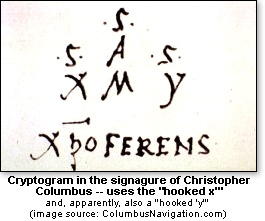 Columbus' monogram, as seen online. Hooks appear on several letters. In reviewing Templar history, Wolter claims that the Templars fled Europe to practice their religion and to “protect” a secret—the Holy Grail—which, of course, is the fictional bloodline of Christ that I discussed above. Confusing ancestors and descendants, Wolter seems to think that Jesus’s kids gave rise to the Templar hierarchy (a departure from the Holy Blood claims about the bloodline being the Merovingian kings), and dear Lord, I apparently came to close to the “truth” when I described the fictional unicorn conspiracy earlier in the week.
Wolter then discusses the “symbols” of males (^) and females (V) derived from the Victorian sex-worship theorists, and he chooses to revise the Holy Trinity to represent the family of Christ: Jesus, Mary Magdalene, and their kid…Boots? Esmeralda? Scott? Thus, the small bar on the “hooked X” is the baby in Mary’s V-shaped womb above Jesus’s inverted v-shaped penis. That would be news for the Vikings most alternative believers think carved the Kensington Rune Stone. I’m also unsure how the French Knights Templar, fleeing France, decided to start speaking Old Swedish. The “proof” of this theory is a sculpture made in the 1500s in which Mary Magdalene appears in bulging, flowing robes. This Wolter and Roberti interpret as evidence of Mary’s pregnancy. I am not quite sure I understand, though, how the statue connects to the Templars that Wolter had just asserted fled from Europe to America two centuries earlier, on Saturday, October 14, 1307. (Isn’t it nice we know the exact day?) Who was left to carry on the Templar heresy in Europe and become Freemasons if they all went to America? Wolter’s next piece of “evidence” is a “dot code” on the Kensington Rune Stone that supposedly indicates which special letters to read to find the word “Grail,” gral in Swedish he says, though that form of the word is actually German, from the French graal or greal. In fact, the word gral is not found at all in any genuine Old Swedish document. There has been a great deal of controversy over whether these dots were intentional, and I have no particular interest in litigating this dispute. I am not sure how Wolter can translate the hooked X as the letter A if there are no other examples of a hooked X to know what letter it is meant to represent. Wolter uses 3-D microscopic analysis to determine that the marks are genuine, but his former colleague Richard Nielsen, who accused Wolter of dishonesty in documents available on his website, has also conducted microscopic analysis and found that, when accepting Wolter’s standard for what constitutes a punch mark (a “dot”) two other runes feature the same dot in between the G and the R, forming GTER, not GR, and ruining the Grail Code. At the very least, the evidence is much more ambiguous than Wolter claims. (Full disclosure: Nielsen sent me links to material on his websites.) As we cross the halfway point, Wolter suggests that the ossuary (burial box) of Jesus was (a) real and (b) concealing a hooked X as a sacred symbol of Wolter’s imaginary trinity. This “Lost Tomb of Jesus” was the subject of a 2007 documentary of that name, promoted by Simcha Jacobovici, who claimed that because two ossuaries marked Jesus and Mary contained remains DNA proved were unrelated they were therefore married and the Jesus and Mary Magdalene of the Da Vinci Code conspiracy. The forensic archaeologist Jacobovici claimed confirmed the marriage of the two denied he did any such thing, noting DNA cannot test for marriage. Additionally, the archaeologist who first excavated the tomb in 1980 confirmed that the “Jesus ossuary” was not found in the tomb when it was opened but had been added into the tomb at a later date, backed up by site reports that failed to record any evidence of the Jesus ossuary in 1980. By most scientific accounts, the Jesus ossuary was a fake, with a new inscription added to a genuinely old ossuary. But even if it were there, Jesus and Mary were two of the most popular names of the era, making the chances of these boxes belonging to the Biblical figures vanishingly small. Jerry Lutgen, whose only credential seems to be that he runs a website about the Talipot Tomb, claims that the odds are 175:1 in favor of this being Jesus’ tomb, a ridiculous number derived from several assumptions about the statistical prevalence of certain Biblical names and the uncritical acceptance that the Jesus bone box is legitimate, something most archaeologists do not accept because of significant problems with it. Wolter is happy to accept all of this as true, and he points to one of the marks on the Jesus ossuary, an X with a curve (not a hook) at the end of the lower right line, as an “early” hooked X. I don’t see it myself; it looks like a random curve, certainly not an intentional crossbar. Wolter seems to have started from a conclusion and is working backward to pick out evidence. Then we see something so profoundly stupid that it made me laugh: Wolter asserts that a Templar coin from c. 1200 contains an image of the front door to the Talpiot Tomb because the headgear worn by the man on the coin’s face has a triangle with a circle in the center, which he thinks looks like the pediment of the Talpiot tomb with its circular medallion set beneath. He also asserts that the face on the coin is Jesus himself. At no point does it occur to him to check with a numismatist to find out what the coin actually depicts, or even to read the writing on the coin to see if it has any relevance; that would all just be part of the conspiracy anyway. Various combinations of chevrons and circles appear on several Templar coins of the era, and on this coin by chance the chevron appears above the circle. More commonly, the chevron (or triangle) is placed between two circles. Afterward, Wolter asserts that his proof that the Templars became Freemasons was the hooked X, which is circular logic since he earlier asserted that the Templar-Freemason connection was what led him to his understanding of the hooked X. Oh, well. It doesn’t matter because the Rosslyn Chapel hooked X isn’t one, and the Knights Templar didn’t speak Old Swedish. Wolter also claims a connection to the Copiale Cipher, which is not a Masonic document, despite his assertions. It was a pseudo-Masonic document created in the 1740s by a group of mostly Catholic eye doctors (oculists—it’s not a code word!) after the pope banned Catholics from becoming Masons. It wasn’t a conspiracy. The “hooked X” again differs from the Rune Stone version in having a crossbar through the right upper leg (stave), and a circle attached to the left upper stave. Joe Rose, who spoke out about how America Unearthed had butchered his ideas, is very excited about the symbol and its secrets. “It’s like an eighteenth-century James Bond movie!” Wolter enthuses. [Update: My discussion, based on media reports, is contradicted by Scottish Rite masons, who state that the media reports are wrong and the cipher actually reflects German masonic rituals. The evidence, however, is not clear enough to distinguish between Masonic and pseudo-Masonic rituals; at any rate, it still does not have a hooked X like the one on the Rune Stone.] And just because we’re not far enough down the rabbit hole, we have to look at Nicolas Poussin’s Shepherds in Arcadia, the infamous painting supposedly offering a connection to the Priory of Sion and the Holy Grail. (It illustrates a moment from Pliny’s Natural History 35.5.1 when the first artist see his shadow and thus discover the art of painting by tracing it.) As I mentioned above, the Priory of Sion is a modern hoax. We see a stone carving of the painting in Britain known as the Shugborough relief, but nothing much comes of this other than some speculation about hidden codes. We hear that some mysterious letters carved on the stone version can be read as a code indicating 2,810 miles (English, presumably) between the relief and Oak Island, the site skeptic Joe Nickell identified as a Freemasons’ initiation center. The Shugborough relief dates only from the mid-eighteenth century and is therefore far too late to have anything to do with the bloodline of Christ that would have left Europe 500 years earlier; and even if the relief was a Freemasonic code, it falls within the historic period of Freemason activities and therefore does not imply anything about the missing centuries between 1312 and the eighteenth century. Wolter leaves us with a cliffhanger: the Newport Tower! Rafn would roll over in his grave if he knew Wolter wanted to throw overboard his Norse builders in favor of bloodline-unicorn-Templar-Masons. But now we know: America Unearthed thinks of itself as a miniseries building toward a Da Vinci Code climax, and Wolter sees himself as making a case for a deeply-held, near-religious belief that he will find the Holy Grail. It really gives new meaning to the term “cult archaeology.”
102 Comments
Kathryn
3/2/2013 04:18:50 am
This show made me dizzy from the sudden leaps of assumptions - I am amazed how he can take one little piece of "evidence" and make a huge case out of it. e.g. the coin image that he says is the tomb and the face of Jesus.
intelligentheating
3/2/2013 05:13:54 am
The Shugborough relief was featured in a TV show that came out back in 2005 I believe, where they took some code breakers from Bletchley house, who had worked on cracking German war time encryption and let them loose on it.
Kathryn
3/2/2013 05:25:47 am
Thanks for that link - when Wolter suggested that if you reverse the relief, it meant that you should cross the ocean, I about laughed myself sick. But what if you took a mirror to the relief? I'm sure that's been done in the name of code breaking :)
David
10/25/2014 03:47:01 pm
This show, Wolter, Dan Brown, Holy Blood/Holy Grail authors, let's see just about everyone of these clown acts, are examples of neophytes that are very, very, much babies to the understanding of the graal. For one, even the word "graal", however you translate it (and it is a large serving platter in old French) is a METAPHOR. Why is the graal cloaked in metaphor? Because those that know, know that to speak directly about it, is in fact, oddly dangerous. There are references from the early medieval era stating that only an unmarried ordained bishop might speak of it, and then with caution. Forget about these silly claims and begin a cursory study of the graal for yourself….it will take a lifetime…or more. As you learn, you become more and more humble about what you find. Then you are only beginning. There is no need to search for the graal, it will find you, when you are worthy.
intelligentheating
3/2/2013 04:54:12 am
Oh boy, where to start with this episode.
Christopher Rooke
3/4/2013 04:42:07 am
I have never believed Jesus and Mary Magdelene were married. The bible states that marriage is an institution of God, so why would Jesus' marriage be left/taken out of the bible? Why would it be taboo for God's own son to be married? Some of the Apostles were married, so what's the big deal? I think it's a blatant attempt to humanize Jesus, and belittle the church. Another thing that bothers me is it's always the Roman Catholic church that people speak of. What about non-Catholic Christians? The bible makes no mention of the Catholic church. Acts 11 uses the term Christian, not Lutheran. not Baptist, and certainly not Catholic, and the bible also says nothing about the Apostle Peter being the first Pope. The Catholic church didn't even exist in Jesus' time, nor in the time when the bible was written. The church is the term used for all those who believe in God, and Jesus, not some building, or sect.
Thomas
3/9/2013 06:59:39 pm
If Jesus were married that would not have been taken out of the Bible, I agree with your view. The reason that you don't see that mentioned is that it's not what Jesus came here to accomplish, therefore he did not marry or have children.
barb
2/1/2015 10:04:07 am
i agree with most of what you said. the whole purpose of Jesus was to humanize him to be like us in everything but sin. he is 100% God and 100%human, his humanity never deminished his divinity. his humanity enabled him to experience us. i.e. His agony in the garden, he was fearful.
Kathryn
3/2/2013 05:05:41 am
I meant to add that it's sad that there will be many people who will take this show on blind faith and not investigate the real truth. There should be a disclaimer at the beginning of each episode!
intelligentheating
3/2/2013 05:48:55 am
Kathryn,
Kathryn
3/2/2013 06:01:56 am
The question has to be asked: if the Anson family admired the painting so much as to have a relief made, why reverse it? Copyright law - LOL?
david
10/25/2014 03:55:41 pm
Much of these poetic engravings were quite well understood, during their time. Perhaps the two devastating World Wars (especially WWI) did much to lobotomize everyone to these references.
intelligentheating
3/2/2013 06:10:05 am
Kathryn, 3/2/2013 06:11:32 am
I believe it was carved from an engraving. The engraving was reversed due to the printing process.
intelligentheating
3/2/2013 06:17:32 am
Ahh that makes sense. So no pointing to the opposite side of the Atlantic then ;)
intelligentheating
3/2/2013 06:12:44 am
I wonder if Wolter read this article before visiting the Hall?
Marco
3/2/2013 06:33:57 am
Well Jason, you've covered most of the points that I would have addressed concerning the show. The whole Templar/Freemason thing has been done to death. Scholars have traced this back to works published by a Jacobite exile named Andrew Michael Ramsey who concocted a bogus Crusader background to the masons. In 1749, after his death, Ramsey's work "The Philosophical Principles of Natural and Revealed Religion" contained the remark "every Mason is a Knight Templar". The whole Templar/Bannockburn thing is a Victorian fiction too. As for the Templar fleet at La Rochelle, well, I don't think there's too much evidence for that either. The main sea route from France to Outremer began in Marseilles, in ships that were able to make port in various places en route to take on supplies of water and food. They were not equipped for sailing across the Atlantic.
intelligentheating
3/2/2013 06:41:37 am
"Wouldn't they use French or Latin instead of a Nordic alphabet?"
liz
1/24/2015 06:43:42 am
Hi. You probably never will get this response, but America unearthed just became available on Netflix and I tried to watch it but couldn't complete a single episode because of the crap this man was saying. You said in your post about the reasons not being clear to why the king of France accused the Templar's and had the order wiped out. Basically. He was broke and owed the Templar's money. He wanted their money to get his kingdom out of the deep debt he was responsible for. But the Templar's only answered to the Pope and were untouchable. He devised a plan to put a Pope on the throne that he could manipulate. It wasn't easy apparently. He managed to get the current pope disgraced and then (I do believe) he went through 2 other popes before he found his "puppet" pope to sign the papal bull accusing the Templar's of all the false allegations. True, pope clemont did 1308 write the chinon parchment because after investigating their "crimes" found the Templar's not guilty of heresy, but still guilty regarding the lesser crimes against the church. He ordered the Templar's to be disbanded anyways. And we all know what happened anyways
Marco
3/2/2013 06:56:08 am
Henry Lincoln of "Holy Blood" fame? Oh well. As for the Newport Tower that will be the subject of the next show, I thought that was a 17th Century windmill. Two digs, in 1951 and 2006 have uncovered nothing to link the place with the Templars.
intelligentheating
3/2/2013 07:14:14 am
Yep the one and same Henry Lincoln of "Holy Blood" fame.
Marco
3/2/2013 07:44:09 am
The Newport Tower was actually described as "my stone build Wind Mill" in the will of its owner in 1677.
Christopher Randolph
3/2/2013 09:53:40 am
Apparently Wolter is taking the phrase "tilting at windmills" literally.
david
10/25/2014 04:02:52 pm
The Newport Tower is a poorly constructed copy of a windmill that existed in Benedict Arnold's hometown. He lived in Newport. When he died he deeded this structure to his wife. End of story.
J. Adamson
3/2/2013 07:03:03 am
In his own book (yes I own and have read The Hooked X), the 'GRAL' translation he uses isn't represented as any kind of direction or clue that the Holy Grail is in America. There are many more letters with dots that he translates as a prayer to fallen warriors. On page 10 he translates it as:
intelligentheating
3/2/2013 08:00:34 am
Marco,
Marco
3/2/2013 08:16:27 am
Probably. D'you know that if I stand on my roof and look eastwards, I can draw a mental straight line between my chimney pot and the sarsen stone at Stonehenge? Must be something to that. As for the Kensington Rune Stone, I can't believe that someone is still clinging to the theory that it's genuine.
Christopher Randolph
3/2/2013 09:06:17 am
"...and their alien-hybrid human descendants maintained immortality by consuming refined white gold and human menstrual blood."
Christopher Randolph
3/2/2013 09:09:09 am
I meant so say that the two volumes certainly were printed originally in 1865; my copies seem either more recent ltd. ed. reprints or I have ones in stunning condition for their age.
Tom
3/2/2013 10:48:18 am
oOooOo... Naughty!
phillip
3/2/2013 09:22:59 am
I guess what baffles me the most about Wolter was his comment early on in the show. He stated the Narragansett Stone was surely stolen by people who dont want other people to know the truth about Templars in America. ??????? Am I crazy? Does that sense to anyone else?
Kathryn
3/2/2013 09:42:50 am
Phillip - even though he didn't state it, I think he intimated that the Templars still exist and they wouldn't want it known??
phillip
3/2/2013 01:39:28 pm
Oh.. I see now, Thanks Kat.
Christopher Randolph
3/3/2013 08:24:45 am
That's a theme that runs through all of the paranoid conspiracy-mongering. Propose a group of people who want everything to be a secret, yet they leave overt clues that Scooby and Shaggy could work out in plain sight.
Tara Jordan
3/2/2013 09:52:16 am
This whole Secret des Templiers (Knights Templar) Tomb of Jesus - Holy Grail conspiratorial garbage was first commercialized in 1962 then in 1967 by De Sède and Plantard. It took a couple of decades to cross the Channel,then another couple of decades to reach Dan Brown. Strange diffusionism indeed.
david
10/25/2014 04:10:00 pm
BTW….i met Pierre Plantard. Decent guy. He NEVER proposed there was a "bloodline" of Jesus and Mary Maggie. He was privy to some deep esoteric information, and some opportunistic writers took and ran with their pet, baby graal research, featuring the stupid bloodline mess. AND…the Meovingians never claimed descent from Jesus and Maggie, either, for that matter.
B L
3/2/2013 11:07:54 am
I agree with Jason. I think this Templar/Holy Grail thing is what the entire season has been building toward. We've spent the last nine episodes "proving" that Europeans have been coming to America for centuries prior to Columbus, and now at the season's end Wolter is about to spring the big reveal on us.
Kathryn
3/2/2013 11:13:14 am
Very well said!
B L
3/2/2013 11:30:35 am
Why waste all this time on speculation, Wolter? Why not just join the Masons? Once a member they would certainly let you in n the secret, unless.....they are in on the conspiracy.
Lisa
3/18/2013 01:13:06 am
Completely agree. It now seems the first 8 episodes were so much fluff designed to develop a sense of distrust for academia and build our suspension of disbelief ready for the big revelation.
Tripps
3/2/2013 01:37:15 pm
Never seen such hate for a man
Kathryn
3/2/2013 02:19:23 pm
Not hate - I don't know the man enough to "hate" him.
Tara Jordan
3/2/2013 09:36:59 pm
Wolter is a professional charlatan,an unscrupulous character who makes a living by defrauding intellectual simpletons like yourself.I claim the right to despise him, whether you like it or not...
Marco
3/3/2013 01:53:15 am
I don't hate Scott Wolter. I've never met him. All I've done is question his research and conclusions which is part and parcel of academic debate.
Gus
3/3/2013 03:24:23 am
I certainly hope so. The fewer people who are moved to slit strangers' throats because they don't like seeing charlatans exposed, the better. Also, you're a sick person and I hope someone bashes your worthless skull in with a phony runestone.
Thomas
3/9/2013 07:16:00 pm
They could use the one taken from the lake... I hear the neighbor was in favor of it disappearing.
Sully
3/12/2013 05:11:50 pm
Gus, apparently you cant read because the poster was talking about slitting THEIR throat, not some stranger. Honestly, you language, tone, and overt calls to violence prove you to be the base individual that you accuse others of being.
Thane
3/4/2013 12:23:20 pm
"Am I the only one who has browsed these rant blogs then felt like slitting their throat at the negative nattering..."
Martin R
12/16/2013 08:27:14 am
Nimrod? http://en.wikipedia.org/wiki/Nimrod
intelligentheating
3/2/2013 02:04:48 pm
"Never seen such hate for a man"
Tripps
3/2/2013 03:29:53 pm
Go back and read some of the comments by folks like you. You guys need to get a life
Tom
3/2/2013 08:54:22 pm
After giving him an hour of our time, I feel we do need to discuss his wild theories expressed on the show - or are we supposed to 'get a life' and either accept it all or treat it as entertainment?
Tara Jordan
3/2/2013 09:14:59 pm
"I believe Scott is one of the few qualified to be the front man to get this info out to the public ...". How many red flags do you need before handing over your credit card to a Nigerian internet banker?
Wade Baker
3/3/2013 04:02:39 am
Scott could say the sun was yellow and these same 18 people would jump on here to point out what an idiot he is.
Steve K
3/2/2013 07:24:44 pm
I am so happy the show got renewed. Watching AE and reading this blog are like peanut butter and jelly. I wouldn't want one without the other. Thank you Wolter and Colavito for the entertainment.
Thomas
3/9/2013 07:21:21 pm
I agree, very enjoyable. I think they need to post the link to this blog after the show. It'd really boost the show's ratings and this blog's site traffic. Win. Win. Win.
Lynn Brant
3/2/2013 11:54:39 pm
I remember well a conversation I had with Scott in which he used the phrase, "cottage industry." I believe that is how he sees all of this now. What's even more interesting, is that it seems to be launching a parallel but opposite cottage industry, that plays wack-a-mole with any alternative history, debunkifying it for the same kind of entertainment value.
B L
3/3/2013 12:42:45 am
Lynn, that was exactly what I feared after watching the first 5 minutes of the first episode of America Unearthed.
Sean
3/3/2013 04:14:24 am
As someone who has lived in New England my entire life the stand-out, best part of this whole episode was during one of the scripted scenes of Wolter and Roberti conversing in which Roberti "spontaneously" asks Wolter if he's referring to the holy grail but makes it sound like something you heat up in the microwave for lunch. ( "You mean the cup-o-christ?") I actually burst out laughing.
Mike
3/3/2013 07:45:49 pm
"But now we know: America Unearthed thinks of itself as a miniseries building toward a Da Vinci Code climax, and Wolter sees himself as making a case for a deeply-held, near-religious belief that he will find the Holy Grail." 3/3/2013 10:29:13 pm
I have never accused anyone on AU of actually being consciously racist. There is a difference between setting out to purposely denigrate Native Americans and unconsciously, through one's own biases and prejudices, producing work that is functionally racist. AU's overarching storyline--for which there is no unambiguous evidence--tells a story that simply has no room for treating Native peoples as autonomous, intelligent beings. In reducing them to the role of furniture, AU becomes functionally racist, even though it is not explicitly or intentionally so.
Lynn Brant
3/3/2013 11:52:15 pm
Being ignorant that Indians sometimes did build with stone or use metals, is not the same as being consciously or unconsciously racist. I do believe I am the only person who has posted in this series of AU blogs who actually knows Scott. I can say a lot of things about him, but he is not racist 3/3/2013 11:59:38 pm
I have never accused anyone involved with the show of being a racist. I only said that their work feeds into a racist narrative, though perhaps "ethnocentric" is the better term to use. It is not that they have anything against Native Americans, they just more or less completely ignore them to focus on European culture. Again, this has nothing to do with what is in their hearts, only how the narrative presented on the TV program comes across. The story is independent of the storyteller.
Christopher Randolph
3/4/2013 01:54:31 am
Lynn -
Marco
3/4/2013 02:11:06 am
One way for the show to avoid even the appearance of racism would be to provide a brief overview of what is known about the building methods of native Americans of the period. Anothing thing that occured to me was the vast amount of labour that would be needed to gather the materials needed for these structures. Why wouldn't a small group of colonists use local labour for these projects?
Mike
3/4/2013 02:33:43 am
I agree that you have not, Jason, that's why I said you've been responsible and have not cast direct aspersions. I just thought you might have less of a problem with the show's subject matter now that it's clear that the episodes' have been written to develop the overarching plot that you identified, a plot about a European group. But fair enough, I respect your opinion, thanks.
Christopher Randolph
3/4/2013 02:20:52 am
Mike -
Mike
3/4/2013 03:13:22 am
And there it is, more snide, patronizing sarcasm and tortured logic from "Christopher" to deflect from his intolerant and immoral behavior. You made the jump from correlation to causation by calling them racist. And your response is to point to others on the internet whom you claim misuse the phrase? Gee, great defense.
Christopher Randolph
3/4/2013 03:44:46 am
Mike -
Mike
3/4/2013 05:09:48 am
Very cynical, "Christopher". After being shown to be a race-baiter, you assert that I don't have anything to bring to the table - dismissive but not very convincing. Then you begin to deflect and counter-attack.
Christopher Randolph
3/4/2013 05:48:57 am
Mike -
Cathleen Anderson
3/4/2013 12:45:06 am
The Copiale Cipher really is masoinic. 3/4/2013 12:55:24 am
Thank you for that information. I have updated the post above to include it.
Cathleen Anderson
3/4/2013 09:58:42 am
You are welcome.
Thomas
3/9/2013 07:29:27 pm
It is like getting slapped with a fish isn't it Cathleen?
Marius
3/4/2013 01:31:45 am
Thanks for a great blog!
SN
3/6/2013 02:46:32 am
Thank you for sharing the link. What a difference between Scott Wolter and prof. Henrik Williams of Uppsala University. I could not believe the rudeness of S.W. when he challenged the professor to sue him... S.W. has turned this into a personal crusade and is deaf and blind to any but his conclusions, which in fact makes him as bad as those "academics" he so likes to trash.
Lynn Brant
3/6/2013 02:58:01 am
Six of one, and a half-dozen of the other.
Christopher Randolph
3/6/2013 04:17:36 am
Really, Lynn, it's a toss-up?!
cora
3/4/2013 07:15:43 am
I think I have caught up on all episodes. You know there is a market for alternative history in the literary market. This series simply took that to cable. It is almost pure entertainment. The science to me is very sloppy. As entertainment mystery story it works well. A mystery,investigation and a surprising conclusion the edges the viewer to the idea of some bigger unknown secret.
Steve D.
3/5/2013 07:40:21 am
Jason,
Lynn Brant
3/5/2013 08:23:29 am
OMG! Will it be about Hunters Mountain?
Danielle
3/7/2013 12:10:03 pm
Get your names right Lynn.
Lynn Brant
3/7/2013 01:13:36 pm
Do school me.
Thomas
3/9/2013 07:40:16 pm
I and many others including Jason have a very open but practical mind. Prove with facts that really only mean what you're saying it means within a reasonable doubt before we can consider your facts.
SN
3/5/2013 10:17:32 am
I wonder if Westford Knight will be included in the next episode?
cora
3/6/2013 11:22:12 am
Oh, since I am making predictions for the show a couple other things we might see.
William M Smith
3/9/2013 08:26:41 am
The following link will give you a computer program that will allow you to view the outside of the Newport Tower. When it opens you are looking at the north surface of the tower. If you use your cursor and turn the tower to the west window you will see this window has an archway above it. This archway structure is a way to transmit the upper load to the sides of the window frame. This was needed because of the wooden yard arm that protruded from the tower at the small hole directly above this window. This yard arm lift aid also extended out od the tower on the North east to aid in lifting fire wood into a ground pit that supplied central heating to the structure. When you rotate the tower to look for the north east hole you will see it has a large stone at the top side to counter the unloading of barrels of cod fish through the west window. (http://www.photospherix.com/flash_client.asp?id=np_0000_out )
Sinclair
3/14/2013 02:38:24 am
WOW here we go again, I have loved the Oak Island Treasure thing since I was a young teen, when it was first brought to my attention on the back of a ceareal box of Shreddies. There was a map of the money pit on the back of the box and a prize inside. This was the supposed treasure of Captain Kidd.
Lisa
3/18/2013 02:02:45 am
And lo, Alan Butler has now become a 'Templar expert'.
CRITICXTREME
3/24/2013 12:35:12 pm
This is why true factors about events will remain "His-Story" instead of true history. Historically, when there are advertisers, producers, etc., to pay, the need for trickery and fake shenanigans will rise. Here are some truths -
Kevin Camp
5/1/2013 03:13:08 pm
Scott is getting paid very well to give these conspiracy theories.....Thats what his show is....how much money are YOU making blogging, not as much as Scott....I would love to get paid to fly all over the country for bullshit, wouldnt you???
Kijo Smith
7/28/2013 08:29:04 pm
Thank you for the enjoyable reads.
Dr. Sheldon Cooper
11/29/2013 03:38:43 pm
Best. Dialog. Ever.
Josey Wales
1/4/2014 01:50:43 am
On the editing room floor: "Tipping the Tumbler"
josephs
1/6/2014 09:59:44 am
When the comments surrounding the tomb arose, I felt as a student of theology that I should at least look up exactly what the inscriptions genuinely said, having a basic grip of both hebrew and greek. Enjoyably this turned up:
Rick
2/2/2014 08:23:46 am
I have to admit that some of my Freemason brothers believe in a Templar connection. There are no links. Any evidence is circumstantial only and historians write all of them off. The accepted theory was that Freemasonry was developed by craft guilds of the time. Stone Masons were highly regarded and it is believed that handshakes designated a mason by his level of expertise.
jeff trout
2/2/2015 11:49:43 am
Whats the deal with the hidden M?
barb
2/2/2015 02:03:31 pm
the "m" is nonsense insofar as referencing mary magdalen. really think about it why would the Blessed Mother use coded symbols pointing to mary mag, it would be the other way around. Jesus holding his hand with the two center fingers together and the pointer and pinky slightly away may look like an "m" but in actualilty He is giving an eastern rite blessing, in His name in Greek. In Greek Ch is X and R is P. all this has nothing to do with hidden code referencing mary mag. i know you want to say how do you see a ch r that looks like an m what could i tell you that is what it is. and when other paintings and statues have someone diplaying their fingers in what looks like an m symbol it is referring to X P stands for "CHRist". I hope this was helpful
Ken
4/5/2015 06:36:22 am
Almost everything you said to be false about the templars and Freemasons are wrong their is strong evidence showing they are one and the same and that the knights templars were never part of the knights of st john but they did find something at temple mount the evidence is to strong to say they didn't and your right they didn't flee to Scotland there was already templars in Scotland the templars in France fled to Switzerland
CeeJay
11/21/2016 12:27:06 am
Simply put............. the history channel needs to stop telling "Whooptlers" Your comment will be posted after it is approved.
Leave a Reply. |

AuthorI am an author and researcher focusing on pop culture, science, and history. Bylines: New Republic, Esquire, Slate, etc. There's more about me in the About Jason tab. 
Newsletters
Enter your email below to subscribe to my newsletter for updates on my latest projects, blog posts, and activities, and subscribe to Culture & Curiosities, my Substack newsletter.
Categories
All
Terms & ConditionsPlease read all applicable terms and conditions before posting a comment on this blog. Posting a comment constitutes your agreement to abide by the terms and conditions linked herein.
Archives
April 2024
|

- Home
- Blog
- Books
-
Articles
-
Newsletter
>
- Television Reviews >
- Book Reviews
- Galleries >
- Videos
-
Collection: Ancient Alien Fraud
>
- Chariots of the Gods at 50
- Secret History of Ancient Astronauts
- Of Atlantis and Aliens
- Aliens and Ancient Texts
- Profiles in Ancient Astronautics >
- Blunders in the Sky
- The Case of the False Quotes
- Alternative Authors' Quote Fraud
- David Childress & the Aliens
- Faking Ancient Art in Uzbekistan
- Intimations of Persecution
- Zecharia Sitchin's World
- Jesus' Alien Ancestors?
- Extraterrestrial Evolution?
- Collection: Skeptic Magazine >
- Collection: Ancient History >
- Collection: The Lovecraft Legacy >
- Collection: UFOs >
- Scholomance: The Devil's School
- Prehistory of Chupacabra
- The Templars, the Holy Grail, & Henry Sinclair
- Magicians of the Gods Review
- The Curse of the Pharaohs
- The Antediluvian Pyramid Myth
- Whitewashing American Prehistory
- James Dean's Cursed Porsche
-
Newsletter
>
-
The Library
-
Ancient Mysteries
>
-
Ancient Texts
>
- Mesopotamian Texts >
-
Egyptian Texts
>
- The Shipwrecked Sailor
- Dream Stela of Thutmose IV
- The Papyrus of Ani
- Classical Accounts of the Pyramids
- Inventory Stela
- Manetho
- Eratosthenes' King List
- The Story of Setna
- Leon of Pella
- Diodorus on Egyptian History
- On Isis and Osiris
- Famine Stela
- Old Egyptian Chronicle
- The Book of Sothis
- Horapollo
- Al-Maqrizi's King List
- Teshub and the Dragon
- Hermetica >
- Hesiod's Theogony
- Periplus of Hanno
- Ctesias' Indica
- Sanchuniathon
- Sima Qian
- Syncellus's Enoch Fragments
- The Book of Enoch
- Slavonic Enoch
- Sepher Yetzirah
- Tacitus' Germania
- De Dea Syria
- Aelian's Various Histories
- Julius Africanus' Chronography
- Eusebius' Chronicle
- Chinese Accounts of Rome
- Ancient Chinese Automaton
- The Orphic Argonautica
- Fragments of Panodorus
- Annianus on the Watchers
- The Watchers and Antediluvian Wisdom
-
Medieval Texts
>
- Medieval Legends of Ancient Egypt >
- The Hunt for Noah's Ark
- Isidore of Seville
- Book of Liang: Fusang
- Agobard on Magonia
- Book of Thousands
- Voyage of Saint Brendan
- Power of Art and of Nature
- Travels of Sir John Mandeville
- Yazidi Revelation and Black Book
- Al-Biruni on the Great Flood
- Voyage of the Zeno Brothers
- The Kensington Runestone (Hoax)
- Islamic Discovery of America
- The Aztec Creation Myth
-
Lost Civilizations
>
-
Atlantis
>
- Plato's Atlantis Dialogues >
- Fragments on Atlantis
- Panchaea: The Other Atlantis
- Eumalos on Atlantis (Hoax)
- Gómara on Atlantis
- Sardinia and Atlantis
- Santorini and Atlantis
- The Mound Builders and Atlantis
- Donnelly's Atlantis
- Atlantis in Morocco
- Atlantis and the Sea Peoples
- W. Scott-Elliot >
- The Lost Atlantis
- Atlantis in Africa
- How I Found Atlantis (Hoax)
- Termier on Atlantis
- The Critias and Minoan Crete
- Rebuttal to Termier
- Further Responses to Termier
- Flinders Petrie on Atlantis
- Amazing New Light (Hoax)
- Lost Cities >
- OOPARTs
- Oronteus Finaeus Antarctica Map
- Caucasians in Panama
- Jefferson's Excavation
- Fictitious Discoveries in America
- Against Diffusionism
- Tunnels Under Peru
- The Parahyba Inscription (Hoax)
- Mound Builders
- Gunung Padang
- Tales of Enchanted Islands
- The 1907 Ancient World Map Hoax
- The 1909 Grand Canyon Hoax
- The Interglacial Period
- Solving Oak Island
-
Atlantis
>
- Religious Conspiracies >
-
Giants in the Earth
>
-
Fossil Origins of Myths
>
- Fossil Teeth and Bones of Elephants
- Fossil Elephants
- Fossil Bones of Teutobochus
- Fossil Mammoths and Giants
- Giants' Bones Dug Out of the Earth
- Fossils and the Supernatural
- Fossils, Myth, and Pseudo-History
- Man During the Stone Age
- Fossil Bones and Giants
- Mastodon, Mammoth, and Man
- American Elephant Myths
- The Mammoth and the Flood
- Fossils and Myth
- Fossil Origin of the Cyclops
- History of Paleontology
- Fragments on Giants
- Manichaean Book of Giants
- Geoffrey on British Giants
- Alfonso X's Hermetic History of Giants
- Boccaccio and the Fossil 'Giant'
- Book of Howth
- Purchas His Pilgrimage
- Edmond Temple's 1827 Giant Investigation
- The Giants of Sardinia
- Giants and the Sons of God
- The Magnetism of Evil
- Tertiary Giants
- Smithsonian Giant Reports
- Early American Giants
- The Giant of Coahuila
- Jewish Encyclopedia on Giants
- Index of Giants
- Newspaper Accounts of Giants
- Lanier's A Book of Giants
-
Fossil Origins of Myths
>
-
Science and History
>
- Halley on Noah's Comet
- The Newport Tower
- Iron: The Stone from Heaven
- Ararat and the Ark
- Pyramid Facts and Fancies
- Argonauts before Homer
- The Deluge
- Crown Prince Rudolf on the Pyramids
- Old Mythology in New Apparel
- Blavatsky on Dinosaurs
- Teddy Roosevelt on Bigfoot
- Devil Worship in France
- Maspero's Review of Akhbar al-zaman
- The Holy Grail as Lucifer's Crown Jewel
- The Mutinous Sea
- The Rock Wall of Rockwall
- Fabulous Zoology
- The Origins of Talos
- Mexican Mythology
- Chinese Pyramids
- Maqrizi's Names of the Pharaohs
-
Extreme History
>
- Roman Empire Hoax
- American Antiquities
- American Cataclysms
- England, the Remnant of Judah
- Historical Chronology of the Mexicans
- Maspero on the Predynastic Sphinx
- Vestiges of the Mayas
- Ragnarok: The Age of Fire and Gravel
- Origins of the Egyptian People
- The Secret Doctrine >
- Phoenicians in America
- The Electric Ark
- Traces of European Influence
- Prince Henry Sinclair
- Pyramid Prophecies
- Templars of Ancient Mexico
- Chronology and the "Riddle of the Sphinx"
- The Faith of Ancient Egypt
- Remarkable Discoveries Within the Sphinx (Hoax)
- Spirit of the Hour in Archaeology
- Book of the Damned
- Great Pyramid As Noah's Ark
- Richard Shaver's Proofs
-
Ancient Texts
>
-
Alien Encounters
>
-
US Government Ancient Astronaut Files
>
- Fortean Society and Columbus
- Inquiry into Shaver and Palmer
- The Skyfort Document
- Whirling Wheels
- Denver Ancient Astronaut Lecture
- Soviet Search for Lemuria
- Visitors from Outer Space
- Unidentified Flying Objects (Abstract)
- "Flying Saucers"? They're a Myth
- UFO Hypothesis Survival Questions
- Air Force Academy UFO Textbook
- The Condon Report on Ancient Astronauts
- Atlantis Discovery Telegrams
- Ancient Astronaut Society Telegram
- Noah's Ark Cables
- The Von Daniken Letter
- CIA Psychic Probe of Ancient Mars
- Scott Wolter Lawsuit
- UFOs in Ancient China
- CIA Report on Noah's Ark
- CIA Noah's Ark Memos
- Congressional Ancient Aliens Testimony
- Ancient Astronaut and Nibiru Email
- Congressional Ancient Mars Hearing
- House UFO Hearing
- Ancient Extraterrestrials >
- A Message from Mars
- Saucer Mystery Solved?
- Orville Wright on UFOs
- Interdimensional Flying Saucers
- Flying Saucers Are Real
- Report on UFOs
-
US Government Ancient Astronaut Files
>
-
The Supernatural
>
- The Devils of Loudun
- Sublime and Beautiful
- Voltaire on Vampires
- Demonology and Witchcraft
- Thaumaturgia
- Bulgarian Vampires
- Religion and Evolution
- Transylvanian Superstitions
- Defining a Zombie
- Dread of the Supernatural
- Vampires
- Werewolves and Vampires and Ghouls
- Science and Fairy Stories
- The Cursed Car
-
Classic Fiction
>
- Lucian's True History
- Some Words with a Mummy
- The Coming Race
- King Solomon's Mines
- An Inhabitant of Carcosa
- The Xipéhuz
- Lot No. 249
- The Novel of the Black Seal
- The Island of Doctor Moreau
- Pharaoh's Curse
- Edison's Conquest of Mars
- The Lost Continent
- Count Magnus
- The Mysterious Stranger
- The Wendigo
- Sredni Vashtar
- The Lost World
- The Red One
- H. P. Lovecraft >
- The Skeptical Poltergeist
- The Corpse on the Grating
- The Second Satellite
- Queen of the Black Coast
- A Martian Odyssey
- Classic Genre Movies
-
Miscellaneous Documents
>
- The Balloon-Hoax
- A Problem in Greek Ethics
- The Migration of Symbols
- The Gospel of Intensity
- De Profundis
- The Life and Death of Crown Prince Rudolf
- The Bathtub Hoax
- Crown Prince Rudolf's Letters
- Position of Viking Women
- Employment of Homosexuals
- James Dean's Scrapbook
- James Dean's Love Letters
- The Amazing James Dean Hoax!
- James Dean, The Human Ashtray
- Free Classic Pseudohistory eBooks
-
Ancient Mysteries
>
- About Jason
- Search
 RSS Feed

© 2010-2024 Jason Colavito. All rights reserved.