Classic articles and books on fact and fantasy
in archaeology, anthropology, and ancient history.
|
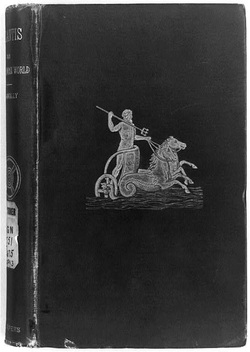
Our only reason for noticing this curious book is that the names of writers of authority which constantly appear in its pages may lead some readers astray. But the author, while quoting them, has neither assimilated their method nor understood the bearing of their facts. In spite of the patient labour bestowed upon the work, and the numerous illustrations with which it is adorned, it is merely another contribution to that mass of paradoxical literature which awaits the "Budget" of a second De Morgan. -- Review of Atlantis: The Antediluvian World by Ignatius Donnelly (1882) in Nature 26 (August 10, 1882). |
|
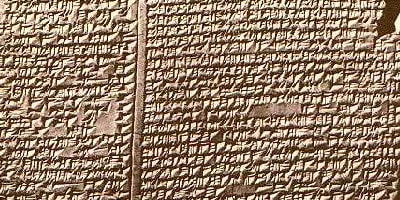
THE EPIC OF GILGAMESH
The much-cited ancient text (2nd millennum BCE) "The chief fragments of the Nimrod [Gilgamesh] epic were discovered in 1854 by Hormuzd Rassam in the ruins of Nineveh. The tablets, twelve in number, belonged originally to the famous library of King Ashurbanipal (668-626 B.C.), as the colophons to the several tablets clearly state." |
|
THE BABYLONIAN CREATION
Believed to be the model for Genesis (7th century BCE) "The publication of the above-mentioned texts and translations proved beyond all doubt the correctness of Rawlinson's assertion made in 1865, that 'certain portions of the Babylonian and Assyrian Legends of the Creation resembled passages in the early chapters of the Book of Genesis.'" |
|
THE PERIPLUS OF HANNO
One of the first major ancient voyages to sub-Saharan Africa (c. 6th century BCE) "...we arrived at a bay called the Southern Horn; at the bottom of which lay an island like the former, having a lake, and in this lake another island, full of savage people, the greater part of whom were women, whose bodies were hairy, and whom our interpreters called Gorillae." |
|
PLATO'S ATLANTIS DIALOGUES
From the Timaeus and Critias (360 BCE) "And Poseidon, receiving for his lot the island of Atlantis, begat children by a mortal woman, and settled them in a part of the island, which I will describe. Looking towards the sea, but in the centre of the whole island, there was a plain which is said to have been the fairest of all plains and very fertile." |
|
PANCHAEA: THE OTHER ATLANTIS
From Euhemerus (c. 4th century BCE) "...he says that he travelled southwards to the ocean, and having sailed from Arabia Felix, stood out to sea several days, and continued his course among the islands of that sea, one of which far exceeded the rest in magnitude, and this island was called Panchaea." |
|
THE PHOENICIAN THEOLOGY
Sanchuniathon (date uncertain) "...The beginning of all things was a dark and condensed windy air, or a breeze of thick air and a Chaos turbid and black as Erebus: and that these were unbounded, and for a long series of ages destitute of form. But when this wind became enamoured of its own first principles (the Chaos), and an intimate union took place, that connexion was called Pothos: and it was the beginning of the creation of all things." |
|
BABYLONIACA
Berossus (c. 290-278 BCE) "In the first year there appeared, from that part of the Erythræan sea which borders upon Babylonia, an animal destitute of reason, by name Oannes, whose whole body was that of a fish; that under the fish's head he had another head, with feet also below, similar to those of a man, subjoined to the fish's tail. His voice too, and language, was articulate and human..." |
|
GÓMARA ON ATLANTIS
Francisco López de Gómara (1552) "But there is now no cause why we should any longer doubt or dispute of the Island Atlantide, for as much as the discovering and conquest of the west Indies do plainly declare what Plato hath written of the said lands. In Mexico also at this day they call that water Atl, by the half name of Atlantis, as by a word remaining of the name of the Island that is not." |
|
EXCAVATING A MOUND
Thomas Jefferson (1781-1782) "I know of no such thing existing as an Indian monument: for would not honour with that name arrow points, stone hatchets, stone pipes, and half-shapen images. Of labour on the large scale, I think there is no remain as respectable as would be a common ditch for the draining of lands: unless indeed it be the Barrows..." |
|
MEMOIR UPON FOSSIL AND LIVING ELEPHANTS
Georges Cuvier (1806) "... every country, and every area, has furnished fossil bones. ... It is probable that the bones of elephants have been often taken for human ones; and this may have given rise to the pretended discoveries of the tombs of giants spoken of in antiquity." |
|
THE MOON HOAX
Richard Adams Locke (1835) "...we have the happiness of making known to the British public, and thence to the whole civilized world, recent discoveries in Astronomy which will build an imperishable monument to the age in which we live, and confer upon the present generation of the human race a proud distinction through all future time." |
|
FOSSILS, MYTH, AND PSEUDO-HISTORY
Edward B. Tylor (1871/1920) "Although the attempt to reduce to rule and system the whole domain of mythology would as yet be rash and premature, yet the piecemeal invasion of one mythic province after another proves feasible and profitable." |
|
THE DELUGE IN THE LIGHT OF MODERN SCIENCE
William Denton (1882) "If the Creator of the universe has spoken to man, how important that we should listen to his voice and obey his instructions! On the other hand, if the Bible is not God's book, we ought to know it. Why should we go through the world with a lie in our right hand, dupes of the ignorant men who preceded us? " |
|
ATLANTIS: THE ANTEDILUVIAN WORLD
Ignatius Donnelly (1882) (includes all 128 original illustrations) "...there once existed in the Atlantic Ocean, opposite the mouth of the Mediterranean Sea, a large island, which was the remnant of an Atlantic continent, and known to the ancient world as Atlantis. [...] [T]he description of this island given by Plato is not, as has been long supposed, fable, but veritable history." |
|
THE MOUND-BUILDERS
George Bryce (1885) "We are especially fortunate in being the possessors also of a field for archaeological study in the portion of the area occupied by the mound builders—the lost race, whose fate has a strange fascination for all who enquire into the condition of Ancient America." |
|
BLAVATSKY ON ANCIENT ASTRONAUTS
H. P. Blavatsky (1888) "When, therefore, we find in the Bibles of Humanity 'other worlds' spoken of, we may safely conclude that they not only refer to other states of our planetary chain and Earth, but also to other inhabited globes -- stars and planets; withal, that the latter were never speculated upon. The whole of antiquity believed in the Universality of life. But no really initiated seer of any civilized nation has ever taught that life on other stars could be judged by the standard of terrestrial life." |
|
THE LOST ATLANTIS
Sir Daniel Wilson (1892) "The legend of Atlantis, an island-continent lying in the Atlantic Ocean over against the Pillars of Hercules, which, after being long the seat of a powerful empire, was engulfed in the sea, has been made the basis of many extravagant speculations; and anew awakens keenest interest with the revolving centuries." |
|
DID THE PHOENICIANS DISCOVER AMERICA?
Thomas Crawford Johnston (1892) "Perhaps no question has so much perplexed the scientists of the past four hundred years as the vexed one of the origin of the Aztecs and the ancient and high civilization of Central America that confronted the Spanish conquerors on their arrival, and that up to the present period has received no satisfactory solution." |
|
DEVIL WORSHIP IN FRANCE
Arthur Edward Waite (1896) "The term Modern Satanism is not intended to signify the development of some new aspect of old doctrine concerning demonology [...] It is intended to signify the alleged revival, or, at least, the reappearance to some extent in public, of a cultus diabolicus, or formal religion of the devil..." |
|
THE STORY OF ATLANTIS and THE LOST LEMURIA
W. Scott-Elliot (1896 & 1904) "The destruction of Atlantis was accomplished by a series of catastrophes varying in character from great cataclysms in which whole territories and populations perished, to comparatively unimportant landslips such as occur on our own coasts to-day." |
|
FABULOUS ZOÖLOGY
William D. Matthew (1909) "The beginnings of Zoölogy lie in the region of fable. In the earliest traditions and myths of primitive races the world is peopled with men and animals, some real, some half-real, some entirely fabulous. Natural and supernatural are mingled together and a religious or superstitious significance attaches to both real and unreal beings seen or imagined by primitive man." |
|
FOSSIL ORIGINS OF THE CYCLOPS
Othenio Abel (1914) "They were perhaps in a beach cave in Sicily and sought shelter from bad weather. In lighting a fire, they saw an elephant skull projecting from the clay. Everything else is a later addition from a time that was inclined to see encounters with all manner or gods..." |
|
THE BOOK OF THE DAMNED
Charles Fort (1919) "When I say that there is nothing to prove, I mean that to those who accept Continuity, or the merging away of all phenomena into other phenomena, without positive demarcations one from another, there is, in a positive sense, no one thing. There is nothing to prove." |
|
THE ORIGINS OF MEXICAN MYTHOLOGY
Lewis Spense (1920) "Great Britain alone remains insensible to the lure of old Mexico, and small indeed is the band of workers that she has given to this department of archaeology. No manifestation of the life and thought of ancient Mexico so well deserves the attention of British students of antiquity as its picturesque if bizarre religion." |
You can also view these articles by category.
Photo credits: Public domain images courtesy Liam's Pictures from Old Books, Library of Congress, and Wikimedia Commons.