• Home
  • Blog
  • Books
    • Cult of Alien Gods>
      • Contents
      • Excerpt
      • Image Gallery
    • Knowing Fear>
      • Contents
      • Excerpt
      • Image Gallery
    • Hideous Bit of Morbidity>
      • Contents
      • Excerpt
      • Image Gallery
    • Cthulhu in World Mythology>
      • Excerpt
      • Image Gallery
      • Necronomicon Fragments
      • Oral Histories
    • JasonColavito.com Books>
      • Faking History
      • Unearthing the Truth
      • Critical Companion to Ancient Aliens
      • Studies in Ancient Astronautics (Series)>
        • Theosophy on Ancient Astronauts
        • Pyramidiots!
        • Edison's Conquest of Mars
      • Unseen Horror>
        • Contents
        • Excerpt
      • The Orphic Argonautica>
        • Contents
        • Excerpt
      • The Faust Book>
        • Contents
        • Excerpt
      • Moon Men!>
        • Contents
      • Classic Reprints
  • Multimedia
    • Merchandise
    • Videos
    • Free eBooks>
      • Origin of the Space Gods
      • Ancient Atom Bombs
      • Golden Fleeced
      • Ancient America
      • Horror & Science
    • Skeptical Xenoarchaeologist Newsletter>
      • Volume 1 Archive
      • Volume 2 Archive
  • Articles
    • Collection: Ancient Alien Fraud>
      • Secret History of Ancient Astronauts
      • Of Atlantis and Aliens
      • Profiles in Ancient Astronautics>
        • Erich von Däniken
        • Robert Temple
        • Giorgio Tsoukalos
        • David Childress
      • Aliens and Ancient Texts
      • The Case of the False Quotes
      • Alternative Authors' Quote Fraud
      • David Childress & the Aliens
      • Faking Ancient Art in Uzbekistan
      • Intimations of Persecution
      • Zecharia Sitchin's World
      • Jesus' Alien Ancestors?
      • Extraterrestrial Evolution?
    • Collection: Skeptic Magazine>
      • Native American Discovery of Europe
      • Interview: Scott Sigler
      • Golden Fleeced
      • Oh the Horror
      • Discovery of America
      • Supernatural Television
      • Review of Civilization One
      • Who Lost the Middle Ages
      • Charioteer of the Gods
    • Collection: Ancient History>
      • Prehistoric Nuclear War
      • The China Syndrome
      • Atlantis, Mu, and the Maya
      • Easter Island Exposed
      • Who Built the Sphinx?
      • Who Built the Great Pyramid?
      • Archaeological Cover Up?
    • Collection: The Lovecraft Legacy>
      • Pauwels, Bergier, and Lovecraft
      • Lovecraft in Bergier
      • Lovecraft and Scientology
    • Scholomance: The Devil's School
    • Prehistory of Chupacabra
    • Alien Abduction at the Outer Limits
  • Galleries
    • Bad Archaeology
    • Ancient Civilizations>
      • Ancient Egypt
      • Ancient Greece
      • Ancient Near East
      • Ancient Americas
    • Supernatural History
    • Book Image Galleries
  • Fiction
    • Short Stories
    • Free Fiction
  • The Library
    • Ancient Mysteries>
      • Ancient Texts>
        • Mesopotamian Texts>
          • Epic of Gilgamesh
          • Babylonian Creation Myth
          • Berossus
        • Hesiod's Theogony
        • Periplus of Hanno
        • Plato's Atlantis Dialogues>
          • Timaeus
          • Critias
        • Panchaea: The Other Atlantis
        • Sanchuniathon
        • Sima Qian
        • The Book of Enoch
        • Julius Africanus' Chronography
        • Isidore of Seville
        • Voyage of Saint Brendan
        • Boccaccio and the Fossil 'Giant'
        • Al-Maqrizi on the Pyramids
        • Voyage of the Zeno Brothers
      • Lost Civilizations>
        • Gómara on Atlantis
        • Jefferson's Excavation
        • Donnelly's Atlantis
        • Mound Builders
        • The Lost Atlantis
        • Phoenicians in America
        • W. Scott-Elliot>
          • The Story of Atlantis
          • The Lost Lemuria
      • Ancient Extraterrestrials>
        • The Moon Hoax
        • Blavatsky on Ancient Astronauts
      • Science and History>
        • Halley on Noah's Comet
        • Fossil Origins of Myths>
          • Fossil Elephants
          • Fossil Mammoths and Giants
          • Fossils and the Supernatural
          • Fossils, Myth, and Pseudo-History
          • Fossil Bones and Giants
          • Mastodon, Mammoth, and Man
          • American Elephant Myths
          • Fossils and Myth
          • Fossil Origin of the Cyclops
        • The Newport Tower
        • The Deluge
        • Devil Worship in France
        • The Mutinous Sea
        • Fabulous Zoology
        • The Origins of Talos
        • Book of the Damned
        • Mexican Mythology
        • Chinese Pyramids
    • US Government Ancient Astronaut Files>
      • Whirling Wheels
      • Denver Ancient Astronaut Lecture
      • Visitors from Outer Space
      • Unidentified Flying Objects (Abstract)
      • UFO Hypothesis Survival Questions
      • Atlantis Discovery Telegrams
      • Ancient Astronaut Society Telegram
      • Noah's Ark Cables
      • The Von Daniken Letter
      • UFOs in Ancient China
      • CIA Report on Noah's Ark
      • CIA Noah's Ark Memos
    • The Supernatural>
      • Sublime and Beautiful
      • Voltaire on Vampires
      • Demonology and Witchcraft
      • Religion and Evolution
      • Transylvanian Superstitions
      • Dread of the Supernatural
      • Vampires
      • Werewolves and Vampires and Ghouls
      • Science and Fairy Stories
    • Classic Fiction>
      • Lucian's True History
      • Some Words with a Mummy
      • The Coming Race
      • King Solomon's Mines
      • An Inhabitant of Carcosa
      • The Xipéhuz
      • The Novel of the Black Seal
      • The Lost Continent
      • Count Magnus
      • The Wendigo
      • The Red One
      • H. P. Lovecraft>
        • Dagon
        • The Call of Cthulhu
        • At the Mountains of Madness
      • The Skeptical Poltergeist
      • The Corpse on the Grating
      • The Second Satellite
    • Recommended Books
  • About Jason
    • Biography
    • What Is Xenoarchaeology?
    • Jason in the Media
    • Contact Jason
    • Media Inquiries>
      • Media Kit
    • About JasonColavito.com
    • Search JasonColavito.com
Books
Hideous Bit of Morbidity
Jason Colavito
McFarland, 2009 (Hardcover)
McFarland, 2012 (Paperback)


Hideous Bit of Morbidity


"...an exciting ride across the history of dark literature...a veritable feast..."
- Mario Guslandi, SFSite.com (featured review)

"Jason Colavito has contributed a delightful reference work (is that an oxymoron?) to the field of horror studies..."
- Amy J. Ransom, Science Fiction Studies


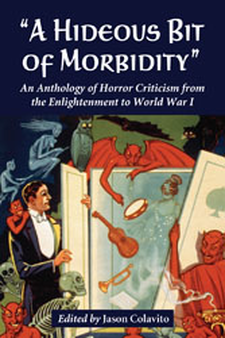
A Hideous Bit of Morbidity: An Anthology of Horror Criticism from the Enlightenment to World War I brings together more than ninety pieces of literary criticism published before 1918 that discuss, review, critique, and explore masterpieces of the horror genre.

Overview of A Hideous Bit of Morbidity
Today, scholars, historians, and literary critics routinely describe the horror genre as emerging in the wake of Horace Walpole's Gothic classic The Castle of Otranto (1764) and developing throughout the nineteenth century through such landmarks as Frankenstein, The Strange Case of Dr. Jekyll and Mr. Hyde, and Dracula. In this view, the progression from Gothic romance to all-out tale of terror takes on the appearance of inevitability, and the cardinal works of the era stand like immovable sentinels guarding the genre’s gates.

However, the story of horror did not appear so clean-cut to those who experienced it first-hand. Until H.P. Lovecraft defined supernatural horror in a 1922 essay, there was no recognized "horror genre" at all; the works we see today as ancestors of Psycho and Saw were seen in their day as fantasies, romances, or tales of the outré and were discussed as such, making contemporaneous discussions of Victorian horror challenging to find.

This edited collection brings together a range of original articles, excerpts, letters, advertisements, and other publications to provide an intriguing glimpse at the way the developing horror genre was viewed by its contemporaries. The collection will cover the 150 years from the beginning of horror in 1764 through the end of World War I, when the "classic" horror story gave way to modern genre horror in the wake of the war.

These collected pieces provide a rarely-seen view of horror classics. In the process of reading these pieces the reader will come to reassess received scholarly paradigms about horror and view the emerging genre through the eyes of critics, often hostile, who attempted to fit horror into the dominant literary theories and paradigms of the day. For example, Jekyll and Hyde was the subject of intense debate in the Victorian press, while Dracula, later subject of intense scrutiny, was quickly dismissed as the equivalent of beach reading. The reader will become reacquainted with forgotten authors like Robert Hichens and Frederick Cobb, once best-sellers, and see how the Victorians conceptualized tales of fear through the twin lenses of Spiritualism and scientific rationalism. The reader will also encounter Victorian moral outrage and horror's content.

What's Special about This Book?
Most of these pieces have not been published since their original appearances in pre-World War I books and magazines. The periodicals that housed these works are often long forgotten, and lacking clear indexes, their contents are largely untraceable. Collecting these works together in one place provides a valuable resource for scholars, libraries, and all those interested in learning more about how early horror was received in the era's popular and scholarly presses.

Why Read A Hideous Bit of Morbidity?
The Victorian conversation about horror is now largely lost, reduced to footnotes in academic articles (if that), and this interesting discussion deserves to be heard again. Victorian views on horror shed light on our own recent debates on the value of a genre known for its shock value, and it provides a perspective unheard for a hundred years.
 
What Does the Title Mean?
The title of the book comes from an early 20th century piece by Frederic Taber Cooper, who described Robert Hichens's horror masterpiece "How Love Came to Professor Guildea" (1900) as "a hideous bit of morbidity, which might pass for a study of insanity, if the author had not precluded that explanation..." The title embodies a particularly dismissive school of horror criticism popular in the pre-World War I era and which continues to this day.


Contents
Excerpt
Images
Picture

Picture
Picture
Home  |  Blog  |  Books  |  Multimedia  |  Contact  |  About Jason Colavito
© 2010-2013 Jason Colavito. All rights reserved.