
6th c. BCE
|
NOTE |
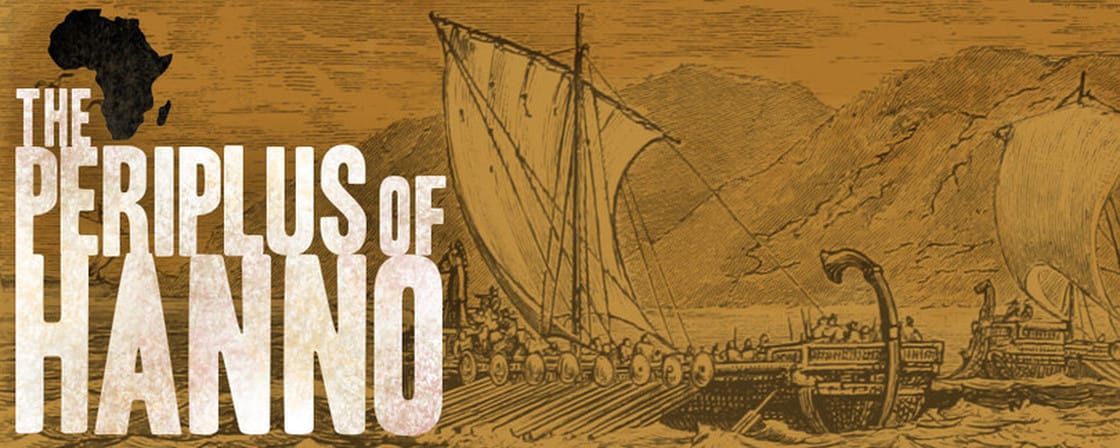
One of alternative archaeology's most frequent claims is that ancient cultures were in frequent transoceanic contact. However, one remarkable ancient text gives the lie to the idea that ancient people frequently interacted across oceans or around the world. The Periplus of Hanno, written apparently by the Carthaginian navigator and later king himself and preserved in Greek translation, tells the story of that sailor's voyage down the coast of Africa and his encounter with what seem to be chimpanzees (here called Gorillas). This document is important not only because it presents what is apparently a genuine account of an ancient voyage, but also because of the awe and wonder with which it was treated. Hanno had it hung up in the temple of Baal Hammon (identified by Greeks and Romans with Cronus and Saturn, respectively) in Carthage, and it was discussed by Pliny the Elder and Arrian. Needless to say, this voyage would hardly have been worth commemorating so elaborately if trips to sub-Saharan Africa, the Americas, or Antarctica were as commonplace as alternative historians claim, or even if such journeys were extant at all.
The text of the Periplus presented below comes from the 1876 edition of I. P. Cory's Ancient Fragments with the introduction written for that edition by E. Richmond Hodge. The original edition was published in 1828, and the more famous expanded second edition was published in 1832. |
The Voyage of Hanno, Commander of the Carthaginians
The Periplus of Hanno the Carthaginian is an account of the earliest voyage of discovery in existence. It is taken from an original, and apparently, official document, which was suspended in the temple of II, or Saturn, at Carthage. Falconer and Bougainville both agree in referring it to the sixth century before the Christian era. The Periplus is introduced by a few lines, reciting a decree of the Carthaginians, relating to the voyage and its objects. It is then continued as a narrative by the commander, or by one of his companions, commencing from the time the fleet had cleared the Pillars of Hercules—the Straits of Gibraltar.
Round the parts of Libya beyond the Pillars of Hercules, which he deposited in the temple of Saturn [i.e., Il, or Israel].
It was decreed by the Carthaginians, that Hanno should undertake a voyage beyond the Pillars of Hercules, and found Liby-Phoenician cities. He sailed accordingly with sixty ships of fifty oars each, and a body of men and women to the number of thirty thousand, and provisions and other necessaries.
When we had passed the Pillars [of Hercules] on our voyage, and had sailed beyond them for two days, we founded the first city which we named Thymiaterium. Below it lay an extensive plain. Proceeding thence towards the west, we came to Soloeis, a promontory of Libya, a place thickly covered with trees, where we erected a temple to Neptune; and again proceeded for the space of half a day towards the east, until we arrived at a lake lying not far from the sea. and filled with abundance of large reeds. Here elephants, and a great number of other wild beasts, were feeding.
Having passed the lake about a day’s sail, we founded cities near the sea, called Cariconticos, and Gytte, and Acra, and Melitta, and Arambys. Thence we came to the great river Lixus, which flows from Libya. On its banks the Lixitae, a shepherd tribe, were feeding flocks, amongst whom we continued some time on friendly terms. Beyond the Lixitae dwelt the inhospitable Ethiopians, who pasture a wild country intersected by large mountains, from which they say the river Lixus flows. In the neighbourhood of the mountains lived the Troglodytae, men of various appearances, whom the Lixitae described as swifter in running than horses.
Having procured interpreters from them, we coasted along a desert country towards the south two days. Thence we proceeded towards the east the course of a day. Here we found in a recess of a certain bay a small island, containing a circle of five stadia, where we settled a colony, and called it Cerne. We judged from our voyage that this place lay in a direct line with Carthage; for the length of our voyage from Carthage to the Pillars, was equal to that from the Pillars to Cerne.
We then came to a lake, which we reacted by sailing up a large river called Chretes This lake had three islands, larger than Cerne from which proceeding a day's sail, we came to the extremity of the lake, that was overhung by large mountains, inhabited by savage men clothed in skins of wild beasts, who drove us away by throwing stones, and hindered us from landing. Sailing thence we came to another river, that was large and broad, and full of crocodiles, and river horses; whence returning back we came again to Cerne
Thence we sailed towards the south twelve days, coasting the shore, the whole of which is inhabited by Ethiopians, who would not wait our approach, but fled from us. Their language was not intelligible even to the Lixitae who were with us. Towards the last day we approached some large mountains covered with trees, the wood of which was sweet-scented and variegated. Having sailed by these mountains for two days, we came to an immense opening of the sea; on each side of which, towards the continent, was a plain; from which we saw by night fire arising at intervals in all directions, either more or less.
Having taken in water there, we sailed forwards five days near the land, until we came to a large bay, which our interpreters informed us was called the Western Horn. In this was a large island, and in the island a saltwater lake, and in this another island, where, when we had landed, we could discover nothing in the daytime except trees; but in the night we saw many fires burning, and heard the sound of pipes, cymbals, drums, and confused shouts. We were then afraid, and our diviners ordered us to abandon the island.
Sailing quickly away thence we passed a country burning with fires and perfumes; and streams of fire supplied from it fell into the sea. The country was impassable on account of the heat. We sailed quickly thence, being much terrified; and passing on for four days, we discovered at night a country full of fire. In the middle was a lofty fire, larger than the rest, which seemed to touch the stars. When day came we discovered it to be a large hill, called the Chariot of the Gods. On the third day after our departure thence, having sailed by those streams of fire, we arrived at a bay called the Southern Horn; at the bottom of which lay an island like the former, having a lake, and in this lake another island, full of savage people, the greater part of whom were women, whose bodies were hairy, and whom our interpreters called Gorillae. Though we pursued the men we could not seize any of them; but all fled from us, escaping over the precipices, and defending themselves with stones. Three women were however taken; but they attacked their conductors with their teeth and hands, and could not be prevailed upon to accompany us. Having killed them, we flayed them, and brought their skins with us to Carthage. We did not sail farther on, our provisions failing us.

Source: E. Richmond Hodge, Cory's Ancient Fragments (London: Reeves and Turner, 1876), 36-40.
