|
I wasn’t sure what to expect going into America Unearthed, H2’s new program about the “hidden” history of America airing immediately after Ancient Aliens. The production values on the show are several steps above Ancient Aliens, with almost cinematic cinematography and high-end graphics; but the program relies heavily on obviously reenacted or scripted conversations in which forensic geologist Scott Wolter “investigates” ancient mysteries. Unlike Ancient Aliens, America Unearthed does not provide much by way of description or context since it lacks a narrator, making it very difficult to pinpoint at times exactly what the program is talking about and thus forcing us to simply go along with Wolter, facts be damned. Wolter, regular readers will remember, is (in)famous for his claims that the Kensington Rune Stone is real evidence of a Viking exploration of Minnesota and that the Bat Creek Stone was a real ancient Hebrew artifact discovered in the United States. Needless to say, his claims hold very little weight, as I discussed before. The program discusses what it calls the “Track Rock site” in Georgia, a mound site which the program claims is evidence that the Maya came to Georgia. The program asserts that the U.S. federal government prohibits access to the site. At first the show implies through lighting and mood music that this is for conspiratorial reasons, and then Wolter just explicitly says so. Despite what America Unearthed claims, the Track Rock Gap Archaeological site is open to the public (for free, no less!), and the government offers directions to help you get there and brochures to help you find your way around the site. The only thing prohibited is archaeological excavation without following the formal application process. Since Scott Wolter is no archaeologist and has no interest in conducting real research, this must be the actual reason the “government” blocked him from trampling through the site, if that is what they did at all. The US Forest Service has a web page (linked above) debunking the claim that the Maya built the mounds and stone walls found at what is properly called the “Track Rock Gap Archaeological Site.” The mounds were constructed by the Creek and Cherokee around 1000 CE, after the Classic Maya had collapsed. The Creek built mounds like most southeastern tribes during the Mississippian period, so there is no need to postulate Maya influence unless you want all the mounds of the Americas to be Mayan. (Note: The Post-Classic Maya built with stone, not dirt, in the period under discussion.) There is evidence of trade with an influence from Mesoamerica on Mississippian culture, but not the direct movement of large numbers of peoples from Mexico to Georgia, as the show implies. This neatly accounts for similar iconography and the movement of materials between the two cultures. Despite the show’s claim, this is not a “taboo” subject but is widely discussed in archaeological literature. For crying out loud, it was in my college archaeology textbook more than a decade ago!The reason we know that the Maya didn’t personally relocate to Georgia at the end of their civilization is (a) they continued (and continue) to live in Mexico, and (b) no indisputably Maya artifact has ever been found in Georgia. Ocmulgee (Track Rock) was very much part of the Southeastern Ceremonial Complex, which is clearly part of a continuum of native cultures that stretched from Mexico to New York. Wolter makes a big deal out of an image of a “Feathered Dancer” found in Georgia and claims it is uniquely related to a Maya image from Chichen Itza. Wolter does not tell you that the feathered dancer is a widespread image found as far afield as the Siouan and Winnebago peoples. The specific image shown in the program, and reproduced below, was found at Etowah, not Ocmulgee. 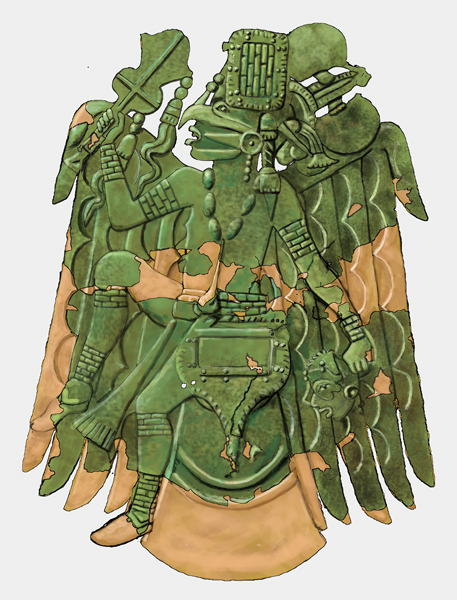 "Feathered Dancer" plate found at Etowah. It uses the common stock of artistic conventions found from Mexico to Minnesota and were diffused across the Americas from at least the time of Poverty Point, the oldest mound-building culture. There is simply no need to postulate the movement of thousands of people when the movement of goods and ideas explains the similarities Wolter found between Mexico and the mound builders of America.
Wolter tries to prove a connection between the Maya and Georgia by creating “Maya blue,” an artistic pigment used in Maya art, with clay from Georgia. (The pigment is also found in other Mesoamerican cultures, like the Aztec, indicating much broader trade than Wolter allows. The Maya, in fact, specifically considered the clay from which the pigment was made a valuable item of trade, a fact known for at least 50 years.) The sample (from a deposit first reported many decades ago) chemically matched that from Chichen Itza under the analysis Wolter had done at a lab, though again details weren't provided to let us judge whether the match excluded all other sources, such as Yucatan deposits. Again, though, trade networks do not require the movement of peoples, only the movement of goods. Amber moved across Europe without people accompanying it, and this clay could very well have followed the same route. Mesoamericans are known to have visited the American southwest for turquoise, and Mississippian artifacts have been found at a Classic Maya site in the Yucatan. Robert Hall, for example, also found clear ritual and mythic diffusion from central Mexico to Mississippian cultures as far away as the Winnebago. That such connections happened is not seriously disputed, though the question of the direction and degree of influence is still debated. “There are a whole host of academics who refuse to believe that there were cultures that came to America prior to Columbus,” Wolter states. “And this is bullshit!” So, congratulations, Scott Wolter: You “proved” a connection that archaeologists have been aware of for ages and you did it while bitching and moaning about how the “establishment” was “suppressing” the very information they are actively investigating and which you used in your own show! As entertainment, America Unearthed is no Ancient Aliens. Since America Unearthed has to rely heavily on the wooden delivery of Scott Wolter instead of a wide range of pundits and focuses on just a single topic, the show is very, very slow and very repetitive. We have long, lingering shots of Wolter looking plaintively at trees and rocks. We have long, long pauses between sound bytes and repeated shots of nature. The cinematic photography can't mask the paucity of facts and information, or the barely-coherent conspiracy mindset both Wolter and the show's producers irresponsibly promote, a mindset we have previously seen leads to paranoia and violence among some in the audience who believe that television tells the truth.
278 Comments
paul h
12/23/2012 03:45:07 am
Will be interesting to see how the show portrays the evidences...and what it omits. What are your thoughts on the Cahokia people ? I've watched the documentary by Kevin Costner entitled "The 500 Nations..The Story of Indian Americans" which is quite good. The Mississipian Cahokia reportedly had a culture which rivaled London or Rome in size in the 1200's and built pyramidal mounds as large as Egyptian or Aztec/Mayan ones, wooden Stonehenge-type astronomical structures, traded on river routes from Canada to Mexico, etc... 12/29/2012 07:30:43 am
You got it wrong. Behind the scenes has been a whole lot of dirty right-wing politics associated with the Track Rock site. We are not sure why Track Rock became a Republican issue, but it did.
Eugene Bridges
2/3/2013 12:35:55 am
Hello My name is Eugene Bridges. My great grandfather Alph Bridges owned approximately 100 acres on Trackrock Gap in the mid 1800's. This land included the petroglyphs that you have made reference to. The property ran from the top of the gap, across to the base of the buzzard roost, down to the terrace walls, which he and his family built. They called the terraces the buzzard roost fields. They grew corn and produce there for many years. My great grandfather also logged all the walnut trees for cross ties. He hauled them to Gainesville, Georgia along with the produce. In 1903, Alph had a son, my grandfather, named Esker Bridges. When he grew up he was given the property and he logged all the acid wood off of it, which they used to make dye. He also hauled this wood to Gainesville, GA by horse and wagon. When my dad, Robert Bridges, was born, his dad Esker turned the property over to his first cousin "Redeye" Barnes, an old moonshiner and logger. Upon payment for the land, once he logged the locust off of it, he sold it to forest service and died owing my grandfather for the property. This is how the forest service owns the property today, even though my grandfather was never paid for the property. I hope this helps you better understand the mystery of the terraces on Track Rock.
pat
11/28/2013 05:36:08 am
Republicans? right wing? you do know that the head of the forest service is appointed by obama, and your average forest service employee is hardly some right wing activist? you seem to have some screaming paranoia going on there pal. I guess the "national media" are right wing activists also? Therapy................therapy
Eric McChesney
11/29/2013 12:17:15 am
First, regardless of politics, I would not necessarily expect the head of the national park service appointed by either party to necessarily have a firm grounding in ancient history or archaeology (unless their degree was in history) anymore than some young MBA degree holders could claim they know about what happened in Vietnam after watching those dumb Swift Boat Vets for "Truth" ads ( though some tried it with me- they disregard primary sources and firsthand eyewitnesses - their money did not equal brains on that subject).
Mark Wolffang
12/10/2013 10:31:01 am
Right wing politics ? Wake up there is only one party in this country and is the money party . The days of left/right thinking should be transcended for people should wake up and see the man or men behind the curtain .
Dan
12/25/2014 04:37:44 am
And its YOU that has this completely sideways. The trees were dead and dying trees that would have fallen on the trails and could have harmed or killed someone, THATS why they were removed. And how you got any "right wing" politics out of this is beyond rational thought. At least to anyone except you and the tinfoil hat crowd.
Rick Wright
2/1/2015 08:54:04 am
I watch this show find it interesting but one thing kind of disturbs me is Scott Wolter seems to have his own little agenda when it comes to solving mysteries. I'm not saying he is totally wrong on some of his conjectures concerning different subjects he tackles but he needs to not be just one sided answers. Sometimes he really does put his foot in his mouth and kind of looks like he makes up things as he goes.... am i wrong or right you tell me ? 2/18/2016 08:03:40 pm
I certainly agree with so much you have shared here and appreciate the for certain knowledge you shared and would like to study more of what you were able to find there? Can you share where I can find your work?
Bud Jamison
1/25/2013 08:22:29 pm
The show is just plain garbage (both episode 1 AND 2)! 2/5/2013 07:37:10 am
The earth, definitely, is a time capsule of some sort, 4.5 billion years old, but the clue to peeling apart this mystery of life on Earth is contained in all the rocks, at or below our feet!
Renee
2/16/2013 08:00:25 am
"Der Kelte" or "die Kelten" as you described originates from the German language and is phonetically spoken as such in those regions. I understand that in proper English it should be pronounced with an "S" as you stated, however some just can't shake off their heritage and pronounce it instead with a "hard k", unlike you.
Vivian Caudell
8/6/2013 06:29:28 pm
Regarding the pronouncement of "Celt"... check you dictionary.
Kevbo
11/3/2013 10:16:33 am
to Renee
John McGrath
2/16/2014 11:02:56 pm
Have to mildly chuckle at the Selt comment. The pronunciation Kelt for Celt is actually an erroneous analogy. Yes in the Irish language C always represents K. But the word Celt is not an Irish word. It is a Greek word that was later taken into Latin (although the Romans themselves called the "Celts" Gauls) and adopted in the 1800s by English speaking nationalists to unite minority communities in the British isles. The Irish call themselves Gaelige not Selts or Kelts. Greek and Latin words coming into English sometimes via French pronounce C (the Greek letter kappa originally) as S before E and I. and ae-- that's why it is Seesar for Caesar even though he pronounced it something like Kaisar. The Boston Celtics have it right. The people who pronounce an English word with a c before an e like a k have it wrong and it is not an Irish word. But I guess you can sound elitist by pronouncing it that way.
Rick W.
2/1/2015 08:59:23 am
I totally agree with you,whenever Scott films it seems like it is totally staged coreographed so much it doesnt seem believable.... seems like everything he says and does fits in exactly on cue and to me this isn't natural one bit. Give me a real show with unexpected events anyday over fakery ! 2/18/2016 08:09:29 pm
I am sorry you feel so negative about the programs you are watching. Maybe you should find something else to watch...like go to National Geographic or Smithsonian channels??? Maybe they will be more factual for you, my dear sir. Beyond that, add something of value, next time? I
Glenn young
3/9/2016 09:40:13 pm
I always watch your show and I like it very much but it seems like nothing gets done always seems like you are chasing dead ends find something tangeble please or your show is going to get cut lots of people are already putting you on the back burner good luck
Kessa Wright
10/18/2016 02:44:06 am
It can be pronounced both ways. 2/2/2013 02:32:16 am
I've been a professional investigator for 40 years and I can tell you this show is garbage and this guy is full of crap. Especially silly is his backpack which he wears for walking from his vehicle the half block to his "dig," on a farm; his "bush shirt" shirt bears no sign of wear or wrinkle and was clearly just washed using fabric softener. In the recent episode with the "Viking sword," ANYBODY could have seen it was not really old enough and in fact looked like a 19th century military sword used by artillery gunners. This show is not worth watching and just melts the brain, as does ANCIENT ALIENS, which is even sillier. Here's the formula: show interesting real pictures and sites and narrate rationally for 15-20 minutes, then "suppose" something, and then spin off from the supposition as fact, and then rant to confuse and enthrall the low-info audience. Best wishes...I'd rather watch DEXTER re-runs.
Nick
2/10/2013 03:18:57 pm
You sir are an ass hat. You claim to have been an "investigator" for 40 years but you give no evidence to prove your claim. Here I will be as smart as you. I have been the King of Macedonia for 57.68 years and these shows are interesting because they make you THINK about the what if instead of being a typical douchnozzle scientist and saying "that can't be true because no one has found it yet (insert stuffy, condescending laugh here). Guess what, people once said the earth is round and were treated the same way. Who was right about that again?
Kevin
3/24/2013 06:01:54 pm
Jeffrey, 5/18/2013 06:09:10 am
I wasted two hours watching this show he doesn't offer any other professional to dispute his claims and he seems obsessed with linking everything to the Holy Grail. I saw the Arizona artifacts show and I am still laughing about the one that someone drew a dinosaur on, he claims it was meant to be a desert lizard but this thing was Barney all the way. History really is reaching here, I won't waste anymore time on it.
Dick Balsak
12/14/2013 05:11:39 pm
Nick, you poor soul.... I hardly even know where to begin. First, the man's credentials have nothing to do with anything here since what he says is self evident. Second, "Thinking,'What if?'" is an exercise in FANTASY! And has NO place in scientific discourse, no matter how 'interesting' it seems to the uneducated. Third, the whole 'Earth is flat' tripe is a myth that has been perpetuated by those same uneducatable neanderthals for centuries to make the Columbus story 'interesting', as you put it. When I watch this show I find myself disgusted by this man and can not believe that he thinks people are gullible enough not to see through his veneer of crap... then I come online and I'm actually appalled to find that there are actually fools who defend this charlatan! Quacks have made a living for millennia because there is no dearth of morons who'll believe anything- as long as it's not the truth!
David
12/30/2013 03:13:01 pm
Then turn the channel and watch Dexter re-runs. 1/12/2014 02:04:16 am
Jeff, unlike Dexter who gets the bad guy that is the real bad guy. you execute the messengers. 1/12/2014 02:04:48 am
Jeff, unlike Dexter who gets the bad guy that is the real bad guy. you execute the messengers. 1/12/2014 02:05:45 am
Jeff, unlike Dexter who gets the bad guy that is the real bad guy. you execute the messengers.
CJ
8/22/2013 02:56:39 pm
This entire blog, which is dismantled further down the comment section, clearly is motivated more by hate than actual facts. This guy is just jealous of what Scott is doing and wishes he was him on some level. One of his comments he even mentions hate of the "right wing". All of this, written by a guy who built his ego-centric website here, which states he writes about evidence of ancient alien civilizations, is bizarre. He also states he has published multiple times but they are mostly self-published loony books which nobody has ever read. What a sad little man this guy is.
Michael D. Harris
7/19/2014 01:14:59 am
Fact is I have Mayan DNA in me so I 100% sure the Cherokee and perhaps some other tribes descended from Mayans who came here by sea from Central America. As my great, great, great grandfather was a Cherokee Chief, DNA says I have cousins in Central America.
Normandie Kent
2/10/2021 02:15:03 pm
It’s not Rocket Science to know that ALL modern Native Americans from Alaska to Tierra Del Fuego descend from the SAME small founding group of ancestral Native Americans! Of course the Cherokee are going to be related to the Mayans, and any other pure blood group that has been genome sequenced, and since most North American tribes in the US haven’t been sequenced, especially the Cherokee who among the tribes who are highly admixed with European and African DNA, of course they are going to be related to the closest tribe that has been genome sequenced . What small Native American you do have is not actually Mayan But closely related, like all other Native American tribes in the States, that are not Inuit or Athabaskan. Think 90per cent was Shiite . And so are 90 per cent of comments it's all just opinions . One man's truth is another's lie and is continuously perpetrated by idiots . I'm not a so called historian but I know a few and if u get them together they can't agree on Shiite . Make your own mind s up . Anybody who can stand their and say this is the 100% real truth please come n see me coz my priest is still tryin to convince me God is real and he's 100% certain he exits he is also a drunken twat. It's up to each person to decide what they believe. Oh n my personal opinion is Americans are so desperate to have history they steel others . I mean most of ya still think ur Irish or Italians or African. fuck me even ur president thinks he's Irish I hope u do wat every other culture has done through the centuries n kill each other. I will apologise to all who do class them selves as Americans and that's the natives that shud own the land as for the rest fuck off Thank you, all, who tried or attempted to try to debunk the debunk'er, Calivito. This guy is like gum you get on your shoe and cant get rid of, because you read his "crap", and now you can not unread it!!! I really have a hard time with anyone, who clearly has an agenda of tearing down others, for the sake of building themselves up for their own self gain! Feeding the ego only gets you more ego, friend, and eventually you end up being the joke in the room.. we all know that guy we went to high school with who no one will have a conversation with, at the class reunions, because he was so nasty to everyone most of their life? His own ego is being fed, yet at what expense??? and really at such little gain???....Did you know that feeding human ego, is like the feeding mold that grows in the dark and under decaying dead leaves, hay, natural and unnatural debris or garbage, etc....and the end product lacks any real "brilliance of sunlight knowledgeable", lacks any horticultural skill to bring it to fruition? So, is it truly valuable other than to eat up other dead and dying matter? Most of the level of conversation, here,(not all because I can see some very bright contenders weighing in, but the blog has so little real value...(really, I mean right wingers versus lefties? come on?) This mans input, reminds me of a situation where a person aspires to become a chef, but has no real talent, himself...so he barely makes it out of college with a C-, is a bad cook, lacking imagination or even ability to put a decent plate of food together, one who went to the top chef college, yet couldn't find real work, and then becomes a food critic, and a bad one at that...one who has to pay for his own work to be seen! It reminds me of the political races right now...the really sad sacks who stand on the stage with nothing to offer this country other than lots of ego, racist remarks, attracting gender haters, has no real knowledge of what is going on in the rest of the world, not to mention the fact that he is so tactless, we will surely end up in a war over this persons inability to play well with others...etc...and they actually have the nerve to believe that they have the right to run a country? WOW! Thats what this guy reminds me of? This is the New America, after all, and add to the New America ideals, the Reality TV shows and they people who watch this garbage, then think about the people who spend their time actually reviewing the garbage? I guess life is like a box of chocolates! If I find a man or women who is using name calling to bring attention to their work, if you are dramatic and controversial, as well as trivial, you get to find your place, in the New America, I guess? It helps to have a little money to pave your road, but a certain amount of charisma will get you even furtherI mean, look at Mr Hitler...what a charismatic guy he was and all that he was able to accomplish and no one was sharp enough in his country to call him out? Not that you are anything like Hitler, Mr Calivito. He was sharp enough to leave out the abuse and or hide it, until the very end? There is definitely a level of freedom of speech i believe in, but I wonder if we really need to listen or read this kind of hate? Like I said, we can not unread it? Shouldn't we all be pulling ourselves up and out of the fungus and cow dung and become better human beings, looking for desirables to stand by? We need people who are doers, like Scott, people who take risks and are willing to be wrong, people who will at least speak of matters, as if they are educated enough, and seem to know what they are talking about? The very first persons response states exactly why the site was shut down and is now unavailable to professionals? That tells me he knew what he was talking about, because he is educated and because he did a spot along with the professionals in pretty famous magazines and or channels! That says a lot! AS someone above stated, just because you say you have # of years as a what ever specialist...fill in the blanks..doesn't mean you are the expert, and then they come along and pepper it up, with a few choice words , so as to call the person in their line of sight, a few bad names, etc...yes, I agree this guy who leads the show, does have an agenda and I agree he is being told what to do by the directors, the executives, etc...welcome to how theories are proven. It starts with ideas, then its followed up with research for and against, and finally a conclusion...he seems to have all these, but is polite enough to the people who have nothing to offer his program, and just want to be on TV, a bit of time...when he would be better served to avoid this kind of data...since there was no data and it was a complete waste of time! Yes, the guy who had the Barney carving, "the dinosaur", or what ever he said it was, wasn't even worth the edit, but even i could see this particular gentleman was playing him, to get attention and Scott went along to get to the i WAS REALLY INTERESTED IN YOUR VIDEO FOUND ON YOUTUBE ON THE "Mississipian Cahokia" AND THE IDEA THAT THEY WERE SO CIVILIZED THEY RIVALED ROME IN SIZE, TRADE AND SOCIAL CIVILIZATION, BUT IT DISPEARED? WHY? DOES ANY ONE KNOW WHY? I HAVE SEEN THIS HAPPEN SO MANY TIMES, USUALLY BECAUSE SOMETHING SHOULD NOT BE OUT THERE FOR THE COMMON PERSON TO BE ABLE TO OBTAIN, THAT IT DISAPPEARS AS FAST AS IT ARRIVED ON YOUTUBE? WHY WOULD IT DISAPPEAR? WHERE IS POSTED AT NOW? NOTIFY ME IF YOU KNOW ANYTHING? VEE
Richard
12/23/2012 12:37:44 pm
After watching this show with the family during our holiday vacation I had to inquire further. Before the first commercial break I was already sick of the over-produced feel with "conspiracy-camera angles" lol. More time was spent on creating drama instead of providing concrete facts and you summed it up brilliantly. Thanks for the write-up and debunk!
Just a few corrections. 12/27/2012 12:36:47 am
I appreciate your comments, and I will obviously fix the spelling errors.
Your points are well taken. I'll only quibble over a couple of them ;)
dawooddmon
2/2/2013 03:26:34 pm
I think u have a serious grudge against Wolter.
Kevin
3/15/2013 02:23:07 pm
One Correction - If you are referring to Bloomington Indiana - it is IU - Indiana University... Just a Midwestern ( U of I - University of Illinois Graduate!)
Dekanogi Ulogilv
3/2/2014 07:15:52 am
Siyo, dtohitsu, Dekanogi Ulogilv daquado AniSahoni, why, do not ALL, of you ask the OBVIOUS ONES? Those who actually HAVE the answers to these questions, the HISTORY KEEPERS of Americas.
Nick
2/10/2013 03:25:32 pm
Burnnnn!!!!!
Nick
2/10/2013 03:28:47 pm
Burn!!!!
Joe smith
3/8/2013 06:49:05 pm
This show is full of shit. His theories are similar to. If the sun rises in the east then the world is flat.
jo
3/17/2013 08:16:59 am
Very nice....I also read about refugees from the Mayan empire. Makes absolute total sense. But the show is akin to Finding Bigfoot. Believe me...if Scott or Moneymaker or Bobo found something, you would have heard it on the news way before the show airs. Because we hear nothing, every single show, although entertaining, has nothing to offer.
D. Earles
1/11/2014 06:05:37 am
Comparing Wolter to Bobo, hilarious. Thanks for the chuckles!
Rick W.
2/1/2015 09:03:15 am
Big foot is a total fake. Up in the pacific northwest where i live we also have great tales about huge hairy creatures roaming the land . Havent seen one yet and most likely ever will..... to me untill either capture a creature or film one alive I will still believe this bigfoot is more or less a myth......
U3
12/28/2013 03:10:08 pm
Years ago I [unfortunalely] purchased the "Ancient American" magazines Wolter used to coproduce/peddle, both Wolter, his Ancient American magazines, as well as his H2 "America Unearthed" series are as phony as a $3.00 bill, crooked as a dog's hind leg and as worthless as the paper they're written on. 12/28/2012 02:27:49 pm
i just love shows like this. even , i just have high school. but have watched stuff like this for as long as i can remember. im 65 years old. and, i have always believed our history hasnt been told in truth. so i hope this show can help set things right. is there anyway to get news letters and up dates. thank you jon van nortwick 820w. laurel st. sherman texas. 75092
Coridan Miller
12/28/2012 03:19:57 pm
If you really want more pre-Columbian history pick up 1491 by Charles Mann instrad of watching this drivel.
Doug
1/14/2013 11:02:59 pm
What an amazing book.
caleb
1/19/2013 04:15:15 pm
It seem to me every time someone says facts that make the "educated" class upset they get very personal with there response this is not the first time I have seen you cry over scott maybe you should ignore him it is worse than responding if you dont like what he's selling.by the way the average person can tell if something historically is false.I like the show and can tell he stretches for things but I wouldn't become paranoid and act violently if no one believed what I told them scott wolter told me. I still think you dislike him on a personal level sorry it is very apparent
Brian
12/28/2012 06:11:29 pm
This show is horrible. I watched two episodes (Arizona Runes / Maya in Georgia). It is all speculation molded into an attempt at factual portrayal. I teach history. Too many students watch these types of shows and think it is all fact and true, including the conspiracies that don't even exist. This show is a major step backwards for history education. I would love to cross examine Scott Wolter. He would fall part if questioned thoroughly about his "evidence." Shows like this contribute to the dumbing down of America.
jd
12/28/2012 08:01:43 pm
I just love how "academics" get their knickers in a twist over these shows. They're all drivel because the info isn't presented as dry, boring statistics and analyses vetted by committees of dry, boring proffessors. I can't tell you how many of these programs have sparked an interest in science in my grandson who hates school. If they inspire him to find out more onhis own,they've done a good thing in my opinion. And who is to say that because the theories are presented as "infotainment" they're totally wrong? I didn't hear anything about massive numbers of Mayans migrating to Georgia or anywhere else, just thst SOME probably came to the SE US. I won't say that I've bought into everything that Wolter has suggested, but even a stopped clock is right twice a day. And I can say from personal experience that yes, there are places where feds will deny access to the strangest places. Just take a drive up into the mountains around Carrizozo, NM. Don't be shocked at the "Deadly Force Authorized" signs!
Brian
12/29/2012 01:18:42 pm
I teach 8th grade American history. I am not a boring professor type. My students are definitely not bored in my history classes, for I make it interesting and exciting, including using mysteries in history all of the time. I have no problem at all for the History Channel and others doing these types of topics. I would encourage lesser-known mysteries and topics, and I completely encourage my students to doubt, question, and weigh evidence with an open mind.
Christopher Randolph
1/5/2013 02:44:45 am
Strawman argument, jd!
Christopher Randolph
1/5/2013 03:27:31 am
What I meant to post was that no one was claiming that the shows were bad because they WEREN'T boring.
sorthious
1/16/2013 01:27:32 pm
Making learning "Entertaining" is always a good idea. It helps people remember things. But, entertaining people with lies and conspiracies without foundation is doing them a disservice. It does nothing but make people stupid.
ray
12/29/2012 06:42:54 am
""Shows like this contribute to the dumbing down of America.""
Scott Wolter
1/1/2013 03:23:58 pm
Fire away with your questions Brian; I'll try not to fold under the pressure. 1/4/2013 03:01:27 pm
Is this the real Wolter and how can we know that? That's Q #1.
U3
12/28/2013 03:41:07 pm
Pierre
1/14/2013 03:19:17 pm
I've never seen such garbage on TV. It's Scott driving, Scott on the phone, Scott in his hotel room, and a bunch of what if, could it be and perhaps.
Sorthious
1/16/2013 01:31:39 pm
Yeah Pierre, but it's on "The History Channel" and not Fox. Presenting this show and others like it on this channel is horrible.
U3
12/28/2013 03:49:29 pm
U3
12/28/2013 03:50:19 pm
U3
12/28/2013 03:50:34 pm
U3
12/28/2013 03:50:39 pm
dawoodmon
2/2/2013 03:44:01 pm
U did nothing except state that u dont have an open mind.
Pierrewhy
2/18/2013 11:21:14 am
Easy on Scott asshole there dawoodmom. Smell something else for a change. Read something else than the phone book for a change.
dawoodmon
2/2/2013 03:44:21 pm
U did nothing except state that u dont have an open mind.
Jafafa Hots
2/23/2013 05:34:09 am
I think the word you're looking for is "you."
Christopher
3/4/2013 07:03:48 am
Brian
Elizabeth
12/29/2012 07:33:56 am
I just have to say whether you like the guy or not, he definitely gets people asking questions. I had never heard of the Mayan Georgia connection before watching this show, and found it fascinating. I am far from an expert, but if the Mayans were as advanced as everyone says they were why is it so hard to believe that they did not travel all over North America. I think the problem with the academic community is that they are so set in their ways they do not bother to dig deeper and look at things with an open mind. Is the show based in fact...I don't know for sure but at least it challenges people to ask questions and explore other alternitives.
Brian
12/29/2012 01:17:41 pm
I teach 8th grade American history. I am not a boring professor type. My students are definitely not bored in my history classes, for I make it interesting and exciting, including using mysteries in history all of the time. I have no problem at all for the History Channel and others doing these types of topics. I would encourage lesser-known mysteries and topics, and I completely encourage my students to doubt, question, and weigh evidence with an open mind.
sorthious
1/16/2013 01:37:03 pm
It's not hard to believe that they "Could have", but that doesn't mean they did. Academics are "set in their ways" for good reason. A doctor doesnt just assume what is wrong with you and start operating. They do tests and observe before doing anything like that.
Kat
2/18/2013 09:14:33 am
Right on Elizabeth! I've been watching the episodes with a grain of sand - after all, they've produced Ancient Aliens, BUT the show makes you aware of archeological questions that exist.
lillian solis
5/2/2013 10:22:37 am
Bravo Kat ! my feelings exactly ! I'm an Disaster show "freak" I just love them n surely are not boring n whether factual or not they are fascinating ! I enjoy them n they also encourages us to think "what if" !
Justin
12/29/2012 04:12:06 pm
History is not totally accurate like the books that were taught in high school. And everyday history is being rewritten because of new discoveries. To many full glasses in the field. We are learning civilizations were built earlier than ever. Traveling across the sea as well ... to stop asking questions is to stop making progress.
heath
1/1/2013 03:26:57 am
Professional archaeologists always come across bits and pieces that doen't quite fit the narrative of the rest of the evidence. They would love to be able to resolve all these quirks except they don't want to waste precious resources on what could be dead end, sidetracking them from the main story.
Bud
2/1/2013 04:31:01 pm
History IS what's true, and what Wolter is pushing IS NOT true, not even CLOSE to the truth.
William Whitebird
12/8/2014 01:54:58 pm
If you watch, he investigates local legions and most of the time disproves them.
Bud
2/1/2013 04:31:16 pm
History IS what's true, and what Wolter is pushing IS NOT true, not even CLOSE to the truth.
William Whitebird
12/8/2014 01:53:42 pm
Correct! The show explore local legions and most of the time they are shown to be untrue. I find it interesting because history is written by the victors not the defeated.
Wade Baker
1/1/2013 01:39:48 am
Just the fact that the show enables more people to learn of these things is good news.
Sorthious
1/16/2013 01:40:18 pm
So learning things that haven't been proven is a good thing? Then, I have a bridge I'd like to sell you!
SmartyPants
2/9/2013 09:24:27 am
So ignoring things that are possible but not proven yet is a good thing.
Scott
1/1/2013 05:08:09 am
Jason, Paul and Richard. Thanks for your frank and open discourse on this topic, it was far more entertaining and informative than the original show.
mark clayton
12/7/2013 11:48:20 pm
Hi scott walter could you contact me about about something 0488249695 thanks
Alan Watts
12/10/2013 10:46:08 am
Mark are you trying to set up some tryst with Scott Walter ?
Oscar
1/1/2013 08:46:58 am
I agree with Wade, Im no history buff or student of these things. But I found the show entertaining and learned about new things I did not know existed. The show got me to look into the subjects further and is why I found this blog and learning there are two sides of the story. If the show makes you want to know and learn more no harm I think.
Christopher Randolph
1/4/2013 03:36:07 pm
But there AREN'T two sides to the story; there's an objectively true narrative which real scientists work through to figure out and there's a group of people who lie to get TV money thrown at them.
Christopher Randolph
1/4/2013 03:36:23 pm
But there AREN'T two sides to the story; there's an objectively true narrative which real scientists work through to figure out and there's a group of people who lie to get TV money thrown at them.
Sorthious
1/16/2013 01:43:23 pm
See, this is the problem!! LOL.... Facts do not have two sides, they may have different interrpretations, but evidence has to exist in order to interrpret it. I can't wait, I'll be hearing about the Mayans living in Georgia for years to come!
Scott Jr.
12/28/2013 04:00:08 pm
Christopher Randolph
1/4/2013 03:36:42 pm
But there AREN'T two sides to the story; there's an objectively true narrative which real scientists work through to figure out and there's a group of people who lie to get TV money thrown at them.
Ricardo
1/4/2013 07:03:15 pm
I found the show entertaining. The host is not objective. His mind was made up already. He could be right, but that isnt science. I also like shows on the the lost ark of the israelites but i seriously doubt it was actually an alien artifact if it even existed. Reality tv invades academia and posts huge numbers. Dont sweat it. If you want hardcore 1/4/2013 11:58:36 pm
Guys guys if it was all buttoned up it would be on THE HISTORY CHANNEL rather than HISTORY 2. It would be scheduled next to the precisiion pricing and appraisals of ancient texts seen on Pawn Stars or the careful archeological digs revealed on American Pickers or the astonishing---over the edge---photography of Ice Road Truckers. Gents, it's a show. A lot of fun, a show. Now, i must go back and watch the guy with the hair explain that the Great Pyramid was a hydrogen plant emitting world wide microwaves.
Christopher Randolph
1/5/2013 02:39:34 am
First off let me apologize for the multiple postings on this thread - I got repeated messages that the posts failed and apparently that wasn't the case. 1/5/2013 03:21:39 am
Hey this is Richard Thornton again. Guess I didn't make a detailedg enough statement, when I said that there was not enough time in the show for most of my interview. Most of the remaining 8 hours dealt with genetics, architecture and linguistics. 1/5/2013 03:22:04 am
Hey this is Richard Thornton again. Guess I didn't make a detailedg enough statement, when I said that there was not enough time in the show for most of my interview. Most of the remaining 8 hours dealt with genetics, architecture and linguistics. 1/5/2013 03:22:45 am
Hey this is Richard Thornton again. Guess I didn't make a detailed enough statement, when I said that there was not enough time in the show for most of my interview. Most of the remaining 8 hours dealt with genetics, architecture and linguistics. 1/5/2013 03:23:36 am
Hey this is Richard Thornton again. Guess I didn't make a detailed enough statement, when I said that there was not enough time in the show for most of my interview. Most of the remaining 8 hours dealt with genetics, architecture and linguistics.
dawoodmon
2/2/2013 04:06:21 pm
Again thinking people are stupid!
Americanegro
9/2/2016 08:14:52 pm
Mr. Thornton,
Sorthious
1/16/2013 01:49:10 pm
LOL....No, it's Rednecks taking over America. Dumb people can't understand REAL history, science,etc., so we need to replace it with things that aren't true, irrelevent material,etc., Oh...you forgot Ax Men, ....oh gotta go, Gates of Hell is on H2, it's about 6 locations believed to be entrances to hell!! I love learning about REAL things!!
dawoodmon
2/2/2013 04:01:54 pm
The guy with the hair is Giorgio. 1/5/2013 03:25:52 am
Hey this is Richard Thornton again. Guess I didn't make a detailed enough statement, when I said that there was not enough time in the show for most of my interview. Most of the remaining 8 hours dealt with genetics, architecture and linguistics.
Sorthious
1/16/2013 02:14:46 pm
Ok...several issues here. In what journals, or elsewhere, can we read about these DNA tests. I would love hear about the spectrum of people tested. Where can I read about 1/3 of the Itstate-Creek language being composed of pure Mayan words. Where can I find written examples of these words for comparison?
Varika
2/15/2013 11:45:03 pm
Funny--the only "Cherokee DNA genetic study" I know of was funded by and tested the CENTRAL BAND of Cherokee in Ohio, and it conclusively proved they were NOT of Jewish ancestry.
Scott
12/28/2013 04:10:44 pm
joe
1/4/2014 05:19:46 pm
Are the Cherokee all living in counting houses? Are they human vampires drinking the blood of gentiles? If so, the Jewish link is real indeed.
Christopher Randolph
1/5/2013 03:37:06 am
Richard -
Tracey
1/6/2013 06:08:46 pm
I was googling this place within the first fifteen minutes of the show and as soon as I saw that it was, in fact, open to the public, all credibility went right out the window. And that's a shame because this stuff IS really interesting all on its own without the drama they dream up. So I continue to watch and just do my own independent research. :)
Arthur B. Fox
1/12/2013 06:28:59 am
I am a retired archaeologist and now teach US and World Geography. I just saw the show last night on the Minoans mining copper in Michigan. This is really a stretch. I was waiting for the facts of how they knew copper was there in the first place, and also how did they get inland by ship. There was no directly route 10,000y years ago. Consider the St. Lawrence route or the Hudson River Route, there would have been many rapids or shoals in the river system. Maybe someone can explain. Thanks
Sorthious
1/16/2013 01:19:10 pm
"Stretch" is being overly kind. To be fair though, he said that tests of wooden braces or something, found in the mine shafts, dated to 5000 years ago.
Mr celestine
10/26/2014 02:01:05 am
We are fast rising real estate firm and to celebrate our
Eric McChesney
1/16/2013 09:11:14 pm
Just as important is the question of how did these tidy copper hungry Minoans manage to travel up the Great Lakes to Michigan without leaving colonies, forts, ports, and huge midden heaps along the way.There certainly are enough turbulent waters along the Great Lakes (the Edmund Fitzgerald tragedy is a case in point) to have made Egyptian derived Minoan ships carrying copper ore on them a fool's errand, not to mention the dangers of the Atlantic. By this logic, the Minoans must've had extra ships to clean up amphora, since none of those have been found along the Great Lakes either. It would've been easier simply to take over Spain and mine them under Minoan supervision than travel to the Americas for copper. Unfortunately for Wolter, no such sites exist anywhere on the routes he mentioned and we are left with alleged Minoan script. Is the writing allegedly Linear A or B?, Wolter doesn't specify and doesn't bring a linguist on the show to translate in case it is the proto-Greek Linear B script. Worse still, the original alleged Minoan texts have (conveniently) disappeared for all practical purposes leaving us to hear Wolter speculate on the the Minoan "W" (a letter that exists neither in Linear A, B, or Greek in any form). Yet if we were to believe Wolter, then we should have expected to find problems such as deforestation to possibly follow the alleged Minoan trash heaps along the Great Lakes for a large scale thousand year long mining operation, but no proof for that is given either. Maybe some of Erich Von Danniken's Ancient Aliens gave the Minoans a helping hand? Not much more far fetched than squaring the real archaeology with the Minoan Michigan theory. Just a few of the questions I wondered about for enquiring minds want to know.
Americanegro
9/2/2016 08:21:03 pm
"I am a retired archaeologist and now teach US and World Geography. I just saw the show last night on the Minoans mining copper in Michigan. This is really a stretch. I was waiting for the facts of how they knew copper was there in the first place, and also how did they get inland by ship."
scott b.
1/12/2013 10:26:42 am
I have enjoyed watching Wolter's show Unearthed. I think Jason has his panties in bind because he doesn't have his own show.Jason, go back to your horror fiction writing.
Sorthious
1/15/2013 02:53:49 pm
The sad thing is that people who like to watch about "History" are now being subjected to this and other shows that exhibit next to no scientific method or leads the viewer by way of omission to believe their "theory." I am no scientist but you really don't have to be to smell bullshit. It's kind of like watching a child try to shove a square peg into a round hole. They grasp at straws to make their "evidence" fit the theory. Thats not science. You, and people like you do a disservice to those with a thirst for knowledge.
J. Mueller
1/15/2013 05:56:42 pm
I'm amazed by some of the comments in here. 1/15/2013 10:28:35 pm
Your cynicism is depressing. In a few lines, you suggested that viewers should treat television as nothing but lies and also suggest a wide-ranging conspiracy between TV producers and the U.S. government to bilk the public because the public takes these programs to be true. Then you add a further conspiracy surrounding its park status. If any of those ideas were true, it would still be important to point out the fakery.
Jordan Mueller
1/16/2013 05:54:03 am
Jason, I'm not sure how you've concluded that I suggested anything that supports your comments. I made no mention of "lies" or "conspiracy." You've simply projected your perceptions to do exactly what the television shows do - attach controversy. Perhaps you should do a show about your ridiculous and overblown responses to comment left on your blog.
Jordan Mueller
1/16/2013 05:54:33 am
Jason, I'm not sure how you've concluded that I suggested anything that supports your comments. I made no mention of "lies" or "conspiracy." You've simply projected your perceptions to do exactly what the television shows do - attach controversy. Perhaps you should do a show about your ridiculous and overblown responses to comment left on your blog.
Jordan Mueller
1/16/2013 05:54:42 am
Jason, I'm not sure how you've concluded that I suggested anything that supports your comments. I made no mention of "lies" or "conspiracy." You've simply projected your perceptions to do exactly what the television shows do - attach controversy. Perhaps you should do a show about your ridiculous and overblown responses to comment left on your blog. 1/16/2013 08:58:56 am
You wrote "isn't it even more curious that at a time when visitation to National Parks is at an all time low, we have a tv show advertising the glorious and mysterious history of America that can be found at National Parks." While my tongue was in my cheek when using the word "conspiracy," you did with that wording suggest that there was a behind-the-scenes collusion between the National Park service and the media.
Eric McChesney
3/2/2013 12:51:12 pm
Jason, I'd say that even if those working with Scott Wolter were simply trying to get more visitors to state and national parks, they are doing this cause a disservice when it comes to an educational standpoint. It hurts the intellectual credibility of those who work there in the public mind (many of whom possess advanced degrees in fields like geology, history, public history), and that cannot be considered good.
Sorthious
1/16/2013 02:49:50 am
It's also a "TV SHOW" on a channel who's very name, The History Channel, implies that it's content is history centric. All these fringe 'scientific' groups spend an hour, espousing assumptions, many 'I believe...' comments, playing dramatic music, etc., then end the show with absolutely no evidence, untestable evidence, or, more often, just a plain summary of their ideas on a particular 'theory.' It's find to put shows like that on other channels, but its a shame to present these things as history or science when they are anything but.
Sharon
2/17/2013 05:30:07 pm
I agree with your comment on tv shows not being true to their titles: Travel channel has food shows, History channel has pawn shops and so on. I watch most shows for entertainment or just background noise, but when I turn on a specific channel because of a specific title, it would be nice to actually get it!
Eric McChesney
1/16/2013 05:37:25 am
I am inclined to side with Sorthious regarding much of the more recent history "educational" programming he mentioned. Scott Wolter's "Unearthing America", specifically the Great Lakes copper heist is a case in point. The idea that the Minoans would have travelled to the Great Lakes for copper is plainly innacurate and the questions Wolter leaves unmentioned make this theory seem even more ludicrous. First, there is no proof that the island based Minoan civilization were such great consumers of copper that they needed to travel far afield ( especially across the Atlantic) to satiate their needs for it. Minoan civilization was based chiefly in the Aegean (Crete), and the southeast Cyclades (Thera) and that was sufficient enough a presence combined with their navy to dominate the Mediterranean trade routes in copper via the Black Sea. Sicily and especially Spain had valuable deposits of copper at the time too, but no evidences of Minoan settlements, forts, or ports are to be found there. Wolter's case becomes even flimsier when applied to some hypothetical Minoan presence in Michigan. Where are the Minoan settlements, forts or ports, (let along areas leading from Crete to the Americas such as island way stations) to be found along the Great Lakes? Not even so much as a shard of amphora or other items in everyday Minoan use have been found along the way, and a mining operation on that alleged scale would have been littered with Minoan midden heaps in several settlements if Wolter's theory was true. None of this has been found either. Wolter largely rests much of his evidence on alleged Minoan writing tablets that have disappeared for all practical purposes in the course of this last century and a grainy photograph of a tablet purported to be evidence of Minoan presence in Michigan. He didn't even distinguish just what type Minoan writing it allegedly was (Linear A or Linear B). If it was Linear B, some excavated examples have been translated for it is a precursor to Greek language proper, yet Wolter doesn't invite any linguistic specialists on his show to attempt to translate the photos of the alleged Minoan texts that he does have. If he could find one, I'm sure they could've given Wolter linguistic pointers such as the fact that the letter W as we know it that Wolter mentions on that episode doesn't exist in Linear A or B, let alone Greek for that matter. In any case, it is the archaeology, knowledge of settlements,trade routes, and linguistic evidence (or lack thereof in all of these cases), that will make or break such hypothetical arguments every time. Just another example of bad scholarship posing as cutting edge knowledge. 1/16/2013 07:23:44 am
Scott Wolter is testing speculations, theories and beliefs. Some are going to pan out, others not. For example, a lot of people in Minnesota believe that a Viking sword was plowed up in a farmers field. Scott found it to be a late 19th century stage prop! I imagine that there will be some programs that we don't know any more about the probability of the theory at the end than in the beginning.
Roger
1/25/2013 03:41:02 pm
Sorry, Richard---there is nobody in Minnesota who believes that clearly 20th century sword is a Viking artifact. Wolters made that "analysis" because he tried to pretend that he's applying scientific rigor to his fairy tales. If this is a sample of his scientific credibility, I have to question how he got a PhD...in any subject, much less geology.
Clyde Woodfin
1/16/2013 12:40:07 pm
I hear talk of evidence that supports your theory, but I don't see any links to media, or text backing up your words. Which petroglyphic boulders are you reffering to in each of these places? Have they been authenticated by other scientists? If you expect people to take you seriously you have to provide details and actual evidence, not dramatic music and camera angles.
Lynn Brant
1/17/2013 01:13:28 am
Adventure fiction cloaked as science is a new genre. The shame is, there "is" evidence of pre-Columbian European exploration in America. But it is now in the bathwater with all the crypto-archeology. This may be the strategy of those who do NOT want true history made more clear - the best place to hide a bit of truth is often inside a pack of lies.
chris call
1/17/2013 08:53:13 am
I'm so sick of these pseudo science / fake docu- dramas.It's ideocrsacy coming true.The History channel and others who show this drivel should be ashamed.
Kris
1/18/2013 04:57:22 pm
I'm sorry - but you're just not thinking fourth-dimentionally... Where Scott Wolter is certainly focused appropriately on America's past, the History2 Producers are currently thinking and planning well into the future, (probably two seasons ahead, even) when the brand new season of "Ancient American Aliens Unearthed" will be unveiled to the pseudo-science-devouring public, and all those apparent "blank spots" and "holes" in Scott Wolter's scientifically proven theories will be filled in with the same Swiss cheese that the Ancient-Alien moon bases were made out of so many millenia ago, and everything will fit nicely into place. ..I can see it now - Scott Wolter and buddy "Hair-guy-with-a-tan" from Ancient Aliens spelunking down a cave together to find the Ancient Pre-Columbian/Meso-American MotherShip hiding from them, with the "smoking-Gun" Swiss cheese inside... (Can't wait)
Kris
1/18/2013 05:28:13 pm
...I know - I spelled "dimensionally" rong... I have watched the first ep and the one with the 12th century Englishman in Arizona and the Copper one in the Great Lakes. The first was conspiracy silly. The second seemed interesting but highly implausible to be able to match the person mentioned on the stone to a single individual in England. The third with the copper, is interesting with the physical evidence of the so called copper culture mining. But if the Minoans had been there and navigated either through the Great Lakes/ St Lawrence or went up the Mississippi, there would have been way points here and there. And likely remains of some settlements on the river/lake fronts. And so far nothing. Highly unlikely given how densely populated and developed they are and how far from the Atlantic is. Even one of those things would be as significant as the Viking settlement in northern Newfoundland. He can't be knocking these out of the park every week and still seem credible.
Lynn Brant
1/22/2013 11:31:11 am
The copper thing is bunk as well. Here's a good source on it -
Lynn Brant
1/22/2013 11:31:19 am
The copper thing is bunk as well. Here's a good source on it -
Lynn Brant
1/22/2013 11:31:32 am
The copper thing is bunk as well. Here's a good source on it -
Lynn Brant
1/22/2013 11:31:46 am
The copper thing is bunk as well. Here's a good source on it -
Lynn Brant
1/22/2013 11:33:21 am
The copper thing is bunk as well. Here's a good source on it -
Lynn Brant
1/22/2013 11:33:34 am
The copper thing is bunk as well. Here's a good source on it -
Lynn Brant
1/22/2013 11:34:15 am
The copper thing is bunk as well. Here's a good source on it -
Lynn Brant
1/22/2013 11:35:28 am
The copper thing is bunk as well.
Lynn Brant
1/22/2013 11:38:18 pm
Sorry about the multiple posts. It kept giving me an error try again message. I have asked that the be removed. The links on the great lakes copper is a good read. "Fueled the Bronze Age" LOL!
cat
1/25/2013 04:05:24 pm
I was incredulous at h2s new show called "America Unearthed" tonight and checked online to see if anyone had reviewed the show.? Your review reinforced my original impression and utter disappointment at what I expected to be an intelligent show. It was completely unscientific and i applaude your review.
Roger
1/28/2013 04:11:27 pm
You are to nice.
claiborne merritt
1/25/2013 04:50:55 pm
America Unearthed is so disrespectful to the mound builders of the Americas and a very racist point of view. It is so arrogant for these European come here and pass this type misinformation as facts.
cat
1/25/2013 05:00:17 pm
Does that "forensic geologist" have a real degree? 1/25/2013 10:29:38 pm
He holds a bachelor's degree and has a license as profession geologist based on his experience examining structural faults in concrete. He claimed an honorary master's degree between 1987 and 2012 but recently admitted it was made of whipped cream. I am not making that up. Check my blog for "whipped cream" and you'll find the posting. As a Native (Ho Chunk) of WI, this whole episode was extremely maddening! How can you base a theory and show just on one fact and that is of the purity of copper? Minoans...really? Also, not 1 native tribe was interviewed for this episode and yet they acknowledge the "Natives" briefly. It is a documented fact the Ho Chunk minded Iron and Bronze in WI, MN, IA and MI. Minoans, really? This is a growing construct by these types of "people" to try to discredit the actual inhabitants of this continent. This show is pathetic!
Cat
1/25/2013 06:36:58 pm
Just have to SAY I would love to be in BRIANS history class......!
Wm. Van Ness
1/27/2013 06:51:17 am
So now the Mithra cult that first developed in the middle-east & was later practiced by the Romans turns out to have been an "Ancient Irish Celtic" religion, just because some old guy in a cowboy hat says so? I don't think I'll need to watch this show anymore. 1/27/2013 06:58:32 am
Do be sure to check out my review of that episode, posted on 1/19/13; I share all of your concerns.
I pretty much agree with most of the comments that say the program is drivel. I find the subject matter interesting, but the program would be much better if it was presented in a documentary format rather than as a reality show. It loses a lot of credibility with such an approach. And Scott Wolter is no actor ... I'm not sure of his academic credentials but the program format certainly does him no favors.
Lynn Brant
2/1/2013 01:09:02 pm
Good review! The goal of this program is not to show that there was pre-Columbian activity in the US. The goal is to entertain the ill-informed, and to make money!
Gary J.
2/1/2013 01:54:24 pm
I'm 'anxiously' awaiting the program on the lost Roanoke colony. It comes on in about 7 minutes and I'm sure we will be treated to some rather startling conclusions ....
walter sabo
2/3/2013 03:07:03 am
Apparently he liked the Dare stones and thinks the colony split. I love how all the other experts say things like..."Uh, that's a helluva story Scott." or "No, that's just not possible. " or "It makes not sense" to almost any inquiry he has. Then he ignores them and takes an expensive trip to England when a phone call would do. I wonder if they shot all the English trips at once? It's a very entertaining show. What we need now is for Scott to believe the only answer to the granite rocks is Alien intervention and then to sell the artifacts on Pawn Stars after they are appraised by the guy with the Amish hat.
Lynn Brant
2/3/2013 04:18:21 am
I can't bring myself to watch an entire show, but I watch 15 min, to get the setup, then skip through to the end. I noticed that with the Dare stones he didn't even make a show of comparing them to some gravestone somewhere. Just a pontifical, "Yup, old." So the stones are authentic purely because he says so, then they "must" have moved west because that's where the stones were. 2/3/2013 04:24:50 am
Agreed. You'll see I made many of these same points in my review of the episode, posted yesterday.
Gary J.
2/4/2013 12:59:08 pm
I suppose all rocks are old .... but to give him a little credit, he did indeed go to the trouble of finding that they types of rock of the Dare stones existed in the area. 2/4/2013 01:06:08 pm
Gary, check my review of this episode (blog entry dated 2/2/13) for more on this topic. The fort symbol is visible under a lightbox, not an x-ray, and it most likely was a correction to the map to fix an error.
LS
2/7/2013 11:47:51 am
I love the fact that in both of the episodes of this programme that I've seen their claims seem to be primarily supported by one really innocuous piece of 'evidence'. The claim about Maya blue is a perfectly literal illustration of a common fallacious tendency my friend Geth once brilliantly described as "there's blue here and there's blue here!" The episode about 'the American Stonehenge' was dependent on a line on a map!
LS
2/7/2013 11:50:07 am
I mean you'd think from the presenter's excitement that he had literally tripped over a buried Mayan pyramid or something!
Lynn Brant
2/7/2013 10:33:20 pm
You make some very good points. The Roanoke episode was entirely based on the specious claim that the Dare stones are authentic. It is really a "what if" speculation: "what if this was the case? Then we could build an interesting fantasy around that."
Varika
2/16/2013 12:01:26 am
"what if this was the case? Then we could build an interesting fantasy around that."
Jafafa Hots
2/23/2013 05:39:14 am
It has been noticed that a lot of creationists have engineering backgrounds too.
Cy
2/8/2013 07:23:07 pm
True knowledge begins with asking questions. Does it not? The more discussion stimulated, the better. Try not to be so rigid as to stifle further investigation. :-)
Lynn Brant
2/8/2013 11:27:32 pm
I appreciate the sentiment, but true knowledge begins with "answering" questions. Anyone can ask them. All myths and legends (and hoaxes) have a grain of truth in them. That's what makes them seem compelling to the low information consumer. Debunking what is false is not rigidity. In fact, attempting to disprove the null hypothesis is the cornerstone of the scientific method.
Crewcheef
2/9/2013 12:24:51 pm
Just watched the episode on the "solar equinox chamber" in Pennsylvania. Total bunk. That was so obviously a root celar to an old home it was ridiculous. You see these all over the Blue Ridge Mts and other places where they take a natural spring and build a structure around it to provide water at the house and store perishables in the area cooled by the ground water. Bunk! Even looked like poured concrete around the "basin"! 2/9/2013 12:45:08 pm
Be sure to read my review of that episode, posted today (2/9). I agree completely.
Pierre
2/18/2013 10:58:24 am
How could Scott miss the fact that the Minoans used all that copper as they were building the great lakes. If you watch the great lakes from space, it is exactly the shape of Minoans symbols.
Jim Brake
2/9/2013 09:00:51 pm
America Unearthed is a complete joke of a program. I wish I could get paid to host a show on a subject I am completely ignorant about. The history channel might better serve its audience with a show outlining the real history of archaeology in the US. American Archaology Decoded or something along those lines. Discover the evolution of scientific archaology in the US. Learn about the key archaologist and the major discoveries and evidence that shape our current view of history and pre-history in the New World.
William M Smith
2/10/2013 12:54:24 am
Can you believe this Guy has ordained himself as a forensick geoligest and H2 is allowing him to represent the process of research in the United States. Do we hand a compass from Minn. to a person in Penn. to take a scientific reading without adjusting the compass for magnetic declination? Was the magnetic north reading 300 or 308?
Lynn Brant
2/10/2013 01:02:46 am
This show is to research what Karaoke is to music 2/10/2013 01:05:57 am
Be sure to check out my review of this episode, S01E08, in my blog post dated 2/9/13. 3/29/2013 05:43:46 pm
You,re all just cruel.These poor people on A. U. and anc alien really dont know.Thats why they ask all those questions"could it be that,,,would they build it if"on and on. I counted and Anci A averages 603 and unearthed,157[slow pace] per episode. Jason,and all you others,please,just start the playback and answer their questions.They;re desperate . . .DESPERATE for answers.Help them.
catie
4/1/2013 06:46:51 pm
The History Channel has done it again!!! "The Indiana Jones of Forensic Geology!!!" What is a Forensic Geologist doing on a program that is depicting itself as ancient archeology? The "History" of ancient peoples? A Forensic Geologist studies the soil by which decomposed bodies have layed and this soil used as evidence in the court of law. What credentials does this man have other than that and an apparent "personal" interest in history. I was, of coarse, expecting an acredited proffesional to head this most interesting subject. But.....nooooo! It's the "New and Improved" History Channel!!! "Bozo's Circus is on the air!!!" Come on kiddies!....Let's watch Bozo throw a creme pie and see if it sticks!!! "Let's get someone with moderate success who will take money in exchange for his reputation to sell a load of bull!!!" Scott is missing the hat and whip. Instead he carries a lab-in-a-sack. I was bamboozled into believing this was going to be an educational adventure about our indigenous people (and those who came from abroad) and all the questions to be raised and if not answered with scientific solidity, at least questioned. NOT possibilities presented as facts. This show is a farse when it could have been great. Scott is no more than a plumber calling himself a proctologist!
catie
4/1/2013 06:54:55 pm
R. Grisi
2/13/2013 12:59:08 pm
Am awaiting his investigation of Paul Bunyan and Babe the Blue Ox.
mj
2/13/2013 04:12:35 pm
This guys leaps of 'logic' are astounding. This show takes supposition, mixes in a few facts, salts it with conspiracy theories and serves it up in a nice mush for the uneducated and easily influenced public. Another case of trying to make money from nothing. It`s crap.
rich
2/14/2013 04:10:45 pm
Well, take it with a ton of skepticism. I just watched the Medieval Desert episode, where "Mike" the "ancient language expert" claims to interpret the rock inscriptions in the Mustang Mountains of Arizona as 12th Century English, which he translates into 29 words.
Ken Overholt
2/15/2013 11:49:51 am
If this guy really and truly believes the shit he is slinging, then he should be examined by a professional. I am watching now as he is trying to find "proof" of what he already believes. I thought one was supposed to determine the facts first then create a hypothesis. Last week I saw someone hand him a sword found buried in a field 100 years ago which looked totally pristine. Not a fleck of aging, corrosion or rust. He immediately pronounced it a viking sword.
Victor M
2/15/2013 03:05:16 pm
Scott Wolter joined my dads club a few years ago (Midwestern Epigraphic Society) and used us to get information he wanted probely for this show. We went down to Kentucky to look at the site the plan was for to spend 4 days. 2 days would be spent at the site we rented rooms and everything scots crew came and left the same day and asked trivia type questions, from what I herd it was bad I didn't get to see the site because I got sick the night before. The trip was bad. He also borrowed my dads car to go get some rocks somewhere near by but didn't come back with any. After the Kentucky trip he didn't keep in contact with the club or my dad.
Lynn Brant
2/15/2013 11:43:28 pm
Scott believes some truly crazy stuff, but most of what we've seen on this show he knows is nonsense. He vowed on multiple occasions that he would never do something like this. He's the ultimate sellout.
JM IN CA
2/15/2013 08:15:54 pm
After reading this thread - I am relieved. Thank goodness so many of the commenters here point out the sheer idiocy and transparent greed of this travesty of a program- America Unearthed. Mr. Wolter - Shame On You. You are producing and promoting absolutely JUNK science. To Wit : The AE program exploring the "Conspiracy" re: Meriwether Lewis' death - was apparently created out of whole cloth by a laughably selective, and willfully ignorant examination of the facts surrounding Lewis' actual death. And it gets worse ... Implicating Thomas Jefferson , as a possible plotter in this fantasy land "murder" of Lewis, with absolutely no evidence -- Even THAT did not exceed The History Channel Execs - nor Mr Wolter's apparently limitless bounds of reason and/or taste. Indeed- Wolter seems to care nothing for actual fact finding - ignoring the tons of documented research on the Lewis death, Corps Of Discovery etc. Never even mentions any fact that might deflate his loony toon theories. Instead - He yammers on breathlessly, laughably propped up with schlocky and "dramatic" **CONSPIRACY MUSIC** and hacky, Hitchcockian camera angles... Awful on every level. There is at no point any actual evidence presented that Lewis and Clark were quote " given a mandate" to seek out Welsh Tribes" . And Wolter sinks to disgusting lows with the "repeated dramatization" of the "conspiratorial" burning of Lewis' missing diary pages -again- with absolutely no credible facts to back this nonsense up - none. In short, the program and Mr. Wolter's work are an intellectual obscenity. This is not just bad, craven, awful TV. It's Snake Oil TV. It's a shameless video con game - disguised (barely), as legit scientific inquiry. The "History" Channel should just quit pretending and change their name already. Maybe The Tall Tales Network would be a better fit. ...or... Tin Foil Hat TV. Mr Wolter and the makers of this corrosive bit of hucksterism should truly be ashamed for dumbing down to an all time TV nadir - in order to make a little (or maybe a lot) of money. And how ? By by preying on people too ill informed or as yet fully educated re: the truth, legit research, and quantifiable scientific inquiry about the historical topics this program pretends to "investigate". Finally: As i suppose is abundantly clear, I will certainly not be watching this drivel anymore. And I sincerely hope this show goes away - but - it probably won't. Mr. Wolter and the History Channel have it seems learned one important fact from American History - "There's A Sucker Born Every Minute" -- At least PT Barnum could put on a good show. Not the case with America Unearthed. May this rubbish TV be figuratively buried, and deep, soon. THE END.
Protector of History?
2/16/2013 12:06:23 am
There will always be people doing bullshit cable TV programs. What bothers me about this is that Wolter promoted himself as a great protector of history with his work on the runestone and his book etc. Like, oh no.. HE isn't going to let the conspiracy of the lying archeologists keep the TRUTH from us!
William Smith
2/16/2013 04:14:54 am
I feel this H2 movie is the best yet. Their are one million or more researchers that have a new look on histry. They may even cut the apron into one million pieces before the end is near. Why do we go to Canada to test it? Lets look at the facts: The Lewis and Clark expedition took place in 1806 and Meriweather Lewis was drunk, high on dope and in a state of depression when he was shot by himself or a bunch of government people in 1809. (The only fact is he died of gunshot wounds in 1809.) The other fact is The Brandenburg Stone was found in 1912 by Graig Cricelius when he was plowing his field. In my opinion it took the H2 a long time in the show to admit the Brandenburg stone was made by an English fake artist. The real problem is not this stupid show it is the dammage done after these imposters make their visit. When I visited the Falls of The Ohio to view the Brandenburg stone and other artifacts in Dec of 2012, the stone was moved for no reason out of their museum. If the museum allows Scott Wolter to convince them that it has no connection to the Welsh then the hard work of people like the late Jim Michael and President of Ancient Kentucky, Lee Penington who was on the show the real victoms of this murder case. Lee and his active Ancient Kentucky group are to good for this quality of movie.
Victor M
2/16/2013 07:10:42 am
Scott has used people to get what he wants to promote himself. Any information he does have he probely just took it from someone else
Peter F
2/17/2013 12:41:46 am
I'm not sure if anyone has mentioned this yet, but I found a mistake on the copper in Lake Superior episode. About 18 min into the show, they show a map that goes from Rock Harbor to McCargoe Cove. Underneath McCargoe Cove, it says "Traveling to acient copper mines". I'm assuming they meant to say ANCIENT. I would think someone would have noticed this before they aired the show on TV?
Lynn Brant
2/17/2013 01:09:52 am
This show is a target-rich environment :-), let's not nitpick over a typo.
jenk
2/19/2013 11:46:56 am
First off i come from an anceint welsh family and we have two storys that are passed down from father to son the first one is that two brothers once stole a horse and were banished to a secret prison colony becouse there uncle was a duke and did not want them exacuted this same uncle was said to have killed a prince in a dule and was banish to the same place america before the british were here i am welsh and native american my grandfather has grey eyes my uncles are green and his brothers brown you never now what eye colar a person in my family will have but were all born with blonde hair that turns black after about age 12 i alway thought theses storys were made up but now i dont the picture of the welshnative women they showed on unurthed looks just like my sister just like her
Tia
1/6/2015 12:43:35 am
jenk, I heard the exact same story about my family growing up! Would you mind contacting me - the_warden4@hotmail.com. Seriously, everything you said occurs in my family as well.
R Gilbert
2/23/2013 06:42:20 am
I watched a couple of the episodes with some interest and questions. I have no great interest in pre-historic America. Then came the episode with the assertions that Mithras was a Celtic deity. I do have some expertise in 1st -3rd century Roman studies, and certainly, Mithras was a Persian god adopted by the Romans, whose worship was largely taken up and spread by the Roman Army. The cult died quickly in the 4th century after Constantine and the advent of Christianity. The Celtic pantheon was well established prior the Roman conquest. However, after the conquest of western Europe and Gaul, the Celtic religion tended to co-mingle with the Roman religion. There was little cultural contact between Roman Britain and Ireland, where the Celtic beliefs would have remained little changed until Christianity. I would challenge Mr. Wolter to give one single, reputable cite that would confirm Mithras as being a “Celtic god.”
Pierre
2/23/2013 06:45:28 am
Well said.
JeffS
2/23/2013 03:58:27 pm
Even more than the show the responses saying "who's to say..." meaning any fool stands on an equal footing to people who have spent their life training and learning in their field. Charlie Pierce has it so right in his book. This is Idiot America!
Lisa C
2/25/2013 12:10:38 am
I am a 29 year old female, with an IQ of 142 (or so I've been told). I don't know what the demographic for the show is meant to be, but I find it highly interesting. First, it is important to note that many of these comments state they only watched the first or first couple of shows. Then, it must be noted that it is important to take ANYTHING you see/hear with a grain of salt. The show, since the first few shows, has made an effort to improve the quality of the narration. 2/25/2013 12:25:38 am
To be honest, I'm not sure how to respond to this. What I want to say is that I am surprised that you are in a doctoral program and are not apparently familiar with the idea of the burden of proof in argumentation or the null hypothesis in science. I have never "closed the case" on any alternative belief, but the burden of proof is on the advocate to prove that it is real. Each week, I evaluate whether the show has done that, and so far it has failed to do so. If the standard is only "could be true," then why aren't we spending tax dollars hunting for unicorns? They could be true, too.
Americanegro
9/2/2016 08:42:12 pm
"I am a 29 year old female, with an IQ of 142" <--- Right there is where I tune out. A smart innie like you should be able to figure out why.
Lynn Brant
2/25/2013 12:29:01 am
On subjects like this (and politics), people tend to polarize. They either embrace everything and anything (Wolter), or they are skeptics and reject everything believing that the "status quo" is the benchmark for truth (Jason). It's hard to find evidence of those who are discriminating. 2/25/2013 12:33:11 am
I do not use the status quo as the benchmark for truth. You are mistaking my assertion that Wolter has the burden of proof to overcome the status quo for an unconditional acceptance of the same. In my own work, I have put forward arguments that have challenged the status quo and in so doing have had to assume the burden of proof--and take the criticism of skeptics.
Lisa C
2/25/2013 09:46:52 am
I am, of course, familiar with burden of proof. I also realize that Wolter may have an agenda of his own. He apparently believes something to be true, and looks for ways to prove it. I understand that may not be the best way to investigate. I do believe, however, that there are potentially important details about his findings. I am not a fanatic, conspiracy theorists, or anything else all that interesting. I just think there is a lot we don't know yet. 2/25/2013 09:57:29 am
I used unicorns because they have a long and storied tradition. Perhaps you are unaware that they appear in the King James Bible? There is a fascinating story behind unicorns; it was not a random suggestion.
R. Schoor
3/4/2016 07:18:19 pm
Thank you so much for starting this post. I found it by doing a google search for scott wolter is an idiot, but he's a rich idiot.
Americanegro
9/2/2016 08:47:37 pm
Oh, Lisa. "Lastly, I don't give two hoots about Obama or his administration. I was simply stating the fact that one group of people were attempting to perpetuate a story which was in direct opposition to the story being told by another group of people."
Lisa C.
2/25/2013 09:51:22 am
Oh and Lynn - I am still laughing about your karaoke comment. As the oh-so-eloquent Larry the Cable Guy said - "Now that's funny. I don't care who you are." = )
Lisa C
2/25/2013 09:54:22 am
Oops, my "Lastly" in the 4th paragraph should be "Secondly"
Lisa C
2/26/2013 03:29:13 am
Jason,
r. Schoor
3/4/2016 07:20:21 pm
Oh please we're down to unicorns now!
Americanegro
9/2/2016 08:54:08 pm
"As for the FMTs. I have worked at 22 hospitals in 3 states." At age 29? Sounds like you're a job hopper, Lisa, or otherwise unreliable. Are you an Angel of Death?
Ryan
3/1/2013 08:41:12 am
I am not a scientist but I think it is perfectly reasonable to assume that the Mayans spread out after they abandon their city the same way the Europeans did after the collapse of the Roman Empire. Where I sta draw the line is the claim that there were Eurpeans roaming the Arizona desert a thousand years ago. That seems to be something that would warrant some serious evidence. Common sense would say that it would be difficult/impossible for someone from Ireland to reach the western half of the North American continent 500 years before Christopher Columbus.
Larry D
3/2/2013 07:51:16 am
I do watch this show, but have noticed as have many others that Mr Wolter picks and chooses the evidence he wants to focus on. He ignores what apparently doesn't fit his narrative. Instead of focusing on one particular symbol, or letter why isn't the whole inscription evaluated as a whole ? Why at least isn't it questioned just why any postulated people landing in the new world would trek thousands of miles inland through a wilderness to leave some relatively small trace of their passage ? Could it possibly have occurred ? Perhaps, but how likely ? Why are supposed carved texts seldom if ever deciphered by established accredited scholars who could put the entire message into context, and establish authenticity beyond a shadow of a doubt ? I could go on and on, but my point is that if Mr Wolters objective is to prove the objective authenticity of these various finds, and his assertion for their origins then he needs to do a more comprehensive analysis, and let the chips fall where they may. I am not against investigating such subjects, and indeed am intrigued by the possibility that we do not know all our history in fine detail. I would like to believe I have an open mind, however I want the investigation to be thorough, unbiased, with all aspects of a given find looked at in "total context" via recognized scholars who have no personal dog in the fight. I believe all around the world there are aspects of various archeological sites that just amaze us even today, and which do not receive the kind of recognition they ought to. However whatever site of archeological interest is found, where ever found needs to be investigated with complete integrity. If at the end of the day the find is found to be a fake then so be it. I say go into the investigation neither pro, nor con, and let the facts take you where they may.
James Nichols
3/11/2013 05:01:27 pm
Obviously, Wolter would love for the show to be longer so that he could show us more of what actually goes on during his investigations. But TV is about money and sponsors. Producers don't care anything about the content of the show as long as it's making money.
Pierre
3/11/2013 05:22:13 pm
If he only has 40 minutes per show, he should make the best out of it and stop showing him on the phone, driving around or sitting in his hotel room. And most of all he should stop saying stupid things and go to the point. If he had anything he wouldn't never say "what if", "could it be", "is it possible", He is the Homer Simpsons of science. 3/17/2013 02:41:26 pm
This show is a hoot. He is very sincere and the Newport towers was a challenge. It rained for the whole shoot. (It always rains there.) But the wacky part was that he didn't look at the key stone until he was there a week. Wouldn't he look at the key stone first? And then we go on a helicopter ride around the Statue of Liberty when photos of the statue are in almost every home. 3/17/2013 02:41:33 pm
This show is a hoot. He is very sincere and the Newport towers was a challenge. It rained for the whole shoot. (It always rains there.) But the wacky part was that he didn't look at the key stone until he was there a week. Wouldn't he look at the key stone first? And then we go on a helicopter ride around the Statue of Liberty when photos of the statue are in almost every home. 3/17/2013 02:41:41 pm
This show is a hoot. He is very sincere and the Newport towers was a challenge. It rained for the whole shoot. (It always rains there.) But the wacky part was that he didn't look at the key stone until he was there a week. Wouldn't he look at the key stone first? And then we go on a helicopter ride around the Statue of Liberty when photos of the statue are in almost every home. 3/17/2013 02:41:49 pm
This show is a hoot. He is very sincere and the Newport towers was a challenge. It rained for the whole shoot. (It always rains there.) But the wacky part was that he didn't look at the key stone until he was there a week. Wouldn't he look at the key stone first? And then we go on a helicopter ride around the Statue of Liberty when photos of the statue are in almost every home.
Herald
5/1/2013 01:17:38 pm
The History Chanel [s] is just junk now! I'd rather go back and watch the overload of Hitler and WW2 programming than to watch the scripted crap like "America Unearthed" and "Pawn Stars". 6/25/2013 05:03:49 pm
Actually i have never heard of this America Unearthed before and I never heard a review such as this right now. i am now curious on what it would be like and now thinking to at least grab a copy of it and will do further research.
Trey
7/8/2013 11:40:55 pm
If anyone takes anything on cable television seriously these days were all in trouble. I dont take half the crap on the nightly news seriously. But if you want your kids to watch tell em to do their own research and not take every word as gospel. Also good exercise to do the same to their history books. I think the mind set of todays archeologists and historians is one of that America history is a done deal and cant be reexamined. Even recently in Bosnia with the pyramids.
Pierre
7/9/2013 02:21:31 am
What you said made sense until you mentioned the pyramid in Bosnia. It has been proved as a scam as soon as whoever made the claim to them.
Donovan
8/9/2013 04:19:43 pm
You talk like you know something, yet you deny everything with legitimate proof! Everything to you is a hoax, are you sure you were born on planet earth or is that a hoax, too? No wonder people that want to present the truth for what it is are disheartened by delusional people like you. No matter what solid proof there is you blow it off as illegitimate. As for these shows they are a joke, always hiding behind false assumptions and misrepresenting the proof, much like you do.
Pierre
8/9/2013 06:15:39 pm
That's a lot of words to tell everybody that you are an idiot.
Donovan
8/10/2013 06:44:47 am
Pierre, I'm sick and tired of all you sorry liars. The Word was written for the lost in order to receive salvation. Unfortunately not too many Japhethic people can accept the truth as I am finding out. Look in Strong's Concordance Japheth- expansion, now the root word is Pathah- allure, deceive, enlarge, entice, flatter, persuade, silly one.
Donovan
8/10/2013 07:07:55 am
The so-called archaeologist keep referring back to the Bible. You notice they only give little tidbits of information? Seems to me they have a whole lot to hide.
Brian F
8/17/2013 03:56:15 am
I do want to start off and say that America Unearthed is a hundred times better than Ancient Aliens. Why? Unearthed follows controversial evidence whereas AA blatantly lies about the evidence. 8/17/2013 04:01:22 am
Any smelted copper can be taken to the same level of purity, as standard textbooks on the subject confirm. There is no mystery to the purity question; only trace element comparison--which Wolter did not do--could confirm a connection.
Mark W
8/22/2013 02:21:28 pm
I just watched my first and last episode of America Unearthed. It dealt with the lead crosses found in the desert outside of Tucson, AZ. I cannot believe that any reputable “scientist” would immediately jump to the conclusion that there is some conspiracy and that history needs to be rewritten.
Gene I
8/24/2013 11:41:55 pm
This overly sensationalized TV show is a disgrace to folks interested in real scientific critical analysis applied to the field of archaeology. However, it is entertaining and somewhat laughable to see how gullible some people can be chasing "Holy Grails" and encountering "knights who say Ni". I hear there's a hillside in New York that belches out magic golden plates with "ancient" inscriptions on them too, harhar! But hey, it's good that some weird sites with artifacts (most of which are probably FORGERIES or are genuine Native American artifacts) get highlighted as roadside attractions and/or entertainment oddities. People with rational minds and critically functioning brains realize this show is entertainment for laughs. The main problem I have with shows like this is that some ignorant people are going to be duped, and some kids are going to be misinformed and believe that this crap is really true. "Of course them Native American Injuns didn't do nuthin' much, little Jimmy, it must've been White Celtic Vikings or summethin' doin' all them carvings - ya see, their happy hunting ground was really our Valhalla all along 'cause there's no way they coulda come up with such ideas on their own!" The show Ancient Aliens craps on the whole human race, saying all of our human achievements are basically those of a superior alien race from across the universe. Unearthed America, on the other hand, seems to prefer to overlook the Native Americans in order to further promote notions of White Supremacy (through the barely veiled notion that "these United States were really White Man's land all along"). Way to relegate the first Americans to an archaeological reservation, History Channel! Disgraceful!! Hey, Scott and the History Channel folks: If you really want to do a good show on strange archaeological sites, please use real scientific critical analysis in your methods and presentation instead of all the wide-eyed gullible belief without sufficient evidence bullcrap, but then again, that might just be too much to ask of a channel that spins yarns about aliens building the pyramids to try and sell commercial space to "what if" history buffs who prefer fantasy to evidence-based reality. Or, at the very least, please rename your channel something more accurate like, "The Folklore Channel", or, "Folklore and People Digging Through Barns To Try And Find Old Crap To Sell Network".
TB
9/2/2013 07:26:24 am
Be uneducated, it's easier to be entertained.
Just_visitin
9/5/2013 12:56:30 am
Was it Mark Twain who said:
just me
11/28/2013 07:44:33 pm
I'm not saying I agree with everything on these types of shows and I don't think any person should. That being said, at some point every scientific/historical "fact" was doubted. Research was then done to prove or disprove those claims but, it was not done on a cable network. That seems to be the biggest problem everyone has with shows like this.
Sheila
12/14/2013 07:10:27 pm
The show is a disappointment. PBS is still the place to go for educational programming. Scot Wolter is no Carl Sagan. As Dr. Sagan proved, a real scientist can also be an entertaining educator. The show seems to be directed at a grade school level of comprehension. 12/29/2013 02:04:48 am
I don't want education. I want entertainment. Scot Wolter ie 12/24/2013 07:41:22 am
Didn't anyone catch Wolter's claim that Denver International Airport is the BUSIEST airport in America? This silly and clearly unfounded claim is enough to reject the entire show. Add in the fake phone calls and trumped up interviews and the show is complete nonsense. 12/24/2013 07:43:34 am
Feel free to visit my review page for America Unearthed S02E02 and see the lengthy discussion about the show's many errors! You can find the link by clicking the America Unearthed Reviews link on the right side of the page. 12/29/2013 02:02:27 am
Gang please remember ....his name is Scott Walters....ie 12/29/2013 02:02:32 am
Gang please remember ....his name is Scott Walters....ie 12/29/2013 02:03:15 am
Gang please remember ....his name is Scott Walters....i.e.: 12/29/2013 04:20:33 am
I watched the episode dealing with the Grand Canyon and the supposition fifty thousand Egyptians immigrated to this site and lived died and buried in caves their dead. 12/29/2013 06:32:50 am
It is a fact when this influx to North America by Egyptians was to have occurred, the land of what was to become Egypt was ruled by the Nubia. The Nubians were today's black folk of the Middle East A.K.A. Africa. So we native bands did not see or notice in any manner black skin peoples in caves and the canyon? Does anyone see or think how ridiculous this concept of thought is? Scott? 12/29/2013 06:34:31 am
If you'd like to discuss the Grand Canyon episode, may I please direct you to my review of that episode, posted today (12/29/13)? There is already a lively discussion going on there. 12/29/2013 09:17:57 am
Jason, I would like very much to discuss the Grand Canyon episode with you or anyone, whether pro or con. You may not care for my views of his(Scotts) theories over all, related to what transpired on these lands prior to permanent settlement of and by Europeans. Permanent being the key to any discussion. 12/29/2013 09:22:26 am
You're welcome to join in here: http://www.jasoncolavito.com/1/post/2013/12/review-of-america-unearthed-s02e05-grand-canyon-treasure.html 12/29/2013 10:26:38 pm
Actongue
12/31/2013 04:38:11 am
Interesting Discussion on this page
Actongue
12/31/2013 04:41:54 am
So if the Vikings were the first known to appear in the Western Hemisphere from the old world, it is quite likely others were here at some point before them, or after and before Columbus 12/31/2013 05:41:47 am
Getting back to this last segment of the 50 grand in the Grand. I will say again The bands(Hopi,Havasupai, Navajo, Apache and other high desert and plains tribes have it NOT in their lore or depictions, The Egyptians were NOT THERE in the Canyon. I do not understand that this issue is still being discussed, written or talked further. NOT!!!!
john
1/3/2014 07:16:36 am
scott is just an actor, trying to make a buck by creating conversations like this.he could give a dam about facts or real history or the people he hurts along the way....its all about the buck$$$$$$$....if people stopped watching this crap, people like him would go away.
Pierre
1/3/2014 07:26:32 am
Scott will never go away. He will end-up growing a beard and join Duck Mindlessly and continue the dumbing down of America.
Netai Raean feather
1/4/2014 02:10:48 am
The Egyptiand (Kemetians ) in the Grand Canyon thor makes sense if you read Dr. Ivan Van Sertima or some of David Hatcher Childress books. This was the Egypt of the West. 1/4/2014 02:13:21 am
Neither Childress nor Van Sertima should be trusted. Both used bad information with little factual support.
Netassi Raven feather
1/4/2014 02:20:03 am
My apologies for the error sent abouve! The Egyptians (Kemetians ) in the Grand Canyon theory makes sense if you read Dr. Ivan Van Sertimas "They Came Before Columbus or some of David Hatcher Childress books. This was the Egypt of the West. http://davidhatcherchildress.com/. I am not too keen on how Wolter edits out history blatantly and some of the comments on his show about "Native Americans" not having metal??? Which Native American? Which tribes? Each tribe (and just dealing within the United States- I dont even have to use Canada, Mexico or South America)Each tribe has a very different culture, way of dress, and housing from brick to tepees, to wooden longhouses. Some were abundant in welding gold and copper and this was hundreds of years before Columbus. The Montauk indiands are different from the Apache, The Cherokee are different from the Navajo, The Shinnecock are different from the Washitaw, the chocktaw are different from the Lacota. When saying "Native Amerian whe Wolter (and some of his guest) when they clearly know which tribe is in the area is an isult. The five civilized tribes were only the ones who deceided to act and mingle with the colonists, but even they did not divulge all of their ancient places. The ones they do know about the lie and cover it up!
Toni
1/25/2014 01:53:26 pm
It seems that everything has to point back to Europe.... I'm not Ok with how the evidence is given.... He shows his biase very well. I wonder does he know people have lived here in the "US" prior to all the Europen visitors?
william
1/26/2014 02:20:47 am
I do not agree with all that Scott reports, and I do not have the confidence that he does in all that he shares on the show.
Jeff Popplewell
2/1/2014 01:15:44 pm
Like most of the critical thinkers who have posted, I occasionally watch some of this stuff merely for the cinematography of exotic sites and take the information proffered with monumental grains of salt. But, then again, as Churchill observed, "History is written by the victors", and I may momentarily ponder anomalies if academia has taken a rigid stance.
JerryJ
2/20/2014 05:36:45 am
Real history can be boring, yet truthful and interesting but still boring. Scott and crew have great acting skills, to the extent of embellishing some truths. I'm sure there might be some truth to the stories told but I think much of it is hogwash.
Bonjing
2/20/2014 10:34:30 am
Problem with Scott Wolther is, he seems to make so-called "scientific" conclusions and declarations even way before he can even present any sort of real evidence that supports it. It's also disturbing to hear him lace his theories with intrigue by suggesting that some sort of government "conspiracy" exists to keep him and other people that believe these ridiculous theories to reveal how supposedly pre-Colombian European peoples "discovered" the new world before the Asian crossed the ice age land bridges between Alaska and Russia... while ridiculously glamorizing their theories by tossing in the Templars and the Holy Grail into the mix.... Really Mr. Wolther???, Templars hiking around the hot, arid western deserts and canyons in America, searching for a cave or hole in the ground to hide it??....really??!....
JerryJ
2/20/2014 03:19:08 pm
looks like we're both on the same page. I often wondered if these realities ever decided to clean up their act, even if only one show at a time to provide some reality. I wonder too, how they expect ratings when they do 'dumb things down' That turns me off. and when viewers are turned off they go elsewhere. Wouldn't it be nice to see truth in some of these shows?
Rémi Dallaire
4/15/2014 01:00:21 pm
OMG !!! Complain complain complain. Bitch bitch piss piss moan moan.
Stephanie Boney
8/14/2014 03:03:57 am
Swamp Mammoth episode was great and just recently they have found more evidence that Solutreans could have been in us first. So....I like the show its fun and interesting
waltersabo
1/6/2015 02:39:56 am
This show is fun and often funny. He makes you think and that's good. They give lots of dramatic pause time to allow for thinking.
Joe S
1/11/2015 02:20:42 pm
Scott's shows are pure entertainment devoid of any hint of the scientific method. If there were an Olympic event for jumping conclusions, Scott would be a gold medal winner.
Macca
1/16/2015 08:12:56 pm
Most rediculous garbage I have ever seen, No evidence at all. 1/24/2015 01:42:57 pm
The show is typical of most of the garbage on the history channel anymore. They always start off their statements with "what if". It would be great to find a program that actually bassed on fact instead of fiction.
doreen dillon
2/5/2015 10:16:06 am
this program is so full of feca matter, i hope scott wolter can go thru it and find something to put in his bank account that has meaning.
Rodger Lee
3/4/2015 04:02:57 pm
This Wolter guy is so full of shite I can smell it through my TV. The fact that people believe him supports my view that humanity's greatest flaw is it's rampant gullibility. P.T. Barnum was right. 9/13/2015 03:05:50 pm
Jason, 9/13/2015 04:29:48 pm
Whoever replied to my comment that was just the quote of another poster. It appeared multiple times by mistake, it should have been once. To be chastised for this B.S.
Frank Caridi
11/17/2016 01:20:53 pm
First off I am not an archaeologist or hold any kind of scientific degree. Having said that, I always find annoying when people who do hold degrees treat me as stupid and that I know should know better because it's written in a history book. Imagine, people thought Galileo when he challenged what was supposedly common knowledge in his time.
Bill
5/17/2017 01:07:35 pm
If you have been there, then and only then can you begin to understand the importance of this site.There is a lot more there than any one has ever documented. All I can say to The Naysayers is please prepare for a change in perspective 🕶 Your comment will be posted after it is approved.
Leave a Reply. |


AuthorI am an author and researcher focusing on pop culture, science, and history. Bylines: New Republic, Esquire, Slate, etc. There's more about me in the About Jason tab. 
Newsletters
Enter your email below to subscribe to my newsletter for updates on my latest projects, blog posts, and activities, and subscribe to Culture & Curiosities, my Substack newsletter.
Categories
All
Terms & ConditionsPlease read all applicable terms and conditions before posting a comment on this blog. Posting a comment constitutes your agreement to abide by the terms and conditions linked herein.
Archives
April 2024
|

- Home
- Blog
- Books
-
Articles
-
Newsletter
>
- Television Reviews >
- Book Reviews
- Galleries >
- Videos
-
Collection: Ancient Alien Fraud
>
- Chariots of the Gods at 50
- Secret History of Ancient Astronauts
- Of Atlantis and Aliens
- Aliens and Ancient Texts
- Profiles in Ancient Astronautics >
- Blunders in the Sky
- The Case of the False Quotes
- Alternative Authors' Quote Fraud
- David Childress & the Aliens
- Faking Ancient Art in Uzbekistan
- Intimations of Persecution
- Zecharia Sitchin's World
- Jesus' Alien Ancestors?
- Extraterrestrial Evolution?
- Collection: Skeptic Magazine >
- Collection: Ancient History >
- Collection: The Lovecraft Legacy >
- Collection: UFOs >
- Scholomance: The Devil's School
- Prehistory of Chupacabra
- The Templars, the Holy Grail, & Henry Sinclair
- Magicians of the Gods Review
- The Curse of the Pharaohs
- The Antediluvian Pyramid Myth
- Whitewashing American Prehistory
- James Dean's Cursed Porsche
-
Newsletter
>
-
The Library
-
Ancient Mysteries
>
-
Ancient Texts
>
- Mesopotamian Texts >
-
Egyptian Texts
>
- The Shipwrecked Sailor
- Dream Stela of Thutmose IV
- The Papyrus of Ani
- Classical Accounts of the Pyramids
- Inventory Stela
- Manetho
- Eratosthenes' King List
- The Story of Setna
- Leon of Pella
- Diodorus on Egyptian History
- On Isis and Osiris
- Famine Stela
- Old Egyptian Chronicle
- The Book of Sothis
- Horapollo
- Al-Maqrizi's King List
- Teshub and the Dragon
- Hermetica >
- Hesiod's Theogony
- Periplus of Hanno
- Ctesias' Indica
- Sanchuniathon
- Sima Qian
- Syncellus's Enoch Fragments
- The Book of Enoch
- Slavonic Enoch
- Sepher Yetzirah
- Tacitus' Germania
- De Dea Syria
- Aelian's Various Histories
- Julius Africanus' Chronography
- Eusebius' Chronicle
- Chinese Accounts of Rome
- Ancient Chinese Automaton
- The Orphic Argonautica
- Fragments of Panodorus
- Annianus on the Watchers
- The Watchers and Antediluvian Wisdom
-
Medieval Texts
>
- Medieval Legends of Ancient Egypt >
- The Hunt for Noah's Ark
- Isidore of Seville
- Book of Liang: Fusang
- Agobard on Magonia
- Book of Thousands
- Voyage of Saint Brendan
- Power of Art and of Nature
- Travels of Sir John Mandeville
- Yazidi Revelation and Black Book
- Al-Biruni on the Great Flood
- Voyage of the Zeno Brothers
- The Kensington Runestone (Hoax)
- Islamic Discovery of America
- The Aztec Creation Myth
-
Lost Civilizations
>
-
Atlantis
>
- Plato's Atlantis Dialogues >
- Fragments on Atlantis
- Panchaea: The Other Atlantis
- Eumalos on Atlantis (Hoax)
- Gómara on Atlantis
- Sardinia and Atlantis
- Santorini and Atlantis
- The Mound Builders and Atlantis
- Donnelly's Atlantis
- Atlantis in Morocco
- Atlantis and the Sea Peoples
- W. Scott-Elliot >
- The Lost Atlantis
- Atlantis in Africa
- How I Found Atlantis (Hoax)
- Termier on Atlantis
- The Critias and Minoan Crete
- Rebuttal to Termier
- Further Responses to Termier
- Flinders Petrie on Atlantis
- Amazing New Light (Hoax)
- Lost Cities >
- OOPARTs
- Oronteus Finaeus Antarctica Map
- Caucasians in Panama
- Jefferson's Excavation
- Fictitious Discoveries in America
- Against Diffusionism
- Tunnels Under Peru
- The Parahyba Inscription (Hoax)
- Mound Builders
- Gunung Padang
- Tales of Enchanted Islands
- The 1907 Ancient World Map Hoax
- The 1909 Grand Canyon Hoax
- The Interglacial Period
- Solving Oak Island
-
Atlantis
>
- Religious Conspiracies >
-
Giants in the Earth
>
-
Fossil Origins of Myths
>
- Fossil Teeth and Bones of Elephants
- Fossil Elephants
- Fossil Bones of Teutobochus
- Fossil Mammoths and Giants
- Giants' Bones Dug Out of the Earth
- Fossils and the Supernatural
- Fossils, Myth, and Pseudo-History
- Man During the Stone Age
- Fossil Bones and Giants
- Mastodon, Mammoth, and Man
- American Elephant Myths
- The Mammoth and the Flood
- Fossils and Myth
- Fossil Origin of the Cyclops
- History of Paleontology
- Fragments on Giants
- Manichaean Book of Giants
- Geoffrey on British Giants
- Alfonso X's Hermetic History of Giants
- Boccaccio and the Fossil 'Giant'
- Book of Howth
- Purchas His Pilgrimage
- Edmond Temple's 1827 Giant Investigation
- The Giants of Sardinia
- Giants and the Sons of God
- The Magnetism of Evil
- Tertiary Giants
- Smithsonian Giant Reports
- Early American Giants
- The Giant of Coahuila
- Jewish Encyclopedia on Giants
- Index of Giants
- Newspaper Accounts of Giants
- Lanier's A Book of Giants
-
Fossil Origins of Myths
>
-
Science and History
>
- Halley on Noah's Comet
- The Newport Tower
- Iron: The Stone from Heaven
- Ararat and the Ark
- Pyramid Facts and Fancies
- Argonauts before Homer
- The Deluge
- Crown Prince Rudolf on the Pyramids
- Old Mythology in New Apparel
- Blavatsky on Dinosaurs
- Teddy Roosevelt on Bigfoot
- Devil Worship in France
- Maspero's Review of Akhbar al-zaman
- The Holy Grail as Lucifer's Crown Jewel
- The Mutinous Sea
- The Rock Wall of Rockwall
- Fabulous Zoology
- The Origins of Talos
- Mexican Mythology
- Chinese Pyramids
- Maqrizi's Names of the Pharaohs
-
Extreme History
>
- Roman Empire Hoax
- American Antiquities
- American Cataclysms
- England, the Remnant of Judah
- Historical Chronology of the Mexicans
- Maspero on the Predynastic Sphinx
- Vestiges of the Mayas
- Ragnarok: The Age of Fire and Gravel
- Origins of the Egyptian People
- The Secret Doctrine >
- Phoenicians in America
- The Electric Ark
- Traces of European Influence
- Prince Henry Sinclair
- Pyramid Prophecies
- Templars of Ancient Mexico
- Chronology and the "Riddle of the Sphinx"
- The Faith of Ancient Egypt
- Remarkable Discoveries Within the Sphinx (Hoax)
- Spirit of the Hour in Archaeology
- Book of the Damned
- Great Pyramid As Noah's Ark
- Richard Shaver's Proofs
-
Ancient Texts
>
-
Alien Encounters
>
-
US Government Ancient Astronaut Files
>
- Fortean Society and Columbus
- Inquiry into Shaver and Palmer
- The Skyfort Document
- Whirling Wheels
- Denver Ancient Astronaut Lecture
- Soviet Search for Lemuria
- Visitors from Outer Space
- Unidentified Flying Objects (Abstract)
- "Flying Saucers"? They're a Myth
- UFO Hypothesis Survival Questions
- Air Force Academy UFO Textbook
- The Condon Report on Ancient Astronauts
- Atlantis Discovery Telegrams
- Ancient Astronaut Society Telegram
- Noah's Ark Cables
- The Von Daniken Letter
- CIA Psychic Probe of Ancient Mars
- Scott Wolter Lawsuit
- UFOs in Ancient China
- CIA Report on Noah's Ark
- CIA Noah's Ark Memos
- Congressional Ancient Aliens Testimony
- Ancient Astronaut and Nibiru Email
- Congressional Ancient Mars Hearing
- House UFO Hearing
- Ancient Extraterrestrials >
- A Message from Mars
- Saucer Mystery Solved?
- Orville Wright on UFOs
- Interdimensional Flying Saucers
- Flying Saucers Are Real
- Report on UFOs
-
US Government Ancient Astronaut Files
>
-
The Supernatural
>
- The Devils of Loudun
- Sublime and Beautiful
- Voltaire on Vampires
- Demonology and Witchcraft
- Thaumaturgia
- Bulgarian Vampires
- Religion and Evolution
- Transylvanian Superstitions
- Defining a Zombie
- Dread of the Supernatural
- Vampires
- Werewolves and Vampires and Ghouls
- Science and Fairy Stories
- The Cursed Car
-
Classic Fiction
>
- Lucian's True History
- Some Words with a Mummy
- The Coming Race
- King Solomon's Mines
- An Inhabitant of Carcosa
- The Xipéhuz
- Lot No. 249
- The Novel of the Black Seal
- The Island of Doctor Moreau
- Pharaoh's Curse
- Edison's Conquest of Mars
- The Lost Continent
- Count Magnus
- The Mysterious Stranger
- The Wendigo
- Sredni Vashtar
- The Lost World
- The Red One
- H. P. Lovecraft >
- The Skeptical Poltergeist
- The Corpse on the Grating
- The Second Satellite
- Queen of the Black Coast
- A Martian Odyssey
- Classic Genre Movies
-
Miscellaneous Documents
>
- The Balloon-Hoax
- A Problem in Greek Ethics
- The Migration of Symbols
- The Gospel of Intensity
- De Profundis
- The Life and Death of Crown Prince Rudolf
- The Bathtub Hoax
- Crown Prince Rudolf's Letters
- Position of Viking Women
- Employment of Homosexuals
- James Dean's Scrapbook
- James Dean's Love Letters
- The Amazing James Dean Hoax!
- James Dean, The Human Ashtray
- Free Classic Pseudohistory eBooks
-
Ancient Mysteries
>
- About Jason
- Search
 RSS Feed

© 2010-2024 Jason Colavito. All rights reserved.